

What Detox Programs in Chino Accept IEHP
If you are searching what detox programs in Chino accept IEHP, you are probably trying to solve an urgent problem: getting safe withdrawal care without losing time on phone calls that go nowhere.
This guide is built for that moment. It walks you through how to find IEHP behavioral health substance use services that include detox, what “accepting IEHP” really means, how to verify coverage quickly, and what to do today if you cannot find an immediate opening in Chino.
First, what does “accepts IEHP” actually mean?
It is common to hear, “Yes, we take IEHP,” and then find out later that:
- The program is not in-network for your IEHP plan type (IEHP Medi-Cal vs other lines of coverage).
- The service you need (for example, medical inpatient detox) requires authorization or a specific referral pathway.
- The facility can “bill IEHP” for some services but not for detox, or not for your level of care.
Because detox can be time-sensitive, aim to confirm two things as early as possible:
- Network status: Are they in-network with IEHP for your plan?
- Level of care: Do they provide the kind of detox you need (medical inpatient vs outpatient)?
How to find IEHP-covered detox near Chino quickly
When someone is withdrawing or at risk of withdrawal, the goal is not to create the “perfect” plan in one day. The goal is to get safe stabilization and then step into ongoing treatment.
Step 1: Start with a focused request
When calling IEHP or providers, use the most direct wording possible:
- “I am looking for in-network detoxification services for substance use disorder near Chino, CA 91710.”
- “Can you tell me the closest available detox options even if they are in nearby cities?”
- “Do I need a referral or prior authorization for inpatient detox vs outpatient detox?”
Step 2: Verify benefits with the detox program in the same call
Many detox admissions teams will say “we accept IEHP” as a shorthand. Ask the questions that confirm coverage:
- Are you in-network with IEHP Medi-Cal?
- Which IEHP plan type do you accept (Medi-Cal, DualChoice, Covered California)?
- Do you provide medical detox with 24/7 monitoring when needed?
- Will you run insurance verification and tell me if authorization is required before admission?
- If I arrive today, can you do an assessment and place me, or is there a waitlist?
- Do you treat alcohol withdrawal, opioid withdrawal, and benzodiazepine withdrawal?

Step 3: Expand beyond Chino if you need a bed fast
Availability changes daily, and detox beds can fill quickly. If you cannot find immediate placement in Chino, broaden your search to nearby cities that are often within a short drive:
- Ontario
- Montclair
- Pomona
- Rancho Cucamonga
- Upland
- Riverside or Corona (depending on network)
This does not mean you have to keep all care outside of Chino. Many people complete detox elsewhere and then return to Chino-area care for outpatient treatment, counseling, and recovery supports.
Tip: If you’re comparing options, it helps to understand what different recovery settings do after detox. See the role of rehab facilities in addiction recovery.
What Medi-Cal detox near Chino may include
IEHP is a Medi-Cal managed care plan in the Inland Empire. In general, Medi-Cal substance use disorder care can include assessment, withdrawal management (detox), counseling, medications, and referrals into ongoing treatment. Coverage details can depend on medical necessity, network status, and authorization requirements.
Common reasons people seek IEHP-covered detox
- Alcohol detox with IEHP – Alcohol withdrawal can become medically dangerous, especially after long-term heavy use.
- Opioid detox with IEHP – Detox is often paired with medication-assisted treatment (MAT) such as buprenorphine to reduce cravings and overdose risk.
- Benzodiazepine detox – Often requires a slow, medically supervised taper because abrupt stopping can be risky.
- Polysubstance withdrawal – When multiple substances are involved, monitoring and a tailored plan are especially important.
To learn how treatment works beyond detox, you can also explore rehab for couples if relationship stress is part of what’s fueling substance use or relapse.
Why detox is only the first step
Detox helps your body stabilize. It does not treat the underlying addiction by itself. The best detox plans include a “warm handoff” to ongoing care such as residential treatment, partial hospitalization (PHP), intensive outpatient (IOP), counseling, peer support, and MAT when appropriate.
For an overview of how treatment settings work together, see: the role of rehab facilities in addiction recovery.
Inpatient detox vs outpatient detox with IEHP
The right level of care depends on withdrawal risk, medical history, mental health needs, and whether you have a safe place to recover.
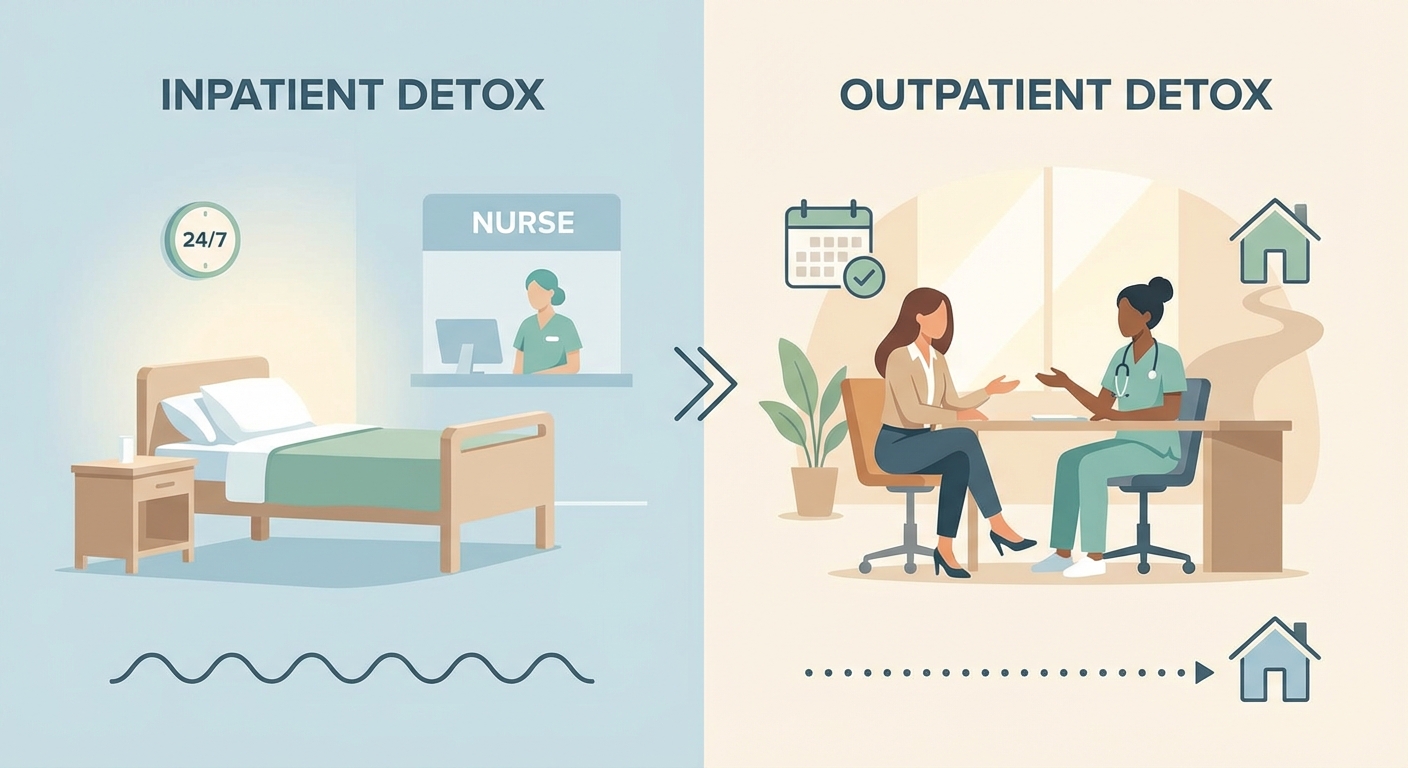
Inpatient or medically monitored detox may be safer if you have:
- A history of severe withdrawal symptoms (seizures, hallucinations, delirium tremens).
- Heavy alcohol use or long-term benzodiazepine use.
- Serious health conditions (heart disease, uncontrolled blood pressure, pregnancy, etc.).
- A co-occurring mental health crisis (suicidal thoughts, psychosis, severe depression).
- Unstable housing or little support at home.
Outpatient or ambulatory detox may be appropriate if:
- Withdrawal risk is mild to moderate.
- You have stable housing and reliable support.
- You can attend frequent check-ins and follow a medication plan safely.
Safety note: SAMHSA’s clinical guidance on detox emphasizes that withdrawal management should match medical risk, especially for alcohol and sedatives. If you are unsure, ask for a medical assessment rather than trying to “push through” withdrawal at home. Source: SAMHSA TIP guidance on detoxification and withdrawal management (archived by NIDA): Detoxification and Substance Abuse Treatment (TIP-based quick guide).
If you’re also looking for complementary supports during early recovery (sleep, anxiety, stress regulation), you may find it useful to explore holistic options on our network at Alternative Addiction’s California mental health resources.
What to do if you need same-day help and cannot find detox in Chino
Not being able to find an immediate detox opening can feel terrifying, especially if someone is already sick, shaky, panicky, or at risk of relapse. You still have options today.
Go to the ER or call 911 if symptoms are severe
Withdrawal can become life-threatening in some cases, especially with alcohol and benzodiazepines. Call 911 or go to the nearest emergency room for:
- Seizures
- Severe confusion, agitation, or hallucinations
- Chest pain or trouble breathing
- Fainting or inability to stay awake
- Signs of dehydration that cannot be managed at home
If it is a crisis but not a medical emergency
- If there are thoughts of self-harm or suicide, call or text 988.
- If you need treatment navigation now, SAMHSA’s free, confidential helpline can connect you to local resources: SAMHSA National Helpline, 1-800-662-HELP (4357).
If you are trying to avoid relapse while waiting
If there is a waitlist, ask about interim supports that can keep you safer:
- Same-day assessment and safety planning
- Outpatient withdrawal management check-ins
- Rapid-start MAT for opioids (when clinically appropriate)
- Peer support and recovery coaching
- Family check-in plan to reduce risk overnight
For practical next steps when you’re trying to locate care quickly, you can also use the facility-finder style resources on our network at American Drug Rehabs.
Red flags to watch for when a program says it “takes IEHP”
When you are exhausted and scared, it is easy to say yes to the first person who answers the phone. A reputable detox should be clear, transparent, and focused on safety.
Be cautious if a detox program:
- Will not explain whether they are in-network with IEHP.
- Pressures you to commit financially before verifying benefits.
- Cannot explain who provides medical oversight (physician coverage, nursing).
- Does not discuss a plan for what happens after detox.
- Makes guarantees or “instant cure” promises.
Questions to ask at intake to improve outcomes
Detox should connect directly to the next step. These questions help you avoid the “detox then disappear” cycle that increases relapse risk.
- What is your discharge plan if I complete detox successfully?
- Do you refer to residential, PHP, or IOP options near Chino?
- Do you offer or coordinate medication-assisted treatment for opioid use disorder?
- How do you treat anxiety, depression, or trauma alongside substance use?
- Can family participate in education or planning (with consent)?
If alcohol is the primary substance, you may also find this DAN article helpful for understanding alcohol’s effects and patterns: Do drunk people tell the truth?
Quick checklist for finding detox with IEHP near Chino
- Confirm the person’s IEHP plan type (IEHP Medi-Cal vs other coverage).
- Ask for in-network detoxification services near 91710 and surrounding cities.
- Call the detox program and confirm in-network status and level of care.
- Ask if authorization is required and whether they can help obtain it.
- Choose the safest level of care (inpatient vs outpatient) based on withdrawal risk.
- Before discharge, schedule follow-up care (IOP, outpatient therapy, MAT, support groups).
Frequently Asked Questions
How do I find what detox programs in Chino accept IEHP?
Start by asking IEHP for in-network “detoxification services for substance use disorder” near Chino (ZIP 91710). Then call each program and verify they are in-network for your exact IEHP plan type and that they provide the level of detox you need (medical inpatient vs outpatient).
Does IEHP cover alcohol detox?
IEHP may cover medically necessary alcohol withdrawal management through in-network providers, but coverage can depend on medical necessity and authorization rules. Alcohol withdrawal can be dangerous, so seek a clinical assessment rather than trying to detox alone. For related context on alcohol’s effects, see Do drunk people tell the truth?.
Can I get opioid detox with IEHP and medication-assisted treatment?
Many people start with withdrawal management and transition into medication-assisted treatment (MAT), such as buprenorphine, which can reduce cravings and lower overdose risk. Ask specifically about “opioid withdrawal management plus MAT” and whether the program coordinates follow-up care near Chino.
What is the difference between inpatient detox and outpatient detox?
Inpatient (or medically monitored) detox provides 24/7 support and is often safer for high-risk withdrawal (alcohol, benzodiazepines, complicated medical or mental health needs). Outpatient detox involves scheduled check-ins and may be appropriate for mild to moderate withdrawal with stable housing and support.
What if there are no detox beds available in Chino today?
Ask for the closest in-network options in nearby cities (Ontario, Pomona, Montclair, Rancho Cucamonga, Upland). If symptoms are severe, go to the ER or call 911. If you are in crisis, call 988. You can also contact SAMHSA’s National Helpline at 1-800-662-4357 for treatment navigation.
Need Help Now?
If you or someone you love is struggling with addiction, help is available 24/7.
- SAMHSA National Helpline: 1-800-662-4357 (free, confidential, 24/7)
- Crisis Text Line: Text HOME to 741741
- National Suicide Prevention Lifeline: 988
Recovery is possible. Take the first step today.
Find Help Near You
Chino Mental Health Info
5624 Philadelphia St #204, Chino, CA 91710
Phone: (840) 237-8324