

Kratom occupies an unusual middle ground. It acts on opioid receptors, but as a partial agonist rather than a full one, and its main alkaloid appears not to trigger the pathway most associated with opioid respiratory depression. It also behaves as a stimulant at low doses and a sedative at high ones. Poison center reports rose from 258 in 2015 to 3,434 in 2025.
What the pharmacology actually shows
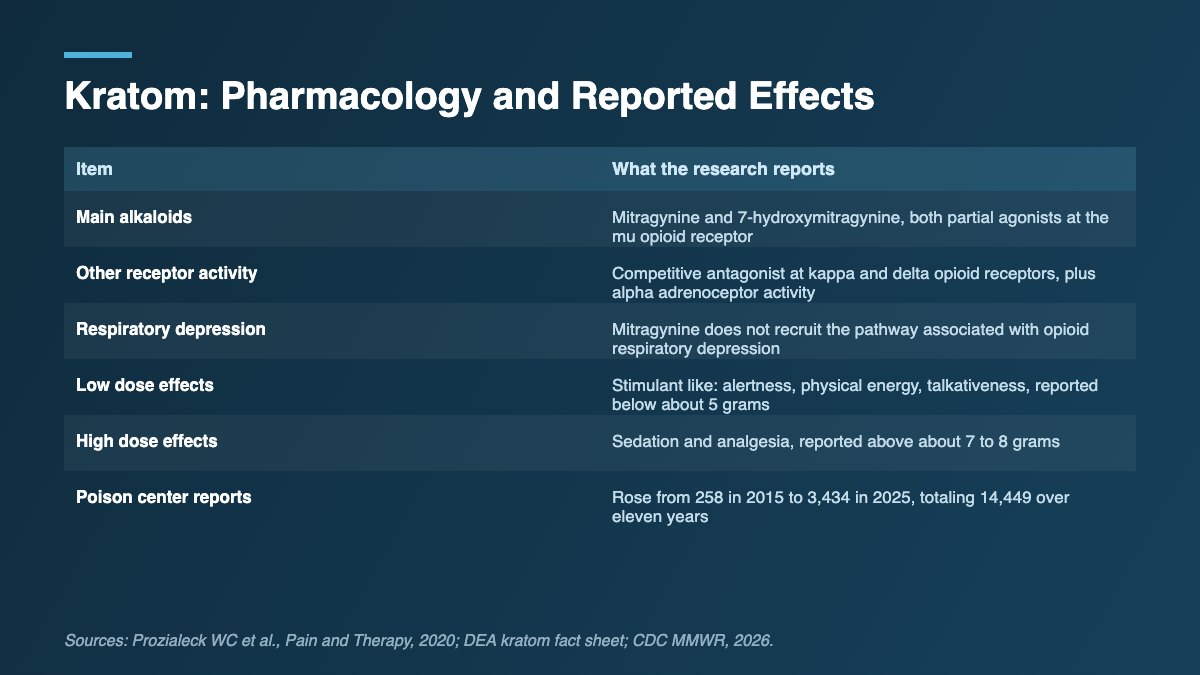
Kratom, from the tree Mitragyna speciosa, contains more than forty alkaloids. The two that matter most are mitragynine and 7-hydroxymitragynine, both partial agonists at the mu opioid receptor, meaning they activate it but to a lesser degree than morphine does.
Mitragynine is also a competitive antagonist at kappa and delta opioid receptors, and has activity at alpha adrenoceptors, which helps explain an effect profile that does not map neatly onto opioids. Critically, unlike morphine it does not appear to recruit the beta-arrestin-2 pathway associated with respiratory depression.
That last point is the pharmacological basis for kratom being less likely than a conventional opioid to stop someone breathing. It is not the same as being safe, and the poison center data below shows why.

One metabolic detail matters for the products now on the market. Oxidation of mitragynine in the body produces 7-hydroxymitragynine, which is a more efficacious mu agonist than the parent compound. Concentrated 7-OH products therefore behave differently, and more like a conventional opioid, than leaf material does.
Low dose versus high dose
Kratom is one of the few substances whose reported effects reverse with dose. At low doses users describe stimulant effects: increased alertness, physical energy and talkativeness. At higher doses the effects become sedative, opioid like and analgesic.
Reported thresholds put stimulant-like effects below about 5 grams and strong sedation and analgesia above about 7 to 8 grams. Those figures come from the review literature and should be read as approximate, because product potency varies enormously between vendors and preparations.
What poison centers are seeing
A CDC analysis published in 2026 found kratom related exposure reports to the National Poison Data System rose roughly 1,200 percent, from 258 in 2015 to a record 3,434 in 2025, totaling 14,449 reports across the eleven years.
Most involved males and adults aged 20 to 39, though reports among adults aged 40 to 59 rose most sharply.
The severity pattern points clearly at combinations. Reports involving multiple substances resulted in hospitalization in 44 to 56 percent of cases annually, against 24 to 29 percent for single substance reports, and serious outcomes in 57 to 66 percent against 41 to 49 percent. Kratom alone sends fewer people to hospital; kratom with something else sends roughly twice as many.
Deaths, with the coverage stated
Among approximately 27,000 unintentional and undetermined intent overdose deaths across 27 states between July 2016 and December 2017, mitragynine was detected postmortem in 152 decedents, and kratom was listed as a cause of death by the medical examiner or coroner in 91 of those.
That is surveillance data from 27 states, not a national count, and it should not be compared against national death certificate totals. We state the coverage because these figures are frequently quoted without it.
Dependence and withdrawal
Kratom produces physical dependence and a withdrawal syndrome, and the research suggests it is generally milder than opioid withdrawal.
In one online sample of experienced US kratom consumers, 52.7 percent had never met criteria for kratom use disorder, 17.8 percent were in remission, and 29.5 percent met the past year threshold, with severity split as 14.0 percent mild, 7.0 percent moderate and 8.5 percent severe. In another sample of experienced consumers, 93 percent of whom had used for more than a year, 66.7 percent met criteria, predominantly mild.
These two figures are not interchangeable, and both come from self selected online samples biased toward heavy users rather than population representative surveys. What the studies described consistently is that physical dependence was common but largely without psychosocial impairment, and that withdrawal was moderate: gastrointestinal upset, restlessness, anxiety, irritability, fatigue and craving. Notably, withdrawal and disorder symptoms tracked dose frequency more closely than dose amount.
See our drug information library for related material.
Takeaways
- Kratom’s main alkaloids are partial agonists at the mu opioid receptor, not full agonists like morphine.
- Mitragynine does not appear to recruit the pathway most associated with opioid respiratory depression.
- Effects reverse with dose: stimulant-like below about 5 grams, sedative above about 7 to 8 grams.
- Poison center reports rose from 258 in 2015 to 3,434 in 2025.
- Hospitalization was roughly twice as likely when kratom was taken with other substances.
- Withdrawal is real but generally moderate, and tracked how often people dosed more than how much they took.
Sources
Prozialeck WC and colleagues, Kratom: Pharmacology, Clinical Implications, and Outlook, Pain and Therapy, 2020. British Journal of Pharmacology, 2022, on respiratory depressant effects of mitragynine. Drug Enforcement Administration, Drug Fact Sheet: Kratom. Centers for Disease Control and Prevention, Increases in Kratom-Related Reports to Poison Centers, Morbidity and Mortality Weekly Report, 2026. Olsen EO and colleagues, Morbidity and Mortality Weekly Report, 2019, on kratom detected in overdose deaths across 27 states. Smith KE and colleagues, 2022 and 2024, on kratom use disorder and physical dependence.
Need help now? In an emergency call 911. If you are in crisis or thinking about suicide, call or text 988 (Suicide and Crisis Lifeline; veterans press 1). For free, confidential treatment referrals 24 hours a day, call the SAMHSA National Helpline at 1-800-662-4357. You can also search licensed programs at FindTreatment.gov, or use our rehab directory and state listings.
Addiction Now publishes health journalism and reference material. This page is not medical advice, a diagnosis, or a treatment plan. Do not stop a prescribed medication without talking to a clinician. Withdrawal from alcohol, benzodiazepines and barbiturates can cause seizures and can be fatal without medical supervision.