


SAMHSA published a rewritten version of 42 CFR Part 8 on 2 February 2024, the first substantial overhaul of federal opioid treatment programme rules in more than two decades. It made pandemic era methadone take home flexibilities permanent, replaced fixed eligibility criteria with practitioner judgement, and set a compliance date of 2 October 2024.
What the rule actually changed
Before 2020, the number of take home methadone doses a patient could receive was governed by a rigid schedule tied to time in treatment and to eight specific criteria a programme had to certify. On 16 March 2020, SAMHSA issued an exemption allowing states to request a blanket exception so that stable patients could receive up to 28 days of take home medication, with 14 days for those judged less stable. That exemption was a temporary response to a public health emergency. The 2024 rule made the underlying flexibility permanent.
Three changes matter most. First, practitioners are no longer required to work through a fixed checklist to justify a take home decision; they exercise clinical judgement within regulatory ceilings and document the reasoning. Second, the longstanding requirement that a patient demonstrate at least one year of opioid addiction before admission to a programme was removed in favour of diagnosis based admission criteria. Third, a programme may admit a patient after a screening examination that establishes the need for treatment and an appropriate initial dose, rather than waiting for a complete physical examination.
The rule also addressed remote care. Initiation of buprenorphine through telehealth, including audio only contact under defined conditions, was made permanent. For methadone, which is a Schedule II medication, the requirements are tighter: audio visual telehealth may be used in the initiation process under specified circumstances, and audio only is acceptable only where audio visual is unavailable and the patient is in the presence of a practitioner registered to dispense controlled medications.

Ceilings, not entitlements
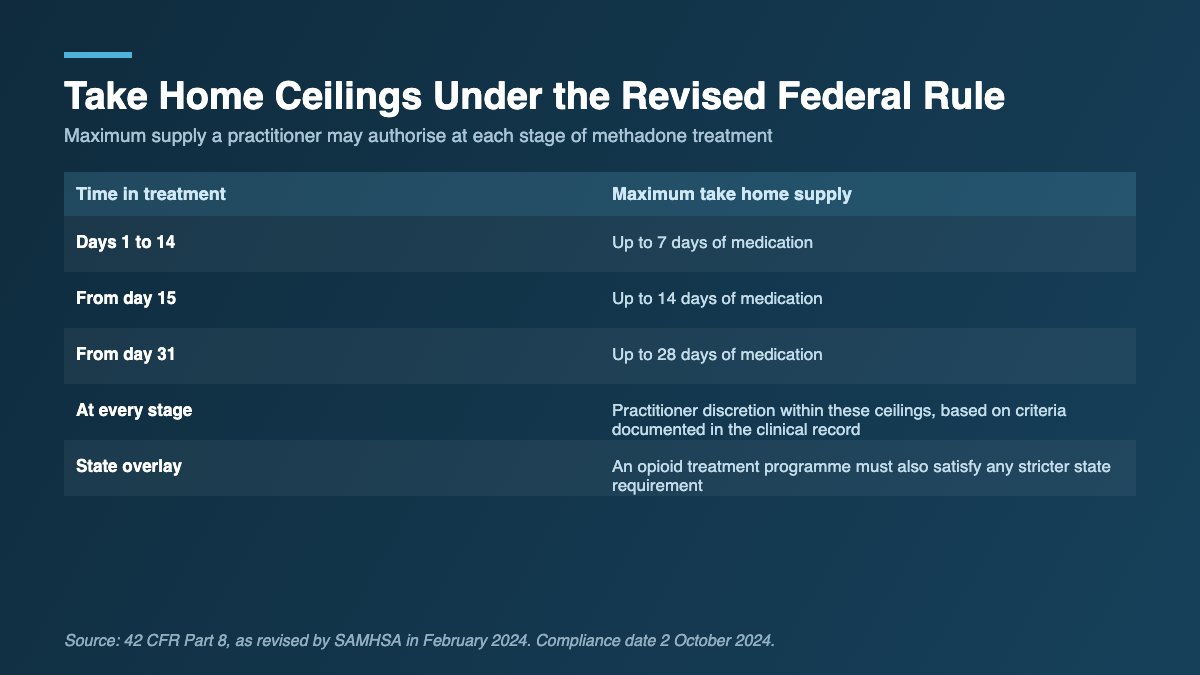
It is worth being precise about what the take home schedule does. It sets maximums. During the first 14 days of treatment the supply may not exceed 7 days. From day 15 the ceiling rises to 14 days. From day 31 the ceiling is 28 days. Nothing in the regulation obliges a programme to reach those ceilings for any individual patient, and practitioners retain discretion within them based on criteria recorded in the clinical record.
That distinction explains a good deal of the variation patients report. Two programmes operating under identical federal rules can produce very different experiences, because the rule delegates the decision rather than dictating it. A programme with conservative internal policy, limited counselling capacity or a cautious medical director may sit well below the federal ceiling for most of its caseload.
What the research found before the rule was written
The regulatory change was not made in an evidence vacuum. A retrospective observational cohort study published in The Lancet Regional Health Americas examined retention and adverse outcomes among patients newly entering methadone maintenance after take home rules were extended. It reported equivalent retention in care at six months and equivalent risk of adverse events while in care, alongside slightly higher rates of opioid use at group level, including at sites where routine early take homes exceeded one to two weeks.
On mortality, a study by Rebecca Arden Harris and colleagues published in JAMA Health Forum in June 2023 examined methadone involved overdose deaths before and after the federal policy change. It found no overall increase in fatal overdoses once the effects of the pandemic period were accounted for. Rates were unchanged for several groups and fell for Black and Hispanic men. Later work extended the question to urban and rural communities separately, published in a peer reviewed addiction journal in 2025.
SAMHSA itself reported, in the material accompanying the rulemaking, that states and programmes described increased treatment engagement and improved patient satisfaction during the exemption period, with relatively few incidents of misuse or diversion. That is programme reporting rather than a controlled study, and should be read as such.
Why practice has changed unevenly
Federal rules set a floor of permission, not a national standard of practice. An opioid treatment programme must satisfy both federal regulation and the requirements of the state in which it operates, and where the two differ, the stricter one governs. Some states rewrote their regulations quickly after the compliance date; others left older, more restrictive language in place, which effectively caps what a programme can offer regardless of what the federal rule permits. State opioid treatment authorities are the relevant approval body, and their positions vary.
Operational factors matter as well. Take home dosing changes a programme business model built around daily attendance, affects diversion control procedures, requires lockboxes and patient education, and can reduce the billable contacts a programme relies on. Programmes that adopted the flexibility furthest during the emergency period had usually already rebuilt their workflow around it.
Readers looking for background on the opioids most often involved in the cases these programmes treat can consult our reference pages on fentanyl, heroin and oxycodone.
What remains unresolved
The rule did not change who may dispense methadone for opioid use disorder. It remains restricted to federally certified opioid treatment programmes, and cannot be prescribed through a retail pharmacy the way buprenorphine can. Proposals to change that sit with Congress rather than with SAMHSA, and none has been enacted. The rule also did not resolve how programmes should handle patients whose stability fluctuates, or how quickly take home privileges should be reduced when it does.
Longer term monitoring of diversion is still thin. The studies published so far examine retention, overdose mortality and adverse events among patients in care. They do not measure diverted doses reaching people who are not patients, which is the harm regulators were guarding against with the pre 2020 schedule. That evidence gap is real, and honest coverage should say so rather than treat the question as settled in either direction.
Key takeaways
- SAMHSA published the revised 42 CFR Part 8 on 2 February 2024. It took effect on 2 April 2024 with a compliance date of 2 October 2024.
- Take home supply is capped at 7 days during the first 14 days of treatment, 14 days from day 15, and 28 days from day 31.
- These are ceilings, not entitlements. Practitioners decide within them and document the reasoning.
- Published studies report equivalent six month retention and no overall increase in methadone involved overdose deaths after the flexibilities were introduced.
- State rules can be stricter than federal rules, and where they are, the state rule governs what a programme may offer.
- Methadone for opioid use disorder still cannot be dispensed through a retail pharmacy. Changing that would take an act of Congress.
Sources
This article draws on the text of 42 CFR Part 8 as published in the Federal Register on 2 February 2024 and as it now appears in the Electronic Code of Federal Regulations; guidance and frequently asked questions published by the Substance Abuse and Mental Health Services Administration; a retrospective cohort study published in The Lancet Regional Health Americas; and a study of methadone involved overdose deaths published in JAMA Health Forum in June 2023. Dates and limits are quoted from the regulation itself.
Need help now? In an emergency call 911. If you are in crisis or thinking about suicide, call or text 988 (Suicide and Crisis Lifeline; veterans press 1). For free, confidential treatment referrals 24 hours a day, call the SAMHSA National Helpline at 1-800-662-4357. You can also search licensed programs at FindTreatment.gov, or use our rehab directory and state listings.
Addiction Now publishes health journalism and reference material. This page is not medical advice, a diagnosis, or a treatment plan. Do not stop a prescribed medication without talking to a clinician. Withdrawal from alcohol, benzodiazepines and barbiturates can cause seizures and can be fatal without medical supervision.