
Cocaine raises the risk of heart attack by roughly 24 times, and almost all of that elevation falls inside the first 60 minutes after use. The same pattern holds for stroke: having ever used cocaine was not associated with stroke in young adults, while having used within the previous 24 hours was. This acute window distinction is the detail most articles on the subject get wrong.
The heart attack finding
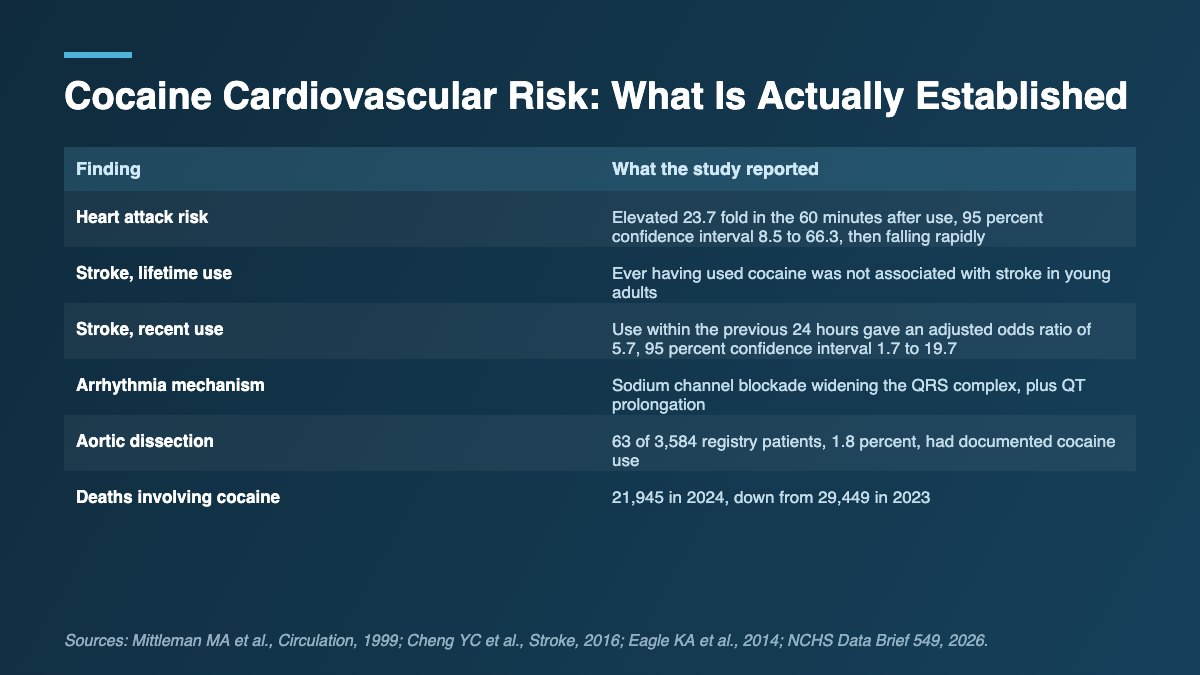
The landmark study came from the Determinants of Myocardial Infarction Onset Study, which interviewed 3,946 heart attack patients a median of about four days after their infarction. Published in Circulation in 1999, it found the risk of heart attack onset elevated 23.7 fold in the 60 minutes after cocaine use, with a 95 percent confidence interval of 8.5 to 66.3, decreasing rapidly thereafter.
This is the origin of the widely quoted figure of about 24 times. What usually gets dropped in the retelling is the phrase that follows it. The risk is transient. It is concentrated in the hour after use, not spread across a lifetime of use.
That has a practical implication. A person presenting with chest pain who used cocaine in the last hour is in a different risk category from one who used last week, and it is the reason emergency clinicians ask about timing specifically.
Why it happens
Cocaine attacks the heart from several directions simultaneously. It raises heart rate and blood pressure, increasing the muscle’s demand for oxygen. At the same time it constricts the coronary arteries through alpha adrenergic stimulation, reducing supply. That combination, a supply and demand mismatch layered on top of vasospasm, is the core mechanism.
The combined effects on contractility and rate also increase shear forces on the coronary endothelium, which contributes to plaque disruption. Research has additionally implicated altered cytokine balance affecting vascular tone.
Rhythm problems, and why one treatment is wrong
Cocaine behaves pharmacologically like a class I antiarrhythmic drug: it blocks sodium channels, which widens the QRS complex on an electrocardiogram, and it prolongs the QT interval by blocking potassium rectifier channels.
This has a specific consequence for treatment. Sodium bicarbonate is used for cocaine induced QRS widening beyond 100 milliseconds. Quinidine, a class IA antiarrhythmic, worsens QRS prolongation, while bicarbonate and lidocaine improve conduction. Cocaine associated arrhythmia is therefore not treated like ordinary arrhythmia, which is one reason it matters that emergency staff know cocaine was involved.
Stroke: the finding that gets misreported
A study of more than 1,000 adjudicated young stroke cases produced two results that need reporting together. Ever having used cocaine was not associated with stroke: 28 percent of cases versus 26 percent of controls.
But acute use was strongly associated. Use within the previous 24 hours carried an adjusted odds ratio of 5.7, with a 95 percent confidence interval of 1.7 to 19.7, after adjustment for alcohol, smoking and hypertension. Of the 26 patients who had used within 24 hours, 14 had used within 6 hours.
For scale, that association was stronger than diabetes at an odds ratio of 3.5, hypertension at 2.8, or current smoking at 1.9. So the honest summary is not that cocaine use causes strokes in general, but that using cocaine puts you into a period of sharply elevated stroke risk that lasts hours.
Aortic dissection
In the International Registry of Acute Aortic Dissection, 63 of 3,584 patients enrolled between 1996 and 2012, or 1.8 percent, had documented cocaine use. Cocaine positive patients were younger, more often male and more often Black. The proposed mechanism is catecholamine driven abrupt blood pressure elevation raising stress on the aortic wall and causing an intimal tear.
Aortic dissection is rare in absolute terms but catastrophic when it happens, and it belongs in the picture of what sudden extreme blood pressure elevation can do.
Where the death toll stands
Final national data show 21,945 deaths involving cocaine in 2024, an age adjusted rate of 6.3 per 100,000, down 26.7 percent from 2023 when there were 29,449 such deaths at a rate of 8.6.
One important qualifier on those figures: a large share of cocaine involved deaths also involve opioids, particularly illicitly manufactured fentanyl. A death certificate listing cocaine does not establish that cocaine acted alone. And where alcohol is also present, the body forms cocaethylene, a longer lasting compound described as more cardiotoxic than cocaine itself.
See our cocaine reference page and drug information library.
Takeaways
- Heart attack risk is elevated about 24 fold in the 60 minutes after cocaine use, then falls rapidly.
- Ever having used cocaine was not associated with stroke; using within 24 hours was, with an adjusted odds ratio of 5.7.
- The mechanism is coronary constriction plus increased oxygen demand, a supply and demand mismatch.
- Cocaine associated arrhythmia is treated differently from ordinary arrhythmia. Tell emergency staff cocaine was involved.
- Chest pain after cocaine use is an emergency and the timing of last use is the key piece of information.
- Deaths involving cocaine fell to 21,945 in 2024, though many also involve opioids.
Sources
Mittleman MA, Mintzer D, Maclure M, Tofler GH, Sherwood JB, Muller JE, Triggering of Myocardial Infarction by Cocaine, Circulation, 1999. Havakuk O, Rezkalla SH, Kloner RA, The Cardiovascular Effects of Cocaine, Journal of the American College of Cardiology, 2017. Wood DM, Dargan PI and colleagues, British Journal of Clinical Pharmacology, 2010. McCord J and colleagues, American Heart Association scientific statement on management of cocaine associated chest pain and myocardial infarction, Circulation, 2008. Cheng YC and colleagues, Stroke, 2016. Eagle KA and colleagues, American Journal of Cardiology, 2014. National Center for Health Statistics, Data Brief No. 549, January 2026.
Need help now? In an emergency call 911. If you are in crisis or thinking about suicide, call or text 988 (Suicide and Crisis Lifeline; veterans press 1). For free, confidential treatment referrals 24 hours a day, call the SAMHSA National Helpline at 1-800-662-4357. You can also search licensed programs at FindTreatment.gov, or use our rehab directory and state listings.
Addiction Now publishes health journalism and reference material. This page is not medical advice, a diagnosis, or a treatment plan. Do not stop a prescribed medication without talking to a clinician. Withdrawal from alcohol, benzodiazepines and barbiturates can cause seizures and can be fatal without medical supervision.