
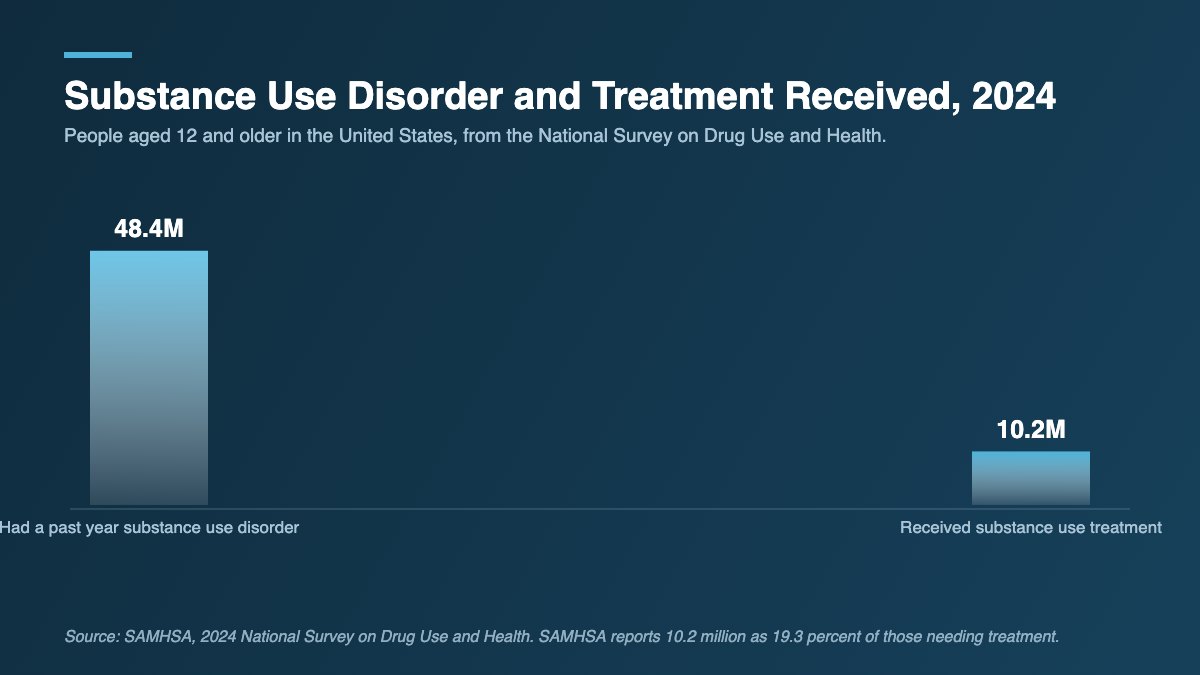
An estimated 48.4 million people aged 12 and older in the United States had a substance use disorder in 2024. About 10.2 million received substance use treatment. The federal survey behind those numbers describes the second figure as 19.3 percent of people who needed treatment, and that denominator is doing more work than most coverage admits.
Two numbers, and the one that gets misquoted
Both figures come from the National Survey on Drug Use and Health, run annually by the Substance Abuse and Mental Health Services Administration. In the 2024 results, 48.4 million people aged 12 and older, or 16.8 percent of that population, met criteria for a past year substance use disorder. Separately, 10.2 million people received substance use treatment in the past year.
Those two numbers are frequently divided into each other to produce a headline like “only 21 percent of people with addiction get treatment.” SAMHSA does not report it that way, and neither should anyone else. The agency reports 10.2 million as 19.3 percent of a different and smaller group: people it classifies as needing treatment. A third figure sometimes appears in coverage, calculated by dividing 10.2 million by the whole population aged 12 and older. That one has no meaning at all.
What needing treatment means in this survey
This is the part worth slowing down for. In the survey, needing treatment is not simply the same as having a diagnosable disorder. The classification is built from survey responses, and it is a construct, not a clinical judgement made by a clinician who examined anyone.
That matters in both directions. Some people who meet criteria for a mild disorder would not be advised by a clinician to enter formal treatment, and counting them as needing it inflates the gap. Meanwhile the survey excludes people who are homeless and not in shelters, people in jails and prisons, and people in hospitals and residential facilities. Those are populations with high rates of substance use disorder, and leaving them out shrinks the gap. The two errors do not cancel out in any measurable way.
The percentage moved, but be careful about the word trend
In the 2023 results, 12.8 million people, or 23.6 percent of those classified as needing treatment, received it. In 2024 that was 10.2 million and 19.3 percent. On its face that is a drop of more than four percentage points in one year.
Two cautions. First, 2024 was the first year with four years of comparable data for key survey outcomes, so the series is young and year to year movement should be read modestly. Second, and more important, SAMHSA did not list treatment receipt among the outcomes it tested and reported as statistically significant changes. A difference that has not been tested is not the same as a decline that has been established. The honest statement is that the reported share fell and the survey does not tell us whether that reflects a real change in the population.
What the survey cannot see
Treatment in this survey is what respondents say they received. It does not distinguish well between a single assessment appointment and a year of continuous care, and it captures medication treatment, counselling, mutual aid attendance and inpatient stays under headings that are not interchangeable. Somebody who attended two group sessions and somebody stable on buprenorphine for twelve months can both land in the same bucket.
That is why the treatment gap, taken alone, is a weak guide to policy. It tells you that a large number of people are not in care. It does not tell you how many are in care that helps, which is the question that determines whether spending more on capacity would change outcomes.
What the gap does reliably show
Across every version of the calculation, and across every year of this survey, the majority of people who meet criteria for a substance use disorder do not receive formal treatment in the same year. That finding is robust to the denominator argument. The most common reason respondents give, year after year, is that they did not think they needed treatment, which is a different problem from cost or capacity and responds to different interventions.
Cost, insurance and availability appear consistently in the reasons given as well, and they are the ones most directly reachable by policy. Readers looking for what specific substances do can start with our drug information section, including reference pages on alcohol and fentanyl.
Takeaways
- An estimated 48.4 million people aged 12 and older had a substance use disorder in 2024, or 16.8 percent.
- About 10.2 million received substance use treatment. SAMHSA reports that as 19.3 percent of people classified as needing treatment.
- Do not divide 10.2 million by 48.4 million, and do not divide it by the whole population. Neither ratio is a figure SAMHSA publishes.
- The comparable 2023 figures were 12.8 million and 23.6 percent, but SAMHSA did not report treatment receipt as a statistically significant change, so this is not an established decline.
- The survey excludes people in jails, prisons, hospitals and unsheltered homelessness, all high prevalence groups.
- The most commonly reported reason for not seeking treatment is not believing it was needed, which cost and capacity policy does not address.
Sources
Substance Abuse and Mental Health Services Administration, National Survey on Drug Use and Health, 2024 and 2023 annual national releases and highlights, published 2025 and 2024 respectively. Survey design and exclusion details from SAMHSA methodological documentation.
Need help now? In an emergency call 911. If you are in crisis or thinking about suicide, call or text 988 (Suicide and Crisis Lifeline; veterans press 1). For free, confidential treatment referrals 24 hours a day, call the SAMHSA National Helpline at 1-800-662-4357. You can also search licensed programs at FindTreatment.gov, or use our rehab directory and state listings.
Addiction Now publishes health journalism and reference material. This page is not medical advice, a diagnosis, or a treatment plan. Do not stop a prescribed medication without talking to a clinician. Withdrawal from alcohol, benzodiazepines and barbiturates can cause seizures and can be fatal without medical supervision.