

Methamphetamine damages several systems at once, and the evidence on whether that damage reverses is more nuanced than either optimistic or hopeless accounts suggest. Some markers of brain injury do recover with long abstinence. Cognitive function appears to lag behind them. Meanwhile the cardiac and dental effects are severe and well documented.
What happens in the brain
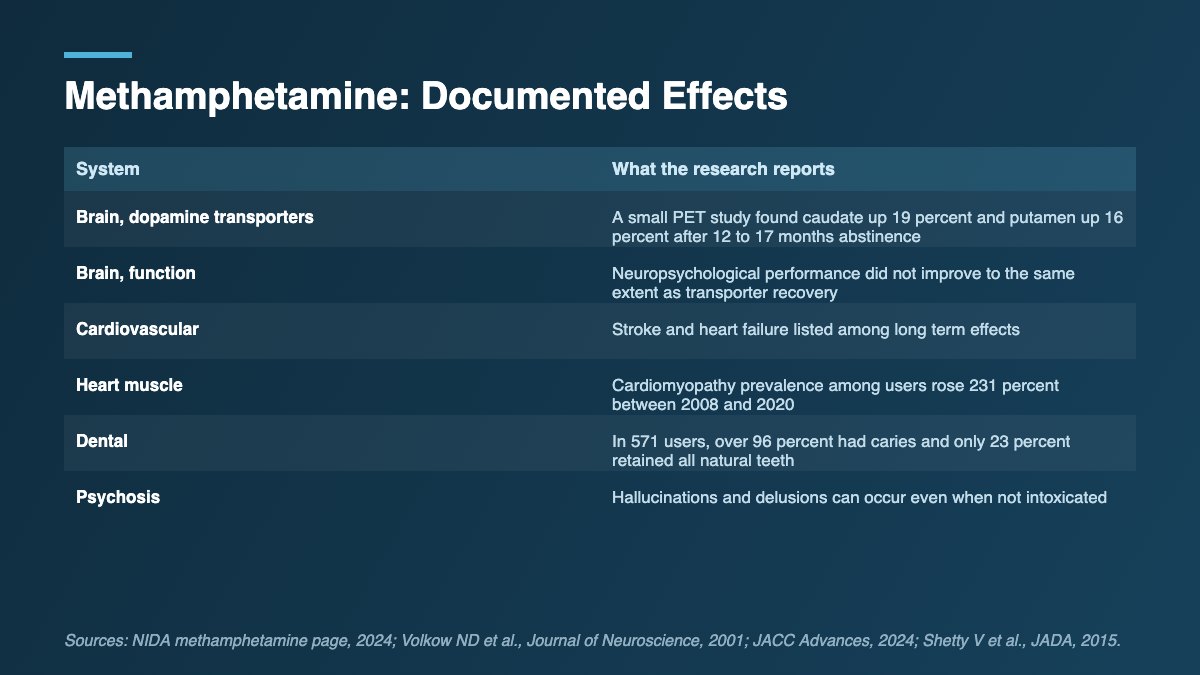
Methamphetamine floods the brain with dopamine and, with sustained use, damages the cells that transport it. The most cited study on recovery used PET imaging on five people who used methamphetamine, scanned during short abstinence of under six months and again during protracted abstinence of 12 to 17 months. Dopamine transporter levels increased significantly, by 19 percent in the caudate and 16 percent in the putamen.
That finding is genuinely encouraging and should be read with its limits stated. Five participants is a very small sample, and the result has been widely repeated without that caveat.
The more sobering companion finding comes from the same research program: neuropsychological test performance did not improve to the same extent as dopamine transporter recovery. In other words the receptor markers rebounded faster than the thinking did. A related study associated dopamine transporter reduction with psychomotor impairment.

The practical translation for someone in early recovery is that feeling mentally slow many months in is consistent with what has been measured, and it is not evidence that nothing is healing.
The heart
This is the effect most likely to kill someone before anything else does. The National Institute on Drug Abuse lists cardiovascular events including stroke and heart failure among long term effects.
A 2024 analysis found that among people who use methamphetamine, cardiomyopathy prevalence rose 231 percent and all-cause mortality rose 195 percent between 2008 and 2020. Users aged 26 to 40 showed a threefold increase in cardiomyopathy-associated hospital admissions compared with non-users.
Cardiomyopathy means the heart muscle itself is weakened and enlarged, reducing its ability to pump. The age band matters here: this is being documented in people in their late twenties and thirties, not only in older long term users.
Teeth
The phenomenon commonly called meth mouth has been measured rather than merely observed. In a study of 571 people who used methamphetamine, more than 96 percent had dental caries, 58 percent had untreated tooth decay, and only 23 percent retained all their natural teeth, against 48 percent in the general US population. Thirty one percent had six or more missing teeth.
Several mechanisms are thought to combine: reduced saliva flow, teeth grinding and clenching, long periods without eating or oral care, and high sugar intake during use. The result is decay that progresses unusually fast.
Psychosis
NIDA describes symptoms of psychosis including hallucinations and delusions that can occur even when a person is not intoxicated. That last clause is the important one: this is not simply being high.
There is also a documented pattern of recurrence. NIDA notes that heavy drinking and stress have been shown to increase the odds that someone who has previously experienced methamphetamine-associated psychosis will have psychotic symptoms again.
On how common it is, the published figures vary enormously by setting, and we are going to be careful here. Reviews report a range of roughly 15 to 23 percent in community and recreational settings and up to about 60 percent in treatment settings. A frequently quoted meta-analytic figure of 36.5 percent circulates widely, but we could not verify its source directly and are not presenting it as established. The setting-dependent range is the more honest framing, and it tells you something real: the people who reach treatment are a more severely affected group than the general population of users.
International guidance reports that psychotic symptoms in heavy stimulant use usually resolve within a week of stopping, while federal treatment guidance notes breakthrough psychotic episodes can occur during the protracted withdrawal phase.
What none of this settles
There is no medication approved for methamphetamine use disorder, which means the response to all of the above is behavioral treatment, medical management of the cardiac and dental consequences, and time. The strongest evidence for a behavioral approach supports contingency management.
The damage described here also varies with dose, route, duration and individual factors, and most of the studies above are observational, meaning they establish association rather than proving a causal chain in any individual case.
See our methamphetamine reference page and drug information library.
Takeaways
- Dopamine transporter levels rose 19 percent in the caudate and 16 percent in the putamen after 12 to 17 months abstinence, in a five person study.
- Cognitive performance did not recover to the same degree as those receptor markers.
- Cardiomyopathy prevalence among users rose 231 percent between 2008 and 2020, with a threefold admission increase in people aged 26 to 40.
- Over 96 percent of 571 users studied had dental caries, and only 23 percent had all their natural teeth.
- Psychosis can occur when not intoxicated, and prior episodes raise the odds of recurrence, particularly with heavy drinking or stress.
- Psychosis prevalence estimates range from about 15 percent in community settings to about 60 percent in treatment settings. Treat any single figure with caution.
Sources
National Institute on Drug Abuse, Methamphetamine research topic page, 2024. Volkow ND and colleagues, Journal of Neuroscience, 2001, on dopamine transporter recovery with protracted abstinence, and American Journal of Psychiatry, 2001, on transporter reduction and psychomotor impairment. JACC: Advances, 2024, on cardiomyopathy-associated hospital admissions. Shetty V and colleagues, Journal of the American Dental Association, 2015. Glasner-Edwards S and Mooney LJ, CNS Drugs, 2014, on methamphetamine psychosis. Substance Abuse and Mental Health Services Administration, TIP 33, updated 2021.
Need help now? In an emergency call 911. If you are in crisis or thinking about suicide, call or text 988 (Suicide and Crisis Lifeline; veterans press 1). For free, confidential treatment referrals 24 hours a day, call the SAMHSA National Helpline at 1-800-662-4357. You can also search licensed programs at FindTreatment.gov, or use our rehab directory and state listings.
Addiction Now publishes health journalism and reference material. This page is not medical advice, a diagnosis, or a treatment plan. Do not stop a prescribed medication without talking to a clinician. Withdrawal from alcohol, benzodiazepines and barbiturates can cause seizures and can be fatal without medical supervision.