


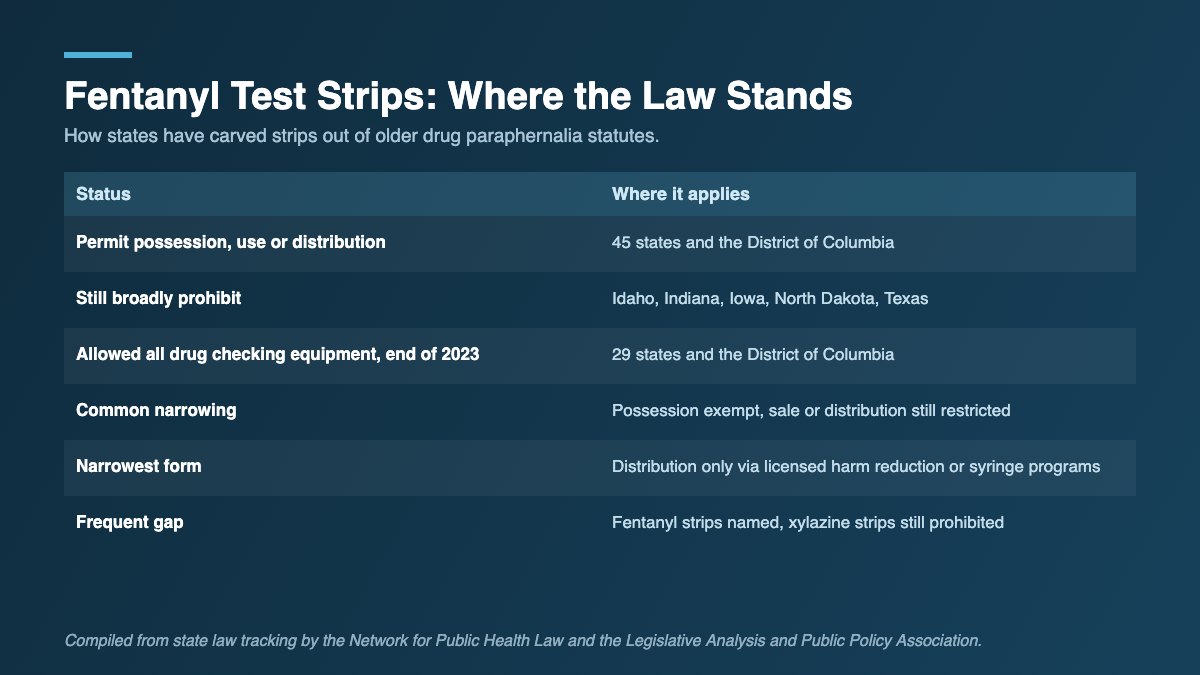
Fentanyl test strips can now be possessed, used or distributed without drug paraphernalia penalties in 45 states and the District of Columbia. Five states still prohibit them broadly: Idaho, Indiana, Iowa, North Dakota and Texas. The shift happened quickly, and the details vary far more than the headline count suggests.
What a strip does, and what it does not
A fentanyl test strip is an immunoassay strip, originally built for urine screening, repurposed to detect fentanyl in a dissolved sample of a drug. It returns a yes or no. It does not report how much fentanyl is present, whether the drug is mixed evenly, or whether a different synthetic opioid is present instead.
That last limitation matters as the supply changes. Strips calibrated for fentanyl do not reliably detect nitazenes, and they do not detect xylazine or medetomidine at all. A negative result narrows the possibilities. It does not establish that a sample is safe, and anyone reading it that way has been given a false reassurance.
Why they were illegal in the first place
Most state paraphernalia statutes were written decades ago and define paraphernalia broadly: equipment used to introduce a controlled substance into the body, or to prepare, test, analyze or package one. The word test appears in many of those definitions. That language, drafted long before illicitly pressed fentanyl existed, is what turned an inexpensive strip into a criminal item.

Legislatures have mostly not rewritten the paraphernalia statute. They have carved test strips out of it. That is the single most useful thing to understand about this area of law, because it explains why the exemptions are narrow, inconsistent, and often already out of date relative to the drug supply.
The count hides the variation
Three patterns recur among the states that have legalized strips.
Some exempt possession and use but leave distribution restricted, so an individual carrying strips is protected while an organization handing them out may not be. Some limit lawful distribution to licensed syringe services or harm reduction programs, which makes access contingent on whether such a program operates nearby. And some exempt fentanyl test strips specifically, by name, rather than drug checking equipment as a category, so a strip designed to detect xylazine remains contraband in a state that has legalized the fentanyl version.
At the end of 2023, by the count kept by legal tracking organizations, 29 states and the District of Columbia allowed all drug checking equipment. The move to 45 states for fentanyl strips over roughly two years reflects how narrowly most of those bills were drafted.
Cost and where people actually get them
Strips are cheap in bulk and awkward to buy retail. Health departments and syringe services programs distribute them free, usually alongside naloxone, and several states fund that distribution with opioid settlement money. Retail availability is inconsistent. They are not a standard pharmacy item in most of the country, and where a pharmacy does stock them they may sit behind the counter and require asking.
The practical consequence is that legality and availability are separate questions. A state can exempt strips from its paraphernalia law and still have no distribution channel outside a few urban programs. The reverse also happens: informal distribution continues in states where the strips remain technically prohibited.
What the research says about behavior
The case for strips rests on whether a positive result changes what someone does. Studies of distribution programs report that a meaningful share of people who get a positive result describe using less, using more slowly, not using alone, or keeping naloxone within reach. That evidence is mostly self-reported, and it is drawn from people already connected to a harm reduction program, which limits how far it generalizes to people who are not.
What the research does not establish is a measurable effect on population level overdose mortality attributable to strips on their own. Isolating that effect is difficult, and the absence of a clean finding is not the same as evidence of no effect. Readers should be sceptical of claims in either direction that go beyond the self-report data.
Where the law still bites
In the five states that prohibit strips broadly, possession can support a paraphernalia charge. In practice the strip is more likely to appear as an additional count alongside a substance charge than as a standalone prosecution, though that varies by county. Legalizing strips also changes nothing about federal scheduling, and it does not immunize anyone from a charge for the substance being tested. For what is actually circulating, see our fentanyl reference page and the wider drug information section.
Takeaways
- 45 states and the District of Columbia permit fentanyl test strips. Idaho, Indiana, Iowa, North Dakota and Texas still broadly prohibit them.
- Legalization usually arrived as a narrow carve out from an old paraphernalia statute rather than a rewrite of it.
- Some states protect possession but not distribution, and some protect fentanyl strips only, not drug checking equipment generally.
- A strip gives a yes or no on fentanyl. It does not measure quantity, does not detect xylazine, and does not reliably detect nitazenes.
- Legality and availability are different problems. Free distribution mostly runs through health departments and syringe services programs.
Sources
State law compilations maintained by the Network for Public Health Law and the Legislative Analysis and Public Policy Association; reporting by KFF Health News on state decriminalization of test strips; Centers for Disease Control and Prevention materials on fentanyl test strips and drug checking.
Need help now? In an emergency call 911. If you are in crisis or thinking about suicide, call or text 988 (Suicide and Crisis Lifeline; veterans press 1). For free, confidential treatment referrals 24 hours a day, call the SAMHSA National Helpline at 1-800-662-4357. You can also search licensed programs at FindTreatment.gov, or use our rehab directory and state listings.
Addiction Now publishes health journalism and reference material. This page is not medical advice, a diagnosis, or a treatment plan. Do not stop a prescribed medication without talking to a clinician. Withdrawal from alcohol, benzodiazepines and barbiturates can cause seizures and can be fatal without medical supervision.