

Zolpidem and the related sleep medications known as Z-drugs act on the same receptor complex as benzodiazepines, just more selectively. They produce sedation reliably. What they produce less reliably is normal sleep, and in some people they produce behaviour carried out while not conscious and not remembered afterwards.
What they are
The group includes zolpidem, sold as Ambien, eszopiclone, sold as Lunesta, and zaleplon, sold as Sonata. They are chemically unrelated to benzodiazepines, which is where the marketing distinction came from, but they bind at the same site on the GABA-A receptor.
The difference is selectivity. Benzodiazepines act broadly across receptor subtypes, producing sedation, anxiety reduction, muscle relaxation and anticonvulsant effects together. Z-drugs act more narrowly on the subtype most associated with sedation, so they are sleep medications rather than general purpose sedatives.
That narrower profile is a real difference. It is not the categorical difference it was originally presented as, and the assumption that Z-drugs carry no dependence risk has not held up.

Sedation is not the same as sleep
These drugs reduce the time it takes to fall asleep and, to a lesser extent, the time spent awake during the night. The improvements measured in trials are often more modest than users’ impressions of them.
Part of that gap is the amnesia. Z-drugs impair the formation of new memories while active, so periods of lying awake are not retained. The night is remembered as continuous sleep because the waking parts were not recorded, which feels like better sleep whether or not more sleep occurred.
Sleep architecture is also altered rather than restored, with the proportion of time in different sleep stages shifted compared with unmedicated sleep.
The complex sleep behaviours
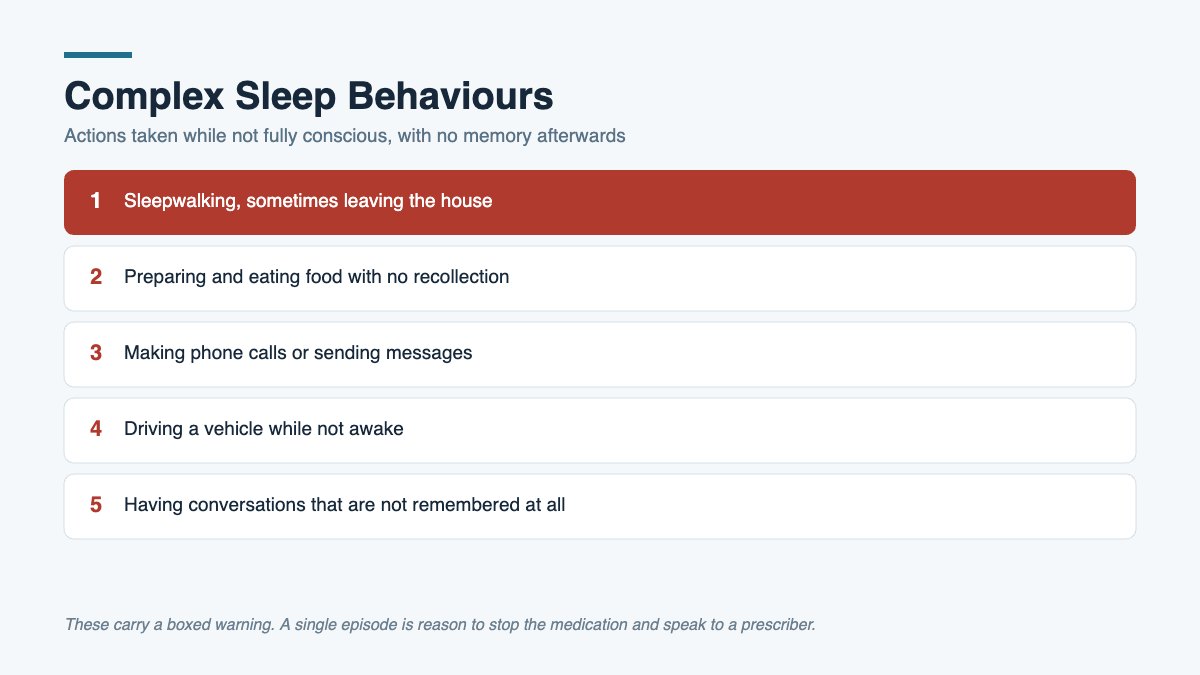
This is the most serious and least anticipated effect, and it carries a boxed warning from regulators.
A minority of people perform complex actions while not fully conscious and with no memory afterwards: walking, eating, preparing food, making phone calls, having conversations, having sex, and driving. Sleep driving in particular has produced serious injuries and deaths.
These episodes have occurred at recommended doses, in people with no history of anything similar, and sometimes on first use. Alcohol and other sedatives make them more likely. Regulators advise that a single episode is reason to stop the medication entirely rather than to reduce the dose, which is a stronger recommendation than applies to most side effects.
Next day impairment
These drugs can persist into the following morning at levels sufficient to impair driving, particularly with the longer acting formulations and the extended release versions.
Clearance also differs between people. Regulators lowered the recommended zolpidem dose for women after evidence that women eliminate the drug more slowly and reach higher morning blood levels than men taking the same amount. Older adults are affected more strongly again, and the fall risk in that group is a well documented harm.
Tolerance, dependence and rebound
Tolerance to the sleep effect develops with regular use, so the same dose does less over time. Dependence develops in some people, and dose escalation follows.
The complication on stopping is rebound insomnia: sleep that is worse for several nights than it was before the medication started. This is temporary, and it is very easily misread as proof that the medication was necessary, which is one of the main reasons short courses become long ones.
In people who have taken high doses for long periods, withdrawal can resemble benzodiazepine withdrawal, including, rarely, seizures. That group should not stop abruptly and needs a taper supervised by a prescriber. Our page on sleep medications covers this further, and our benzodiazepines page explains the shared mechanism.
Who should be most cautious
Older adults are the group where the balance shifts most clearly. Clearance slows with age, sedation lasts longer into the morning, and the association with falls and fractures is well established. Prescribing guidance for older patients reflects this.
Anyone taking an opioid, a benzodiazepine, or drinking regularly is in the other high risk group, because the sedative effects compound and the complex sleep behaviours become more likely.
Practical points
- Never combine with alcohol or opioids. Both deepen sedation and raise the risk of complex behaviours.
- Only take it with a full night available. Short nights are where morning impairment causes accidents.
- Stop and call your prescriber after any sleepwalking episode. This is the boxed warning, not a minor effect.
- Expect a few bad nights on stopping. Rebound insomnia is temporary and misleading.
- Do not stop abruptly after long term high dose use. Taper with a prescriber.
- Ask about cognitive behavioural therapy for insomnia. It outperforms medication over the long term and is rarely offered first.
Sources
This article draws on Food and Drug Administration prescribing information and safety communications for zolpidem, eszopiclone and zaleplon, including the boxed warning on complex sleep behaviours and the revised dosing guidance for women, and on published literature on Z-drug dependence and rebound insomnia. It is reference information, not medical advice.
Need help now? In an emergency call 911. If you are in crisis or thinking about suicide, call or text 988 (Suicide and Crisis Lifeline; veterans press 1). For free, confidential treatment referrals 24 hours a day, call the SAMHSA National Helpline at 1-800-662-4357. You can also search licensed programs at FindTreatment.gov, or use our rehab directory and state listings.
Addiction Now publishes health journalism and reference material. This page is not medical advice, a diagnosis, or a treatment plan. Do not stop a prescribed medication without talking to a clinician. Withdrawal from alcohol, benzodiazepines and barbiturates can cause seizures and can be fatal without medical supervision.