
The American illicit opioid supply is no longer mostly one drug. Fentanyl is still the primary driver of overdose deaths, but it now routinely arrives mixed with veterinary sedatives that naloxone cannot reverse, and alongside a family of synthetic opioids that can require repeat naloxone doses. Here is what the published testing data actually establishes.
Xylazine: how far it spread, and how fast
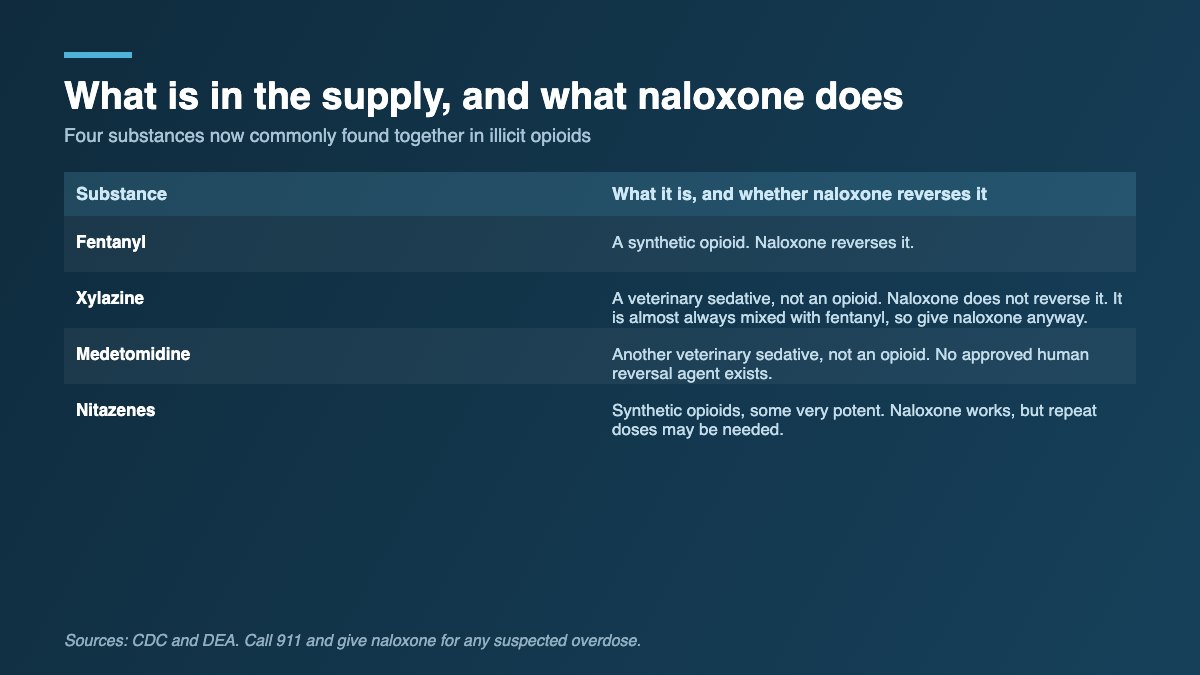
Xylazine is a veterinary sedative. It is not an opioid, and it is not currently a federally controlled substance.
CDC’s State Unintentional Drug Overdose Reporting System tracked its arrival. Across 20 states and the District of Columbia, the monthly share of deaths involving illegally made fentanyl that also involved xylazine rose from about 3 percent in January 2019 to about 11 percent in June 2022. A separate analysis of ten cities found xylazine in under 1 percent of overdose deaths in 2015, rising to nearly 7 percent by 2020.
Regional concentration is the other consistent finding. Between January 2021 and June 2022, across 31 states and DC, xylazine appeared in a higher proportion of fentanyl-involved deaths in the Northeast than elsewhere. Philadelphia is the sharpest local example on record: xylazine was found in 31 percent of overdose deaths involving heroin or fentanyl there in 2019. Testing of syringe service program samples in Maryland in 2021 and 2022 found xylazine in almost 80 percent of opioid-containing samples.

Seizure data tells a parallel story. DEA reported that 30 percent of the fentanyl powder it seized in 2023 contained xylazine, up from 25 percent in 2022, while the share of seized fentanyl pills containing xylazine fell slightly, from 7 percent to 6 percent. DEA has encountered xylazine and fentanyl mixtures in 48 of the 50 states.
Why the naloxone question matters so much
Naloxone works by displacing opioids from opioid receptors. Xylazine is an alpha-2 adrenergic agonist, which means naloxone has nothing to displace and no effect on the xylazine component of an overdose.
The correct practical conclusion is not that naloxone is useless. It is close to the opposite. Because xylazine is nearly always mixed with fentanyl, naloxone should be given for any suspected overdose, and it will reverse the part that is stopping the person from breathing. What responders need to expect is that sedation may persist after the opioid effect is reversed, which is why rescue breathing and a 911 call remain part of the response rather than optional extras.
Medetomidine: a smaller record, a clearer warning
Medetomidine is a second veterinary sedative, not approved for human use, detected in the North American opioid supply since 2022. The best-documented incident is a cluster in Chicago between 11 and 17 May 2024, described by CDC in a report published in May 2025.
Across three hospital emergency departments, clinicians saw 181 patients, of whom 12 were confirmed and 26 probable medetomidine-involved cases. Every specimen that tested positive for medetomidine also contained fentanyl. Among the 12 confirmed cases, 11 showed only partial improvement or none at all after naloxone. Slow heart rate and high blood pressure were the distinguishing clinical signs, which is close to the inverse of what clinicians expect in an opioid overdose. There is no reversal agent approved for human use.
One cluster in one city is a limited evidence base, and we would not describe medetomidine as a national pattern on that basis. It is, however, the pattern that xylazine followed: local detection first, then broader.
Nitazenes: potency without a class-wide rule
Nitazenes are synthetic opioids, some considerably more potent than fentanyl. Unlike the sedatives, they respond to naloxone, though the potency of some compounds can mean more than one dose is required.
The regulatory response has been compound by compound rather than class-wide. DEA has placed individual nitazene analogs into Schedule I on a rolling basis: two compounds were temporarily scheduled effective 15 August 2025, and seven further related opioids effective 15 October 2025, each for a defined term. Bills to schedule nitazenes as a class have been introduced in Congress but not enacted. DEA’s 2025 National Drug Threat Assessment identified nitazenes as a growing concern.
The scheduling gap around xylazine
Xylazine’s legal status is the odd feature of this story. The White House Office of National Drug Control Policy designated fentanyl adulterated with xylazine an emerging threat in April 2023 and published a national response plan in July 2023. Three years later the substance itself remains outside federal scheduling.
Legislation to place it in Schedule III has been introduced in this Congress and advanced out of the Senate Judiciary Committee in March 2026 by 19 votes to 3, but has not passed either chamber. Some states have moved independently: Ohio scheduled it in 2023, and Pennsylvania gave final approval to a further scheduling measure in August 2026.
There is a genuine policy argument here rather than simple inertia. Xylazine has legitimate veterinary uses, and scheduling changes create compliance burdens for veterinary practice, which is part of why the federal bills have taken the form they have.
What to take from this
- Xylazine went from about 3 percent to about 11 percent of fentanyl-involved deaths in CDC’s tracked states between January 2019 and June 2022, with the Northeast most affected.
- DEA found xylazine in 30 percent of seized fentanyl powder in 2023, and has encountered the mixture in 48 states.
- Naloxone does not reverse xylazine or medetomidine, but should still be given, because fentanyl is almost always present.
- Sedation can persist after naloxone works. Rescue breathing and a 911 call are part of the response.
- Medetomidine has no approved human reversal agent, and in the best-documented cluster naloxone produced partial or no improvement in 11 of 12 confirmed cases.
- Nitazenes do respond to naloxone, but repeat dosing may be necessary.
- Xylazine is still not federally scheduled, despite a 2023 emerging threat designation.
For background on the substances involved, see our drug information library, including the pages on fentanyl and heroin.
Sources
This article relies on published data and guidance from the Centers for Disease Control and Prevention, including its State Unintentional Drug Overdose Reporting System and its Morbidity and Mortality Weekly Report, the Drug Enforcement Administration, the White House Office of National Drug Control Policy, and the Federal Register record of temporary scheduling actions. Percentages reflect the states, cities and periods named in each source and are not national totals unless stated.
Need help now? In an emergency call 911. If you are in crisis or thinking about suicide, call or text 988 (Suicide and Crisis Lifeline; veterans press 1). For free, confidential treatment referrals 24 hours a day, call the SAMHSA National Helpline at 1-800-662-4357. You can also search licensed programs at FindTreatment.gov, or use our rehab directory and state listings.
Addiction Now publishes health journalism and reference material. This page is not medical advice, a diagnosis, or a treatment plan. Do not stop a prescribed medication without talking to a clinician. Withdrawal from alcohol, benzodiazepines and barbiturates can cause seizures and can be fatal without medical supervision.