


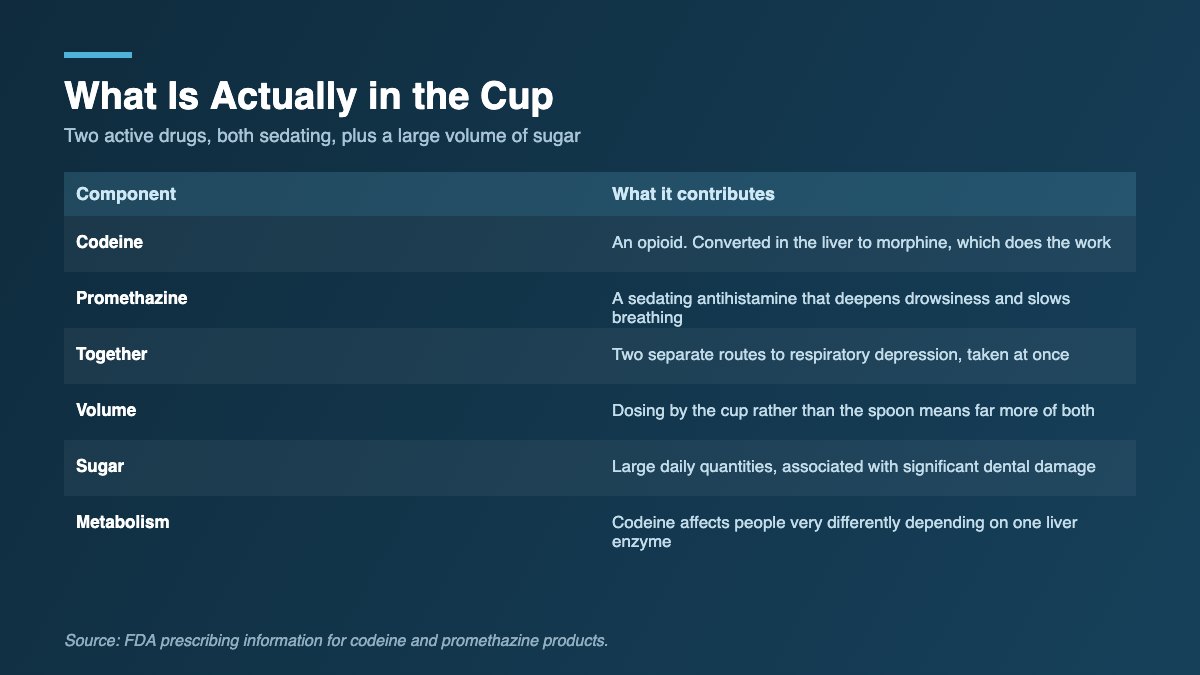
Prescription cough syrup containing codeine and promethazine, consumed in large volumes and usually mixed with soda, delivers two sedating drugs at once. Both suppress breathing, by separate mechanisms, and the quantities involved bear no relationship to the dose the formulation was designed for.
The two active ingredients
Codeine is an opioid. It is relatively weak in itself and works mainly through conversion in the liver into morphine, which produces the analgesia, the euphoria and the respiratory depression.
Promethazine is not an opioid at all. It is a first generation antihistamine with strong sedative properties, included to suppress cough and to counter nausea. On its own it produces heavy drowsiness.
The formulation exists because both suppress cough by different routes. The problem when it is consumed recreationally is that both also suppress consciousness and respiration, and taking them together compounds that rather than balancing it.

Why the volume changes everything
Cough syrup is dosed in teaspoons. Recreational use is measured in ounces, often several across an evening, and mixing with soda both disguises the taste and makes the quantity harder to track.
Someone drinking steadily from a cup has no clear sense of how much codeine they have taken, and because opioid effects build with a delay, the dose already consumed may not have fully registered when more is poured. That gap between consumption and effect is where overdoses happen.
The metabolism problem
Codeine depends on a liver enzyme called CYP2D6 to become morphine, and people differ enormously in how much of it they have.
A minority convert very little and get almost no opioid effect, which can prompt taking considerably more. A different minority convert unusually fast, producing much higher morphine levels than expected from the same amount. This is not a rare curiosity: it is the reason regulators restricted codeine use in children after deaths in ultra rapid metabolisers.
Practically, it means the amount someone else drinks tells you nothing about what is safe for you, and that a dose tolerated once by one person can be dangerous for another.
How it causes harm
The main acute danger is respiratory depression. Codeine suppresses the brainstem drive to breathe as any opioid does, and promethazine adds sedation deep enough that someone may not rouse as their breathing slows.
Naloxone reverses the codeine component but does nothing for the promethazine, so someone may remain heavily sedated after naloxone even with the opioid effect reversed. That is a reason to call 911 rather than to assume the situation has been handled.
Vomiting while sedated is a second route to death, through aspiration, and it is a real risk given the volumes of liquid involved.
Seizures have been reported with high dose promethazine, and combining the syrup with alcohol or benzodiazepines raises every one of these risks substantially.
What accumulates with regular use
Opioid tolerance and physical dependence develop as they would with any opioid, so stopping produces the familiar withdrawal: aches, sweating, runny nose, nausea, diarrhoea, restlessness and insomnia. People who think of it as cough medicine are frequently surprised to find themselves in genuine opioid withdrawal.
Constipation is persistent. Weight gain is common, driven by both the sedation and the sugar.
The dental damage deserves specific mention because it is severe and often the first visible consequence. Large daily volumes of sugary syrup and soda, combined with the reduced saliva that opioids cause, produce rapid and extensive tooth decay.
The specific danger of injecting promethazine
Promethazine is intensely irritating to tissue. Injected, particularly outside a vein, it can cause severe tissue damage, including necrosis serious enough to require surgery or amputation. It is a recognised and well documented injury and worth stating explicitly.
Why it is not a milder opioid habit
The framing that causes most harm here is the assumption that because it comes from a pharmacy in a bottle labelled for cough, it sits in a different category from other opioids.
Pharmacologically it does not. Codeine becomes morphine. Sustained daily use produces the same tolerance, the same dependence and the same withdrawal, and the respiratory risk is increased rather than reduced by the second ingredient. People who have used it for years frequently arrive at treatment having never described themselves as using opioids at all.
Practical points
- Two sedating drugs, not one. Naloxone addresses only the codeine half.
- Never combine with alcohol or benzodiazepines. Three routes to suppressed breathing.
- Do not gauge your dose from someone else’s. Codeine metabolism varies enormously.
- Expect real opioid withdrawal on stopping. It is not a mild syrup habit.
- See a dentist early. The decay is fast and largely preventable.
- Put anyone unresponsive on their side. Aspiration is a genuine risk at these volumes.
Further background is available on our drug information pages and our prescription opioid reference material.
Sources
This article draws on Food and Drug Administration prescribing information and safety communications for codeine and promethazine, including restrictions related to CYP2D6 ultra rapid metabolism and warnings on tissue injury from promethazine injection. It is reference information, not medical advice.
Need help now? In an emergency call 911. If you are in crisis or thinking about suicide, call or text 988 (Suicide and Crisis Lifeline; veterans press 1). For free, confidential treatment referrals 24 hours a day, call the SAMHSA National Helpline at 1-800-662-4357. You can also search licensed programs at FindTreatment.gov, or use our rehab directory and state listings.
Addiction Now publishes health journalism and reference material. This page is not medical advice, a diagnosis, or a treatment plan. Do not stop a prescribed medication without talking to a clinician. Withdrawal from alcohol, benzodiazepines and barbiturates can cause seizures and can be fatal without medical supervision.