

Nicotine is among the most reinforcing drugs available, largely because of how fast it arrives. Inhaled, it reaches the brain within seconds, and that speed is what makes the habit so durable. Vaping did not change the pharmacology; it changed how much nicotine a person can comfortably take in a day.
What nicotine does
Nicotine binds to nicotinic acetylcholine receptors, which are distributed widely through the brain and body. In the reward pathway that binding triggers dopamine release, and because inhaled nicotine arrives in seconds, the association between the action and the reward is unusually tight.
The felt effects are modest compared with most drugs discussed here: mild alertness, improved concentration, reduced appetite, and a settling of the tension that nicotine withdrawal itself produces. Heart rate and blood pressure rise. Blood vessels constrict.
That last point matters for the cardiovascular effects, which belong to nicotine itself rather than only to smoke.
Why the speed matters more than the strength
A drug that produces a modest effect very quickly, many times a day, builds a stronger habit than a drug producing a large effect occasionally. A pack a day smoker repeats the action hundreds of times daily, each time pairing a specific context with a reliable small reward.
This is why nicotine dependence is so tied to situation: the first of the day, after eating, with coffee, driving, on a break. Those cues are learned individually and persist after the pharmacological withdrawal has passed, which is why craving can return years later in a specific setting.
What vaping changed
The important development was chemical rather than technological. Nicotine salt formulations are much less harsh to inhale than the freebase nicotine in earlier devices, so a far higher concentration can be taken comfortably.
Combined with a device that requires no lighting, produces little smell, and can be used briefly and repeatedly indoors, the practical result is that some people take in considerably more nicotine per day than they would have from cigarettes, in a pattern of near continuous small doses rather than discrete ones.
On harm, the evidence is genuinely mixed and worth stating carefully. Vaping avoids combustion, and combustion produces most of the carcinogens and carbon monoxide responsible for smoking related cancer and much of the cardiovascular disease. That makes vaping less harmful than smoking, which is not the same as safe. Long term effects remain incompletely characterised, the cardiovascular effects of nicotine persist, and the serious lung injury outbreak identified several years ago was linked primarily to vitamin E acetate in illicit cannabis vaping products rather than to nicotine products.
Withdrawal
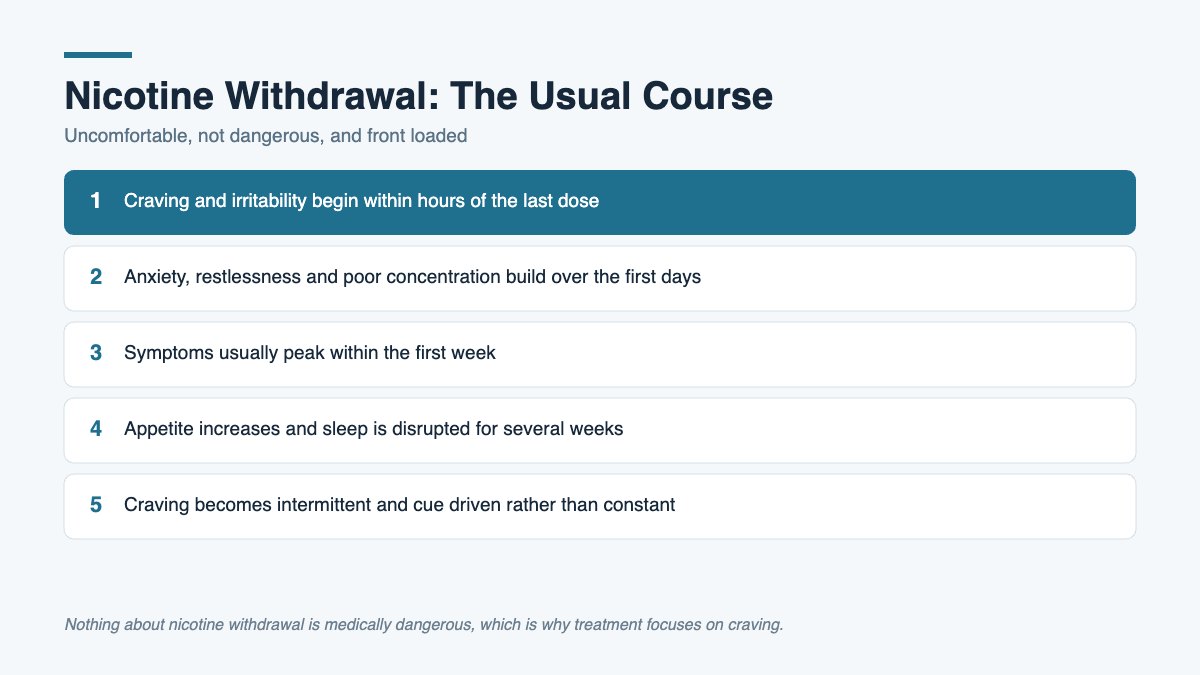
Nicotine withdrawal is uncomfortable and not dangerous. Craving and irritability begin within hours. Anxiety, restlessness, poor concentration, low mood, increased appetite and disturbed sleep build over the first days and generally peak within the first week.
Most symptoms fade over two to four weeks. Appetite change and intermittent cue driven craving persist longer. Weight gain after stopping is common and is driven by both the metabolic effect and the return of appetite, which is worth anticipating rather than being surprised by.
What actually helps people stop
This is one of the better served areas in all of addiction medicine, and the options are underused.
Nicotine replacement is available over the counter, and combining a long acting form such as a patch with a short acting form such as gum, lozenge or spray works better than either alone. Two prescription medications, varenicline and bupropion, have good evidence, and varenicline in particular outperforms nicotine replacement in many comparisons. Behavioural support added to any of these improves results further.
For people vaping rather than smoking, the same medications apply, and the practical difficulty is that continuous small dosing makes the habit harder to interrupt than a discrete one.
Practical points
- Combine two forms of nicotine replacement. Patch plus a fast acting form beats either alone.
- Ask about varenicline. It is prescription only and frequently not offered.
- Expect the first week to be the worst. Symptoms are front loaded.
- Plan for the cues, not just the craving. Coffee, driving and breaks are learned triggers.
- Anticipate appetite change. It is predictable and manageable if expected.
- Less harmful is not harmless. Switching to vaping is a step, not a destination.
More reference material is available on our drug information pages.
Sources
This article draws on National Institute on Drug Abuse and Centers for Disease Control and Prevention material on nicotine, smoking cessation and e-cigarettes, Food and Drug Administration prescribing information for varenicline and bupropion, and published investigations into the lung injury outbreak associated with vitamin E acetate. It is reference information, not medical advice.
Need help now? In an emergency call 911. If you are in crisis or thinking about suicide, call or text 988 (Suicide and Crisis Lifeline; veterans press 1). For free, confidential treatment referrals 24 hours a day, call the SAMHSA National Helpline at 1-800-662-4357. You can also search licensed programs at FindTreatment.gov, or use our rehab directory and state listings.
Addiction Now publishes health journalism and reference material. This page is not medical advice, a diagnosis, or a treatment plan. Do not stop a prescribed medication without talking to a clinician. Withdrawal from alcohol, benzodiazepines and barbiturates can cause seizures and can be fatal without medical supervision.