

More than $50 billion from opioid settlements with drug makers, distributors and pharmacies is moving to state and local governments over roughly two decades. Tracking what arrived is straightforward. Tracking what was spent is not. In several states, a large share of the governments receiving money have filed no spending report at all.
The money arrives slowly, and that shapes the reporting problem
Opioid settlement payments are not a single cheque. They are scheduled instalments, in most cases stretching across 15 to 18 years, split between state governments and the individual counties, cities and towns that signed on. New York alone is expected to receive over $3 billion across the life of its agreements.
That structure has two consequences. The first is that any given year’s payment is modest relative to the headline number, which makes large one-time investments hard to justify without banking funds first. The second is administrative: the money lands in hundreds of separate local budgets, each with its own accounting practices, staff capacity and appetite for public disclosure.
The result is that “how much has been spent” is a question with no single authoritative answer, even three years into the payment schedule.

Wisconsin publishes the itemised version
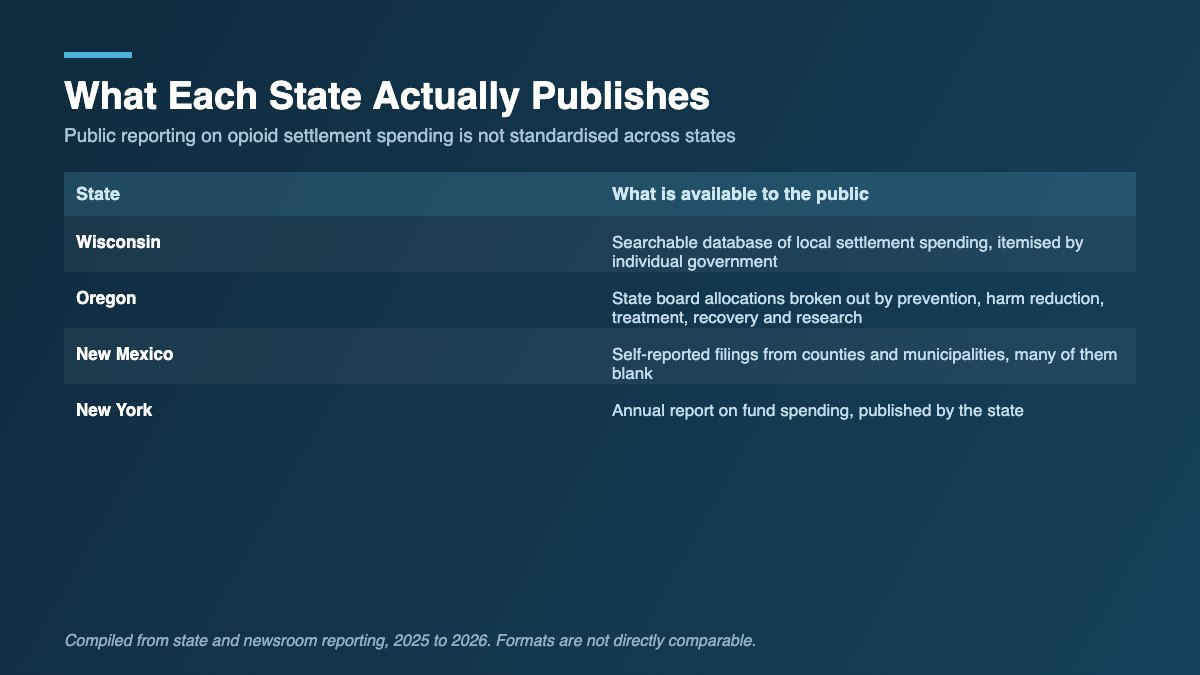
Wisconsin is among the more transparent cases. Local governments there have received more than $160 million in settlement payments, and reporting by Wisconsin Watch compiled that spending into a searchable database broken out by individual government.
The picture it shows is uneven. By the end of 2025, just eight local governments had spent more than half of the settlement money they had received. Sixteen had spent none of it.
Neither of those figures is inherently damning. A county that banks two years of payments to fund a treatment position for five years is behaving more responsibly than one that spends the same money on a one-off awareness campaign. But the spread does show that “received” and “deployed” are very different measures, and that the gap is wide enough to matter.
Oregon reports allocations by category instead
Oregon’s approach is different in kind, not just in quality. Its settlement board has allocated over $116.5 million, and reports that total broken out across prevention, harm reduction, treatment, recovery and research.
Category-level reporting answers a different question than Wisconsin’s database does. It tells you what the state decided to prioritise. It does not tell you which specific programmes received money, whether the money reached them, or what happened afterwards. Both formats are useful. Neither is a substitute for the other, and the two states cannot be meaningfully compared on a single number.
Where reporting simply is not happening
New Mexico is the sharper case. More than three years after counties and towns received their first instalments from a settlement fund approaching $1 billion, almost half of them had filed no spending report at all as of July 2025, according to reporting by Source New Mexico. Many others reported little or nothing spent through June of that year.
A missing report is not proof that money was misused. It is more often a sign of thin administrative capacity in a small jurisdiction, or of a reporting requirement with no consequence attached to ignoring it. But the practical effect is the same: for a substantial share of the fund, the public has no way to know what happened.
The spending that draws the most scrutiny
Where reporting does exist, some of it has raised questions about whether the money is reaching health services at all. Reporting by KFF Health News and STAT examined Louisiana’s decision to route 20 percent of its settlement funds through sheriffs’ offices, following how that money was actually used. Settlement agreements generally require spending on opioid remediation, but that term is defined broadly enough to accommodate law enforcement uses alongside treatment and harm reduction.
This is the recurring tension in settlement oversight. The agreements constrain spending loosely, states interpret the constraints differently, and the reporting that would let anyone check is inconsistent.
What to look for in your own state
- Find out whether your state reports at the local level or only in aggregate. Aggregate totals can hide jurisdictions that have spent nothing.
- Check whether reporting is mandatory and whether anything happens if a government skips it. A requirement with no enforcement mechanism produces the New Mexico pattern.
- Distinguish allocated from spent. A board can allocate money years before it reaches a programme.
- Look for recurring versus one-time commitments. Given a payment schedule running into the 2030s, staffing and services funded on an ongoing basis behave very differently from single-year grants.
- Read the category definitions. “Opioid remediation” covers a wide range of activity, and the label alone tells you little.
For background on the substances driving these settlements, see our reference pages on drug information and fentanyl. Readers looking for licensed programmes can search our state listings.
Sources
This article draws on public reporting and state disclosures from Wisconsin Watch, the Oregon Health Authority, Source New Mexico, KFF Health News, STAT and the National Academy for State Health Policy. Figures reflect the most recent reporting available at the time of writing, and settlement payment schedules continue for years, so state totals change.
Need help now? In an emergency call 911. If you are in crisis or thinking about suicide, call or text 988 (Suicide and Crisis Lifeline; veterans press 1). For free, confidential treatment referrals 24 hours a day, call the SAMHSA National Helpline at 1-800-662-4357. You can also search licensed programs at FindTreatment.gov, or use our rehab directory and state listings.
Addiction Now publishes health journalism and reference material. This page is not medical advice, a diagnosis, or a treatment plan. Do not stop a prescribed medication without talking to a clinician. Withdrawal from alcohol, benzodiazepines and barbiturates can cause seizures and can be fatal without medical supervision.