


Nationally, 38 percent of children who spent time in out of home care during fiscal year 2025 had parental alcohol or other drug use recorded as a circumstance at removal, according to federal AFCARS data published by the National Center on Substance Abuse and Child Welfare. The comparable share in 2000 was 18.5 percent.
Where the number comes from
Every state reports case level information on children in foster care to the Adoption and Foster Care Analysis and Reporting System, known as AFCARS. One field in that system records circumstances associated with a child’s removal, and two of the available entries are parental alcohol abuse and parental drug abuse. The National Center on Substance Abuse and Child Welfare, a joint project of the Administration for Children and Families and SAMHSA, publishes national and state figures drawn from that field.
Its fiscal year 2025 analysis, based on data extracted in May 2026, covers 505,591 children and puts the national share at 38.0 percent. Plotted from 2000 forward, the line rises steadily rather than jumping: 18.5 percent at the start of the series, 38.0 percent at the end.
What the figure does not tell you
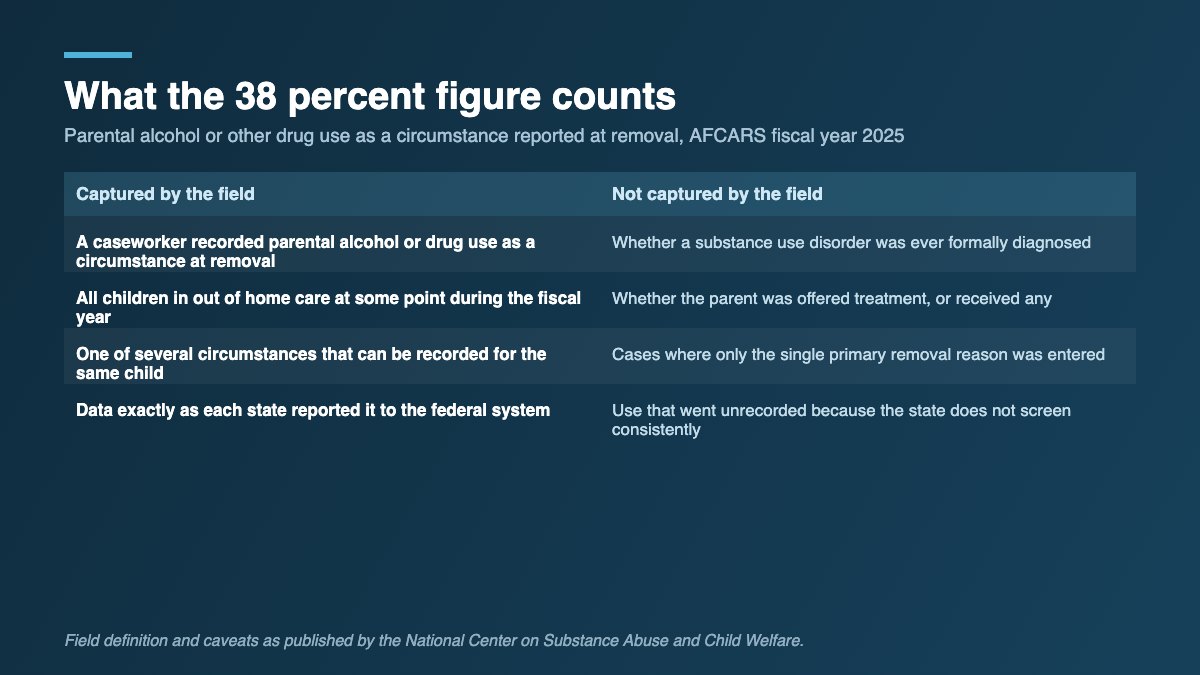
The centre publishing the number is unusually candid about its limits, and those caveats matter more than the headline. States frequently tell federal analysts that the true share in their jurisdiction is higher than the data shows. The listed explanations are all administrative: some child welfare agencies have no consistent protocol for screening and assessing substance use disorders, data entry practices differ between agencies, states capture the field differently in their own case management systems, and the point at which substance use is identified varies. At local level, several removal reasons are often recorded but only the primary one reaches the federal system.
Read carefully, then, 38 percent is a floor for administrative recording rather than a clinical prevalence estimate. It tells you how often a caseworker wrote something down, not how many parents met diagnostic criteria for a substance use disorder.
State variation is far too wide to be real
An analysis by Child Trends using 2023 AFCARS data found that the proportion of children entering foster care with parental drug use recorded ranged from under 1 percent to 60 percent depending on the state. Five states, Utah, Texas, Indiana, Oregon and Oklahoma, reported that more than half of foster care entries were related to parental drug use.
No plausible account of American drug use produces a sixtyfold difference between neighbouring jurisdictions. What the range mostly measures is reporting practice: whether the state tests, whether it screens, whether its case system allows multiple circumstances, and how its statutes define the threshold for intervention. Any comparison of one state against another using this field is measuring bureaucracy alongside behaviour.
Substance use almost never appears on its own
The same Child Trends analysis found that among children who entered care in 2023 with parental drug use recorded, just 27 percent had no other reason listed. For the remaining children, neglect was recorded in 81 percent of cases.
This is the finding most often lost when the topic is discussed. Parental substance use tends to arrive alongside housing instability, poverty, untreated mental illness and domestic violence, and it is frequently the item on that list that is easiest to name in a case file. A system response aimed only at the substance leaves the rest of the cluster untouched. Our reference pages on alcohol and methamphetamine cover the two substances most often named in these records.
What federal law now requires
Two federal statutes shape how child welfare agencies are supposed to respond, and both push toward services rather than removal.
The first is the Child Abuse Prevention and Treatment Act, amended in 2016 by the Comprehensive Addiction and Recovery Act. States must have policies for notifying child protective services when an infant is born affected by substance use or withdrawal symptoms, and must develop a plan of safe care that addresses the health and substance use treatment needs of the infant and of the affected family or caregiver. States must also monitor referrals and whether services were actually received. A notification under this provision is not a finding of abuse and a plan of safe care is not a removal, a distinction that gets blurred in practice.
The second is the Family First Prevention Services Act, enacted in 2018 as part of the Bipartisan Budget Act. For the first time it allowed states to claim federal Title IV-E funds, previously tied largely to foster care placement, for time limited prevention services including substance use prevention and treatment, mental health services, in-home parent skill-based programmes and kinship navigator services. Eligible recipients include children considered candidates for foster care, pregnant and parenting youth in care, and their parents or kin caregivers. Services must appear in the federal Title IV-E Prevention Services Clearinghouse to be claimable.
Takeaways
- Parental alcohol or drug use was recorded as a removal circumstance for 38.0 percent of children in out of home care in fiscal year 2025, up from 18.5 percent in 2000, per AFCARS data published by the National Center on Substance Abuse and Child Welfare.
- The figure measures what caseworkers recorded, not diagnosed prevalence. Federal analysts list screening gaps and data entry practice as reasons the real share may be higher.
- State by state figures ranged from under 1 percent to 60 percent in 2023, a spread that reflects reporting systems more than parental behaviour.
- Substance use is usually recorded alongside other circumstances. In 2023 only about a quarter of these cases listed no additional reason, and neglect appeared in most of the rest.
- Federal law since 2016 requires plans of safe care addressing the caregiver’s treatment needs, and since 2018 has allowed federal foster care funds to pay for substance use treatment as prevention.
- If you are a parent facing a child welfare case, the treatment record is part of the case record. Our drug information library explains what treatment for each substance typically involves.
Sources
This article draws on the National Center on Substance Abuse and Child Welfare, a joint programme of the Administration for Children and Families and the Substance Abuse and Mental Health Services Administration, which publishes the AFCARS removal circumstance series; the Adoption and Foster Care Analysis and Reporting System itself, distributed through the National Data Archive on Child Abuse and Neglect and analysed by the Center for Children and Family Futures; Child Trends, for the state level and co-occurring circumstance analysis of 2023 data; the Child Abuse Prevention and Treatment Act as amended by the Comprehensive Addiction and Recovery Act of 2016; and the Family First Prevention Services Act of 2018, together with the Title IV-E Prevention Services Clearinghouse maintained by the Administration for Children and Families.
Need help now? In an emergency call 911. If you are in crisis or thinking about suicide, call or text 988 (Suicide and Crisis Lifeline; veterans press 1). For free, confidential treatment referrals 24 hours a day, call the SAMHSA National Helpline at 1-800-662-4357. You can also search licensed programs at FindTreatment.gov, or use our rehab directory and state listings.
Addiction Now publishes health journalism and reference material. This page is not medical advice, a diagnosis, or a treatment plan. Do not stop a prescribed medication without talking to a clinician. Withdrawal from alcohol, benzodiazepines and barbiturates can cause seizures and can be fatal without medical supervision.