

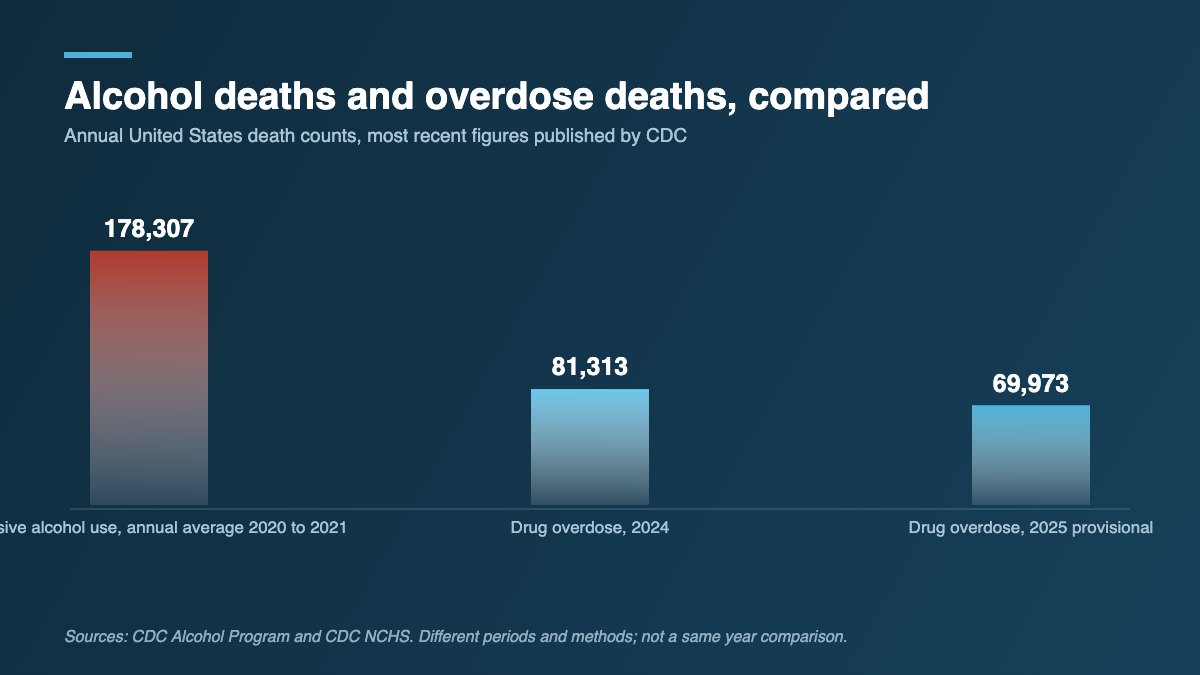
Excessive alcohol use is linked to roughly 178,000 deaths a year in the United States, according to the Centers for Disease Control and Prevention. Drug overdoses killed an estimated 69,973 people in 2025. Alcohol is the larger killer by a wide margin, and it has been for years, yet it draws a fraction of the policy attention and a fraction of the funding.
The two numbers, side by side
CDC estimates that excessive drinking was responsible for an average of 178,307 deaths a year during 2020 and 2021, and that those deaths shortened the lives of the people who died by an average of 24 years. The agency’s provisional overdose count for 2025 is 69,973, down almost 14 percent from the 81,313 estimated for 2024.
The comparison is not perfectly clean, and it is worth being precise about why. The alcohol figure is a two year annual average built with a modeling step: CDC applies alcohol-attributable fractions to dozens of causes of death, from liver disease to certain cancers to motor vehicle crashes, then sums the results. The overdose figure is a direct count drawn from death certificates that name a drug. One number is estimated, the other is tallied. Even allowing generously for that difference, the gap does not close.
Alcohol deaths rose while overdose deaths finally fell
The direction of travel matters as much as the totals. Deaths from excessive alcohol use climbed about 29 percent between 2016 to 2017, when the annual average was 137,927, and 2020 to 2021, when it reached 178,307. The increase was not evenly distributed: deaths among men rose about 27 percent, and deaths among women rose about 35 percent.
Overdose deaths moved the other way. After peaking in the early 2020s, they have now fallen for three consecutive years. The 2025 provisional data show declines across fentanyl, methamphetamine and cocaine at once, which points to something broader than a single-substance shift. Psychostimulants including methamphetamine accounted for roughly 26,000 of the 2025 deaths, and cocaine for roughly 19,000, with substantial overlap between those categories because many deaths involve more than one drug.
So the story of the past three years is two trends running in opposite directions, and only one of them has been widely reported.
Most alcohol deaths are slow, not sudden
About two thirds of deaths from excessive alcohol use, roughly 117,000 a year, come from chronic conditions that develop over time: several types of cancer, heart disease, liver disease and alcohol use disorder itself. The remaining third comes from acute causes, including poisonings, crashes, falls and violence. Around 4,000 deaths a year occur among people under 21.
That distribution helps explain the coverage gap. A fentanyl death is an event. A death from alcohol-related liver disease at 58 is the end of a process that began decades earlier, and it is usually recorded as liver disease. Events generate headlines. Processes generate line items in a mortality file.
Where the mismatch shows up in practice
Three places, mainly.
The first is screening. Alcohol screening in primary care is recommended and widely under-delivered, while opioid risk screening has been built into prescribing systems, prescription monitoring programs and pharmacy workflows over the past decade.
The second is medication. Three medications are approved in the United States to treat alcohol use disorder: naltrexone, acamprosate and disulfiram. They reach a small minority of the people who would qualify for them. Buprenorphine and methadone, by contrast, have been the subject of sustained federal effort, including the removal of the separate waiver requirement for buprenorphine prescribing.
The third is money. Opioid litigation produced more than 50 billion dollars in settlement funds flowing to states and localities. There is no equivalent pot for alcohol, and general prevention budgets have not grown to match the mortality trend.
None of this argues for spending less on overdose prevention. The overdose decline is real and it followed real investment. The point is narrower: the same logic applied to alcohol would predict a much larger response than the one that exists. For background on individual substances, see our drug information library, including the pages on alcohol and benzodiazepines.
A safety point the numbers obscure
One practical consequence of alcohol being treated as the ordinary drug is that people underestimate its withdrawal risk. Stopping heavy daily drinking without medical supervision can cause seizures and delirium tremens, and it can be fatal. The same is true of benzodiazepines and barbiturates. Opioid withdrawal, which is far more feared publicly, is rarely lethal on its own. That inversion of public perception is a direct cost of the attention gap.
What to take from this
- Alcohol is linked to about 178,000 deaths a year; drug overdoses to about 70,000 in 2025. Both figures come from CDC.
- Alcohol deaths rose roughly 29 percent across the late 2010s into the early 2020s, with the sharpest rise among women.
- Overdose deaths have fallen three years running, across multiple drug categories at once.
- Two thirds of alcohol deaths come from chronic disease, which is part of why they are less visible in news coverage.
- If you drink heavily every day, do not stop abruptly on your own. Alcohol withdrawal can be medically dangerous and should be managed by a clinician.
- Effective medications for alcohol use disorder exist and are badly underused. They are worth asking a prescriber about directly.
Sources
This article relies on published data and guidance from the Centers for Disease Control and Prevention (Alcohol Program and the National Center for Health Statistics) and the National Institute on Alcohol Abuse and Alcoholism. Overdose figures for 2025 are provisional and will be revised as additional records are processed.
Need help now? In an emergency call 911. If you are in crisis or thinking about suicide, call or text 988 (Suicide and Crisis Lifeline; veterans press 1). For free, confidential treatment referrals 24 hours a day, call the SAMHSA National Helpline at 1-800-662-4357. You can also search licensed programs at FindTreatment.gov, or use our rehab directory and state listings.
Addiction Now publishes health journalism and reference material. This page is not medical advice, a diagnosis, or a treatment plan. Do not stop a prescribed medication without talking to a clinician. Withdrawal from alcohol, benzodiazepines and barbiturates can cause seizures and can be fatal without medical supervision.