

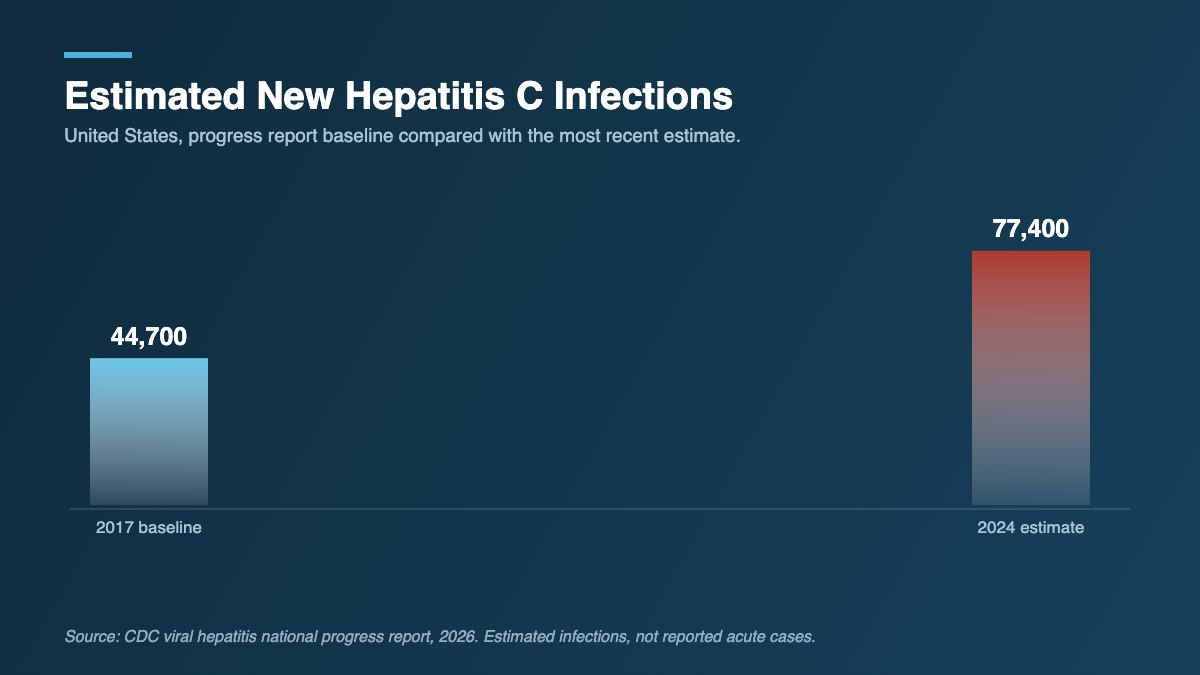
The United States has a national goal of eliminating hepatitis C by 2030. Estimated new infections in 2024 came to 77,400, against a 2017 baseline of 44,700. The infection curve is moving away from the target, the strategic plan behind the target expired in 2025 without a successor, and the dedicated federal elimination program was proposed and never funded.
The number and the target
The 77,400 figure comes from the CDC viral hepatitis national progress report published in 2026. It is an estimate rather than a case count, because reported acute hepatitis C cases substantially understate actual infections: most new infections produce no symptoms that bring anyone to a clinic, and testing is concentrated in people who already have a reason to be tested.
The 2030 elimination target comes from the HHS viral hepatitis national strategic plan issued in 2021. Two complications are worth knowing. That plan reached the end of its term in 2025 and no replacement has been published. And CDC own progress indicators work to 2028 rather than 2030, so the federal government is internally using two different horizons.
Why this gap is unusual
Most public health targets are hard because the intervention is hard. This one is not. Hepatitis C is curable with direct acting antiviral tablets, typically over 8 to 12 weeks, with cure rates above 95 percent in most patients. There is no injection, no interferon, and comparatively little in the way of side effects. A person can be cured and stay cured.

That is what makes rising incidence alongside a curative treatment a distinctive kind of policy failure. The constraint is not pharmacology. It is finding people, treating them promptly, and preventing reinfection in a population that is also being infected faster than it is being cured.
What we know and do not know about people who inject drugs
Injection drug use is the principal transmission route for new hepatitis C infection in the United States. Beyond that, the national picture is thinner than most coverage suggests. There is no current authoritative federal estimate of hepatitis C prevalence specifically among people who inject drugs. Regional studies produce a very wide range, and CDC uses adults aged 18 to 40 as an indirect proxy in its indicators rather than measuring the population directly.
So statements about what proportion of people who inject drugs have hepatitis C should be read carefully, and any single national percentage quoted without a source and a region attached is not reliable. Our reference material on injection related risk sits in the heroin and wider drug information sections.
The barrier data is out of date, in a useful direction
The most cited figures on treatment access come from a CDC analysis published in 2022, which found that within a year of diagnosis, treatment had been initiated for roughly 23 percent of people with Medicaid, 28 percent with Medicare and 35 percent with private insurance. That analysis identified state Medicaid restrictions as a major obstacle, specifically sobriety requirements and rules limiting treatment to people with established liver damage.
Those restrictions have since largely been dismantled. A 2025 review of state Medicaid policies found no jurisdiction still imposing a sobriety requirement for hepatitis C treatment. That is a real and underreported improvement, and it means the 2022 barrier list should not be presented as current. It also means the low initiation rates cannot now be blamed primarily on coverage rules, which shifts the question to diagnosis, linkage and follow up.
One caution on sourcing. There is no Government Accountability Office or Inspector General report on hepatitis C treatment access, despite such attributions appearing in secondary coverage. The primary evidence here is CDC surveillance and academic policy tracking.
What elimination would actually require
The arithmetic of elimination is that cures per year must exceed new infections per year, sustained over time. With infections rising, that requires either a very large increase in treatment volume or a meaningful reduction in transmission, and realistically both. Transmission reduction in this population means syringe access and medication for opioid use disorder, which is why hepatitis C policy and addiction policy are the same problem wearing different labels.
Takeaways
- Estimated new hepatitis C infections reached 77,400 in 2024, against a 2017 baseline of 44,700.
- The national elimination target is 2030, from a strategic plan that expired in 2025 with no successor. CDC indicators use 2028.
- A dedicated national hepatitis C elimination program was proposed but never funded.
- The disease is curable in 8 to 12 weeks with cure rates above 95 percent, so the constraint is delivery rather than medicine.
- State Medicaid sobriety requirements have been largely eliminated since the widely cited 2022 access analysis.
- There is no current federal estimate of prevalence among people who inject drugs. Treat single national percentages with suspicion.
Sources
Centers for Disease Control and Prevention viral hepatitis national progress report, 2026, and viral hepatitis surveillance data; CDC Vital Signs analysis of hepatitis C treatment initiation, Morbidity and Mortality Weekly Report, 2022; US Department of Health and Human Services viral hepatitis national strategic plan, 2021; Center for Health Law and Policy Innovation and National Viral Hepatitis Roundtable state Medicaid policy review, 2025.
Need help now? In an emergency call 911. If you are in crisis or thinking about suicide, call or text 988 (Suicide and Crisis Lifeline; veterans press 1). For free, confidential treatment referrals 24 hours a day, call the SAMHSA National Helpline at 1-800-662-4357. You can also search licensed programs at FindTreatment.gov, or use our rehab directory and state listings.
Addiction Now publishes health journalism and reference material. This page is not medical advice, a diagnosis, or a treatment plan. Do not stop a prescribed medication without talking to a clinician. Withdrawal from alcohol, benzodiazepines and barbiturates can cause seizures and can be fatal without medical supervision.