

A fentanyl test strip answers one question with a yes or no. A growing number of US harm reduction programs now run actual analytical chemistry on drug samples, using infrared and mass spectrometry, and report back what is in them. What those machines find is consistently more complicated than what strips can see.
What a strip cannot do
An immunoassay strip is built to detect one target class. It cannot tell you concentration, cannot identify what else is present, and cannot flag a compound it was not designed for. As the supply has filled with veterinary sedatives, novel synthetic opioids and industrial chemicals, the share of what matters in a sample that a strip can detect has fallen.
Spectrometry works differently. Rather than looking for one target, it produces a signature of the sample and matches components against reference libraries. It can report that a powder is fentanyl plus a cutting agent plus a sedative plus something the library does not recognise, which is a different kind of information.
The technologies and their tradeoffs
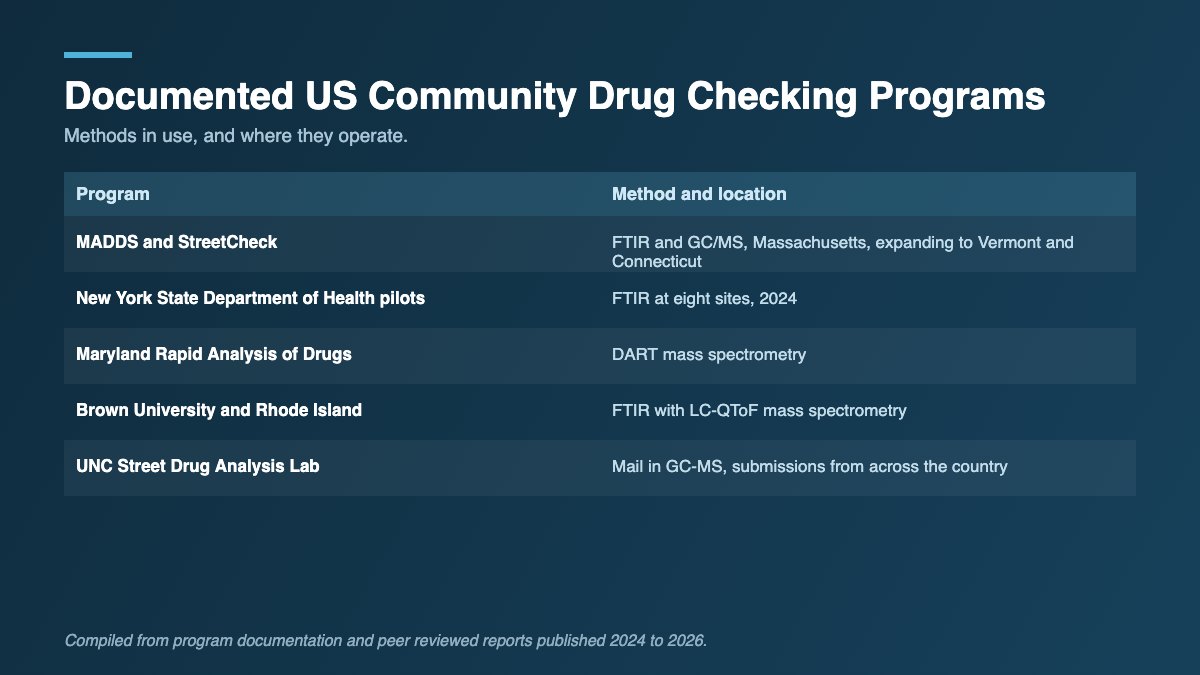
Fourier transform infrared spectroscopy, or FTIR. Benchtop, fast, usable by trained non chemists at a drop in site, and returns a result in minutes. Its weakness is sensitivity: it identifies major components well and routinely misses anything present at low concentration, which in a fentanyl sample is often the fentanyl itself.

Gas or liquid chromatography with mass spectrometry. Far more sensitive, capable of detecting trace components, and the basis for most published findings. It requires a laboratory, trained analysts and time, which means results usually arrive days after the sample.
Direct analysis in real time mass spectrometry, or DART-MS. Faster sample handling than conventional mass spectrometry while retaining much of the sensitivity, which is why it has been attractive for public health deployment.
Most mature programs pair a fast on site method with a slower sensitive one, using the first for immediate feedback and the second for surveillance.
What the machines find
Two findings illustrate the difference from strip based checking.
Analysis of over a thousand opioid samples collected in New York City found xylazine in 43.7 percent of them, and the share rose from 10.7 percent in 2021 to 53.7 percent in 2024. A fentanyl strip returns a positive on every one of those samples and says nothing about the sedative that changes how an overdose presents and how the wounds behave. Our earlier reporting covers what the testing data shows on xylazine, medetomidine and nitazenes in more depth.
The second is stranger. Analysis across nine programs in mid 2024 found an industrial chemical, a light stabiliser used in plastics manufacturing, in roughly one in three fentanyl samples. No strip exists for it, nobody was looking for it, and it was found because the method used does not need to know what it is looking for in advance. That is the central argument for spectrometry over targeted tests.
The turnaround problem
Drug checking splits into two uses that get conflated. Point of care checking aims to inform an individual decision before use, which requires a result in minutes. Surveillance aims to characterise the supply in a city or region, which tolerates a delay of days or weeks and produces better data.
Mail in laboratory services are surveillance, not point of care, however they are described. They are valuable, and they are not going to change what someone does this evening. Programs that pair FTIR on site with laboratory confirmation are attempting to serve both, at the cost of telling people something provisional first.
The unresolved legal question
Most states that legalised drug checking did so by exempting fentanyl test strips by name from their paraphernalia statute. Whether a benchtop spectrometer operated by a harm reduction program falls inside an exemption written for test strips is not obvious, and in several states it has not been tested. Programs generally operate with the knowledge of state or local health authorities, which is a practical arrangement rather than a legal answer.
The samples themselves raise a second question, since analysing a residue means possessing a controlled substance. Programs typically address this through agreements with law enforcement and by analysing residue rather than usable quantities.
Takeaways
- Community drug checking in the US now includes FTIR, gas and liquid chromatography mass spectrometry, and DART mass spectrometry, not just strips.
- Documented programs operate in Massachusetts, New York, Maryland, Rhode Island and North Carolina, among others.
- FTIR is fast but misses low concentration components. Mass spectrometry is sensitive but slower and lab based.
- Spectrometry finds things nobody thought to test for, which is its main advantage over targeted strips.
- Point of care checking and supply surveillance are different activities with different turnaround requirements.
- Whether paraphernalia exemptions written for test strips cover analytical instruments is largely untested.
Sources
Program documentation from the Massachusetts Drug Supply Data Stream and StreetCheck, the New York State Department of Health drug checking pilots, the Maryland Rapid Analysis of Drugs program, Brown University and Rhode Island drug checking research, and the University of North Carolina Street Drug Analysis Lab; peer reviewed findings published in the Harm Reduction Journal, 2025, and JAMA Internal Medicine, 2025.
Need help now? In an emergency call 911. If you are in crisis or thinking about suicide, call or text 988 (Suicide and Crisis Lifeline; veterans press 1). For free, confidential treatment referrals 24 hours a day, call the SAMHSA National Helpline at 1-800-662-4357. You can also search licensed programs at FindTreatment.gov, or use our rehab directory and state listings.
Addiction Now publishes health journalism and reference material. This page is not medical advice, a diagnosis, or a treatment plan. Do not stop a prescribed medication without talking to a clinician. Withdrawal from alcohol, benzodiazepines and barbiturates can cause seizures and can be fatal without medical supervision.