
How long a drug stays detectable in urine is one of the most searched questions in this field and one of the most confidently misanswered. The honest answer is a range, because the window depends on the cutoff concentration the laboratory uses, the dose, and how long the person has been using. Federal treatment guidance publishes its table with exactly that footnote attached.
The standard windows
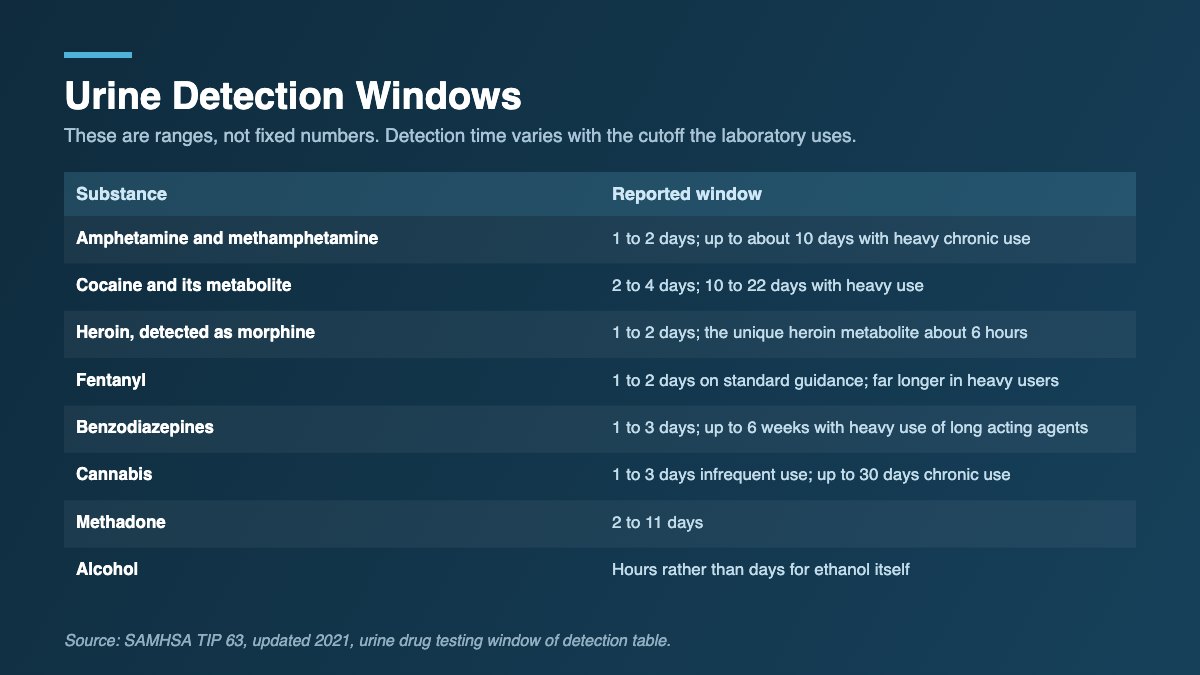
SAMHSA guidance gives the following urine detection windows. Amphetamine, methamphetamine and MDMA, 1 to 2 days. Cocaine and its metabolite benzoylecgonine, 2 to 4 days, extending to 10 to 22 days with heavy use. Heroin, detected as morphine or codeine, 1 to 2 days, with the metabolite unique to heroin present only about 6 hours. Morphine, 1 to 2 days. Fentanyl, 1 to 2 days. Benzodiazepines, 1 to 3 days, extending to as long as 6 weeks with heavy use of long acting agents. Cannabis, 1 to 3 days for infrequent use and up to 30 days for chronic use. Methadone, 2 to 11 days. Buprenorphine, 3 to 4 days. Oxycodone, 1 to 1.5 days. Barbiturates, up to 6 weeks.
A separate clinical reference gives upper bounds after heavy chronic use: amphetamines detectable for ten days, cannabinoids for three months, cocaine metabolites for three weeks and heroin metabolites for 11 days. In plasma, detection times are shorter, often one to two days.
Fentanyl is the number most often wrong
The 1 to 2 day figure reflects occasional or therapeutic exposure. In people who use fentanyl heavily it does not hold.
A 2020 study of 12 people with opioid use disorder entering residential treatment measured mean clearance of 7.3 days for fentanyl and 13.3 days for the metabolite norfentanyl. One participant tested positive for fentanyl at 19 days and norfentanyl at 26 days. Fentanyl is highly fat soluble and accumulates in muscle and adipose tissue, releasing slowly afterward, which is why it behaves nothing like its short half-life suggests.
Anyone told that fentanyl clears in two days, whether by a program, an employer or a court, is working from a figure that does not apply to chronic use.
Two assay problems worth knowing
Standard immunoassay screens do not test for what most people assume. The opiate screen specifically detects morphine, which means it does not reliably detect synthetic opioids such as fentanyl and methadone, or structurally dissimilar opioids including buprenorphine, oxycodone and hydrocodone.
So a negative opiate screen does not mean no opioid use. It means no morphine-like opioid at the cutoff used. Fentanyl in particular will screen negative on an opiate panel unless it is specifically tested for, which is a routine source of confusion in both clinical and legal settings.
Benzodiazepine screening has a parallel gap. It typically targets the metabolite oxazepam, and would be expected to return negative results for benzodiazepines not metabolized to oxazepam, including lorazepam, clonazepam and alprazolam. Most immunoassays have low sensitivity to clonazepam and lorazepam specifically.
False positives
Guidance lists medications that can produce false positives. For amphetamines: bupropion, chlorpromazine, desipramine, fluoxetine, labetalol, promethazine, ranitidine, pseudoephedrine and trazodone. For cannabis: efavirenz, ibuprofen and pantoprazole. Poppy seeds and poppy plant material can produce a positive morphine or codeine screen.
A positive screen is a screen. Confirmatory testing by a different method is what establishes a result, and anyone facing a consequence from a screening result is entitled to ask for confirmation.
Alcohol and the EtG question
Ethanol itself is detectable for hours rather than days, and federal guidance notes metabolism varies considerably by sex, age, physical condition, especially liver condition, and weight.
Ethyl glucuronide, or EtG, is a minor metabolite used to detect drinking over a longer window. Here we want to correct something. A figure of 80 hours circulates widely for the EtG window. We could not verify it against any authoritative source and are not publishing it.
What is documented is that EtG sensitivity depends entirely on the cutoff. In a study of 121 adults and 2,761 samples, a 100 nanogram per milliliter cutoff detected more than 76 percent of light drinking at 2 days and 66 percent at 5 days. A 500 nanogram cutoff, which many US commercial laboratories use because of concerns about incidental exposure from products like hand sanitizer, detected 68 percent of light drinking at 1 day, falling below 58 percent at 2 to 5 days. The practical window is roughly 1 to 5 days, shrinking sharply as the cutoff rises and as the amount consumed falls.
What changes the window
- The cutoff concentration the laboratory uses. This is the single biggest variable and it is set by the lab, not by the drug.
- Dose, frequency and chronicity. Heavy long term use extends windows substantially, most dramatically for cannabis, benzodiazepines and fentanyl.
- Metabolism and excretion rate, urine pH and fluid intake.
- Which assay was run. Screens miss whole categories of opioid and benzodiazepine.
- Body composition, which matters for fat soluble drugs. Research found overweight participants tested positive for fentanyl significantly longer.
- Liver function, age and sex, particularly for alcohol.
See our drug information library and pages on fentanyl, marijuana and benzodiazepines.
Sources
Substance Abuse and Mental Health Services Administration, Medications for Opioid Use Disorder, TIP 63, updated 2021, urine drug testing window of detection table, and Clinical Drug Testing in Primary Care, TAP 32, 2012. StatPearls, Clinical Drug Testing, 2023, and Drug Testing, 2025. Huhn AS and colleagues, Drug and Alcohol Dependence, 2020. Bird HE and colleagues, Journal of Addiction Medicine, 2023. McDonell MG and colleagues, Drug and Alcohol Dependence, 2015, on ethyl glucuronide cutoffs.
Need help now? In an emergency call 911. If you are in crisis or thinking about suicide, call or text 988 (Suicide and Crisis Lifeline; veterans press 1). For free, confidential treatment referrals 24 hours a day, call the SAMHSA National Helpline at 1-800-662-4357. You can also search licensed programs at FindTreatment.gov, or use our rehab directory and state listings.
Addiction Now publishes health journalism and reference material. This page is not medical advice, a diagnosis, or a treatment plan. Do not stop a prescribed medication without talking to a clinician. Withdrawal from alcohol, benzodiazepines and barbiturates can cause seizures and can be fatal without medical supervision.