
Edibles send more people to emergency departments than smoked cannabis does, and the reason is not that they are stronger by label. It is that the effects take up to two hours to arrive, and that the liver converts what you swallow into a different, more potent compound than the one you inhale.
The liver changes the drug
Inhaled THC passes from the lungs into the bloodstream and reaches the brain within seconds, largely unchanged.
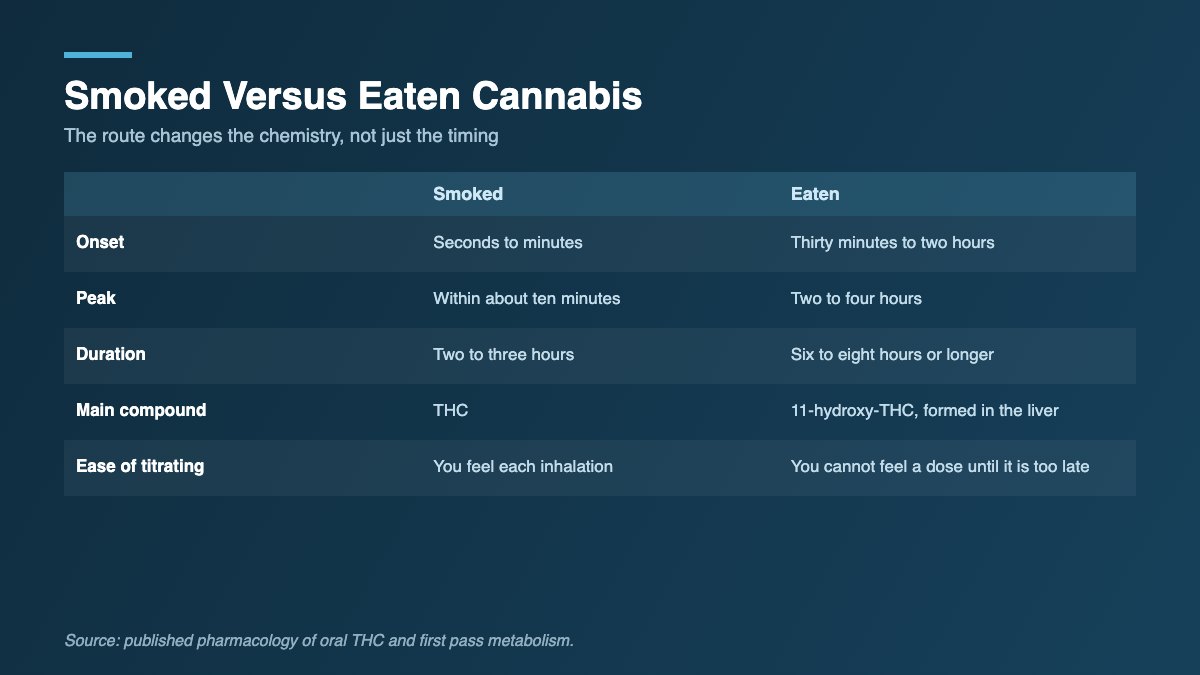
Swallowed THC takes a different route. It is absorbed through the gut and travels first to the liver, where a large proportion is converted into 11-hydroxy-THC. That metabolite crosses into the brain more readily than THC itself and produces a stronger and longer effect.
So an edible is not simply a slower version of a joint. It is a chemically different exposure, which is why people who are entirely comfortable smoking can find an edible overwhelming at what looks like a modest dose.

The gap that causes the problem
Onset ranges from about thirty minutes to two hours, depending on what else is in the stomach. The peak arrives two to four hours in. Effects can last six to eight hours, and residual impairment often continues well beyond that.
The failure mode is predictable and it happens constantly. Someone takes a dose, feels nothing after forty five minutes, concludes it was too little, and takes more. Both doses then arrive together, producing an experience several times more intense than intended, lasting most of a day.
With smoking, feedback is immediate and self limiting. With edibles the feedback arrives long after the decision, which removes the ability to titrate entirely.
What an overdose looks like
Cannabis overdose in an adult is not fatal, and that is worth saying plainly because the experience is frightening enough that people believe they are dying.
What it does produce is intense anxiety and panic, paranoia, a racing heart, chest tightness, disorientation, nausea and vomiting, and in some cases hallucinations or an acute psychotic state with loss of contact with reality. It is unpleasant enough to be a common reason for emergency attendance.
Management is largely supportive: a quiet space, someone present, fluids, and time. The main medical concerns are the cardiac effects in someone with existing heart disease, and injuries caused by disorientation. Anyone with chest pain, fainting or a rhythm that feels wrong should be assessed rather than talked down.
Children and edibles
Paediatric exposures have risen sharply wherever cannabis edibles have become widely available, and this is the most serious safety issue in the category.
The reason is straightforward: many products resemble sweets, chocolate or gummies, and a small child cannot distinguish them. A dose intended for an adult is a very large dose for a young child.
Children present with profound sedation, unsteadiness, slow breathing and sometimes seizures, and a significant proportion require intensive care. Symptoms can be severe enough to prompt investigation for other causes when nobody knows cannabis was involved. Edibles should be stored locked and out of reach, in their original labelled packaging, and anyone bringing a child in should say what was in the house.
Dosing that is harder than it looks
A standard serving is commonly five milligrams of THC, and a great deal of packaging contains several servings in what appears to be a single item: one chocolate bar divided into ten doses, one gummy that is two.
Product consistency also varies, and testing has repeatedly found labelled content differing from actual content, with the discrepancy larger in unregulated products. Concentrates and infused products at the high end reach doses far beyond what an inexperienced user should encounter.
Our marijuana page covers the wider effects of cannabis, including the hyperemesis and psychosis risks associated with heavy use.
Why tolerance from smoking does not transfer
Someone who smokes daily and assumes they can handle a large edible is making a reasonable inference from the wrong premise. Tolerance is partly to THC, and an edible delivers substantial amounts of a different compound the body has less practice with.
Regular smokers do land in emergency departments after edibles, and frequently report being caught out precisely because they expected to be fine. Treat an edible as a separate drug with its own dose ladder rather than as cannabis in another format.
Practical points
- Wait at least two hours before considering more. This single rule prevents most cases.
- Start at half a standard serving if you are new to edibles. Smoking tolerance does not transfer.
- Check how many servings are in the item. One package is rarely one dose.
- Store locked and away from children. The paediatric cases are the severe ones.
- Do not drive. Impairment lasts far longer than with smoking.
- An overwhelming experience is not fatal in an adult. Quiet, company and time are the treatment.
Sources
This article draws on published pharmacology of oral THC and first pass conversion to 11-hydroxy-THC, Centers for Disease Control and Prevention and poison control reporting on paediatric cannabis exposures, and clinical literature on acute cannabis toxicity. It is reference information, not medical advice.
Need help now? In an emergency call 911. If you are in crisis or thinking about suicide, call or text 988 (Suicide and Crisis Lifeline; veterans press 1). For free, confidential treatment referrals 24 hours a day, call the SAMHSA National Helpline at 1-800-662-4357. You can also search licensed programs at FindTreatment.gov, or use our rehab directory and state listings.
Addiction Now publishes health journalism and reference material. This page is not medical advice, a diagnosis, or a treatment plan. Do not stop a prescribed medication without talking to a clinician. Withdrawal from alcohol, benzodiazepines and barbiturates can cause seizures and can be fatal without medical supervision.