

Alcohol affects the heart earlier and more directly than it affects the liver, and the changes are easier to miss because they produce no symptoms until they are advanced. The reassuring part is that most of the damage improves substantially when drinking stops.
Blood pressure
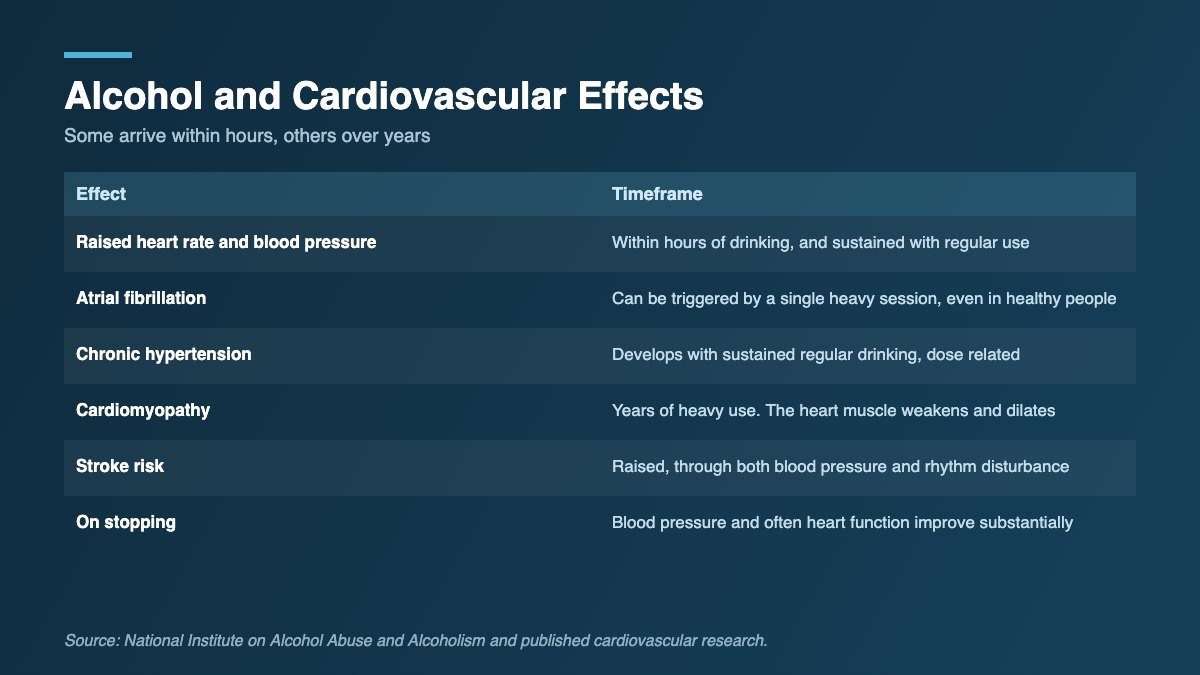
Alcohol raises blood pressure, and the effect is dose related. A drinking session raises it for hours afterwards. Regular drinking raises the baseline, producing sustained hypertension that persists between drinking occasions.
This matters because hypertension is largely symptomless while doing its damage, driving stroke, heart attack and kidney disease over years. It is also among the most reversible things on this list: blood pressure in people who reduce or stop drinking typically falls within weeks, often by a clinically meaningful amount.
Anyone being treated for high blood pressure who drinks regularly is worth checking on this point, because alcohol can be the reason medication is not achieving control.

Rhythm, and the pattern named after holidays
Alcohol can trigger atrial fibrillation, an irregular and often rapid heart rhythm. This can happen after a single heavy session in someone with an otherwise healthy heart, a pattern documented well enough to have acquired the informal name holiday heart syndrome, after its tendency to appear following festive drinking.
Episodes often resolve on their own within a day or so. That does not make them harmless. Atrial fibrillation allows blood to pool and clot in the heart, and those clots cause strokes. Repeated episodes also make the arrhythmia more likely to become persistent.
Palpitations, a racing or irregular heartbeat, breathlessness or dizziness after drinking should be assessed rather than waited out.
Cardiomyopathy
Sustained heavy drinking over years damages the heart muscle itself. The chambers dilate, the walls thin, and the heart’s ability to pump falls. This is alcoholic cardiomyopathy, and it presents as heart failure: breathlessness on exertion and then at rest, swollen legs and ankles, and fatigue.
It develops silently. By the time symptoms appear, the change is usually well established, which is why it is often diagnosed late.
The important and genuinely hopeful finding is that abstinence produces substantial recovery of heart function in many people, particularly where it is caught before the damage is severe. Continued drinking carries a poor outlook. Few clinical situations offer a clearer relationship between stopping and outcome.
What happened to the healthy glass of red wine
For years, observational studies suggested moderate drinkers had less heart disease than abstainers, producing the familiar advice about a daily glass being protective.
That finding has been substantially undermined. The main problem is that the abstainer group in many of those studies included people who had stopped drinking because they were already unwell, which made moderate drinkers look healthy by comparison. Studies designed to account for this, including genetic approaches that avoid the confounding entirely, have generally found no protective effect, and have found harm rising with intake from low levels.
Major health bodies have moved accordingly, and current guidance no longer recommends drinking for cardiovascular benefit. The honest summary is that less is better across the range, and that nobody should start drinking for their heart.
Withdrawal has its own cardiac load
Worth knowing for anyone stopping after heavy daily use. Alcohol withdrawal produces a surge in the stress response: elevated heart rate, raised blood pressure and increased cardiac strain.
In someone with existing heart disease this is a real risk, and it is one of the reasons medical supervision is recommended for heavy drinkers stopping rather than simply advised. Our alcohol page covers the withdrawal picture in more detail.
Combinations that raise the risk further
Cocaine and alcohol together deserve specific mention, because the liver combines them into cocaethylene, a compound that is more cardiotoxic than either substance alone and lingers longer. That combination is associated with a higher risk of cardiac events than cocaine on its own.
Stimulants generally add cardiac load to alcohol’s, and energy drinks taken to offset sedation contribute their own. Anyone who has had chest pain during a night involving both alcohol and a stimulant should treat that as a reason for assessment rather than something the next morning resolves.
Practical points
- If you are on blood pressure medication and drink regularly, raise it. Alcohol may be why it is not working.
- Palpitations after drinking deserve assessment. Do not wait for a second episode.
- Breathlessness on exertion in a heavy drinker is not just fitness.
- Do not drink for cardiovascular benefit. The evidence for it has not held up.
- Expect improvement on stopping. Blood pressure in weeks, heart function over months.
- Do not stop abruptly if you drink heavily daily. Withdrawal itself strains the heart.
Sources
This article draws on National Institute on Alcohol Abuse and Alcoholism material on alcohol and cardiovascular health, published cardiology literature on alcohol induced atrial fibrillation and alcoholic cardiomyopathy, and research using genetic methods to re-examine the claimed cardioprotective effect of moderate drinking. It is reference information, not medical advice.
Need help now? In an emergency call 911. If you are in crisis or thinking about suicide, call or text 988 (Suicide and Crisis Lifeline; veterans press 1). For free, confidential treatment referrals 24 hours a day, call the SAMHSA National Helpline at 1-800-662-4357. You can also search licensed programs at FindTreatment.gov, or use our rehab directory and state listings.
Addiction Now publishes health journalism and reference material. This page is not medical advice, a diagnosis, or a treatment plan. Do not stop a prescribed medication without talking to a clinician. Withdrawal from alcohol, benzodiazepines and barbiturates can cause seizures and can be fatal without medical supervision.