

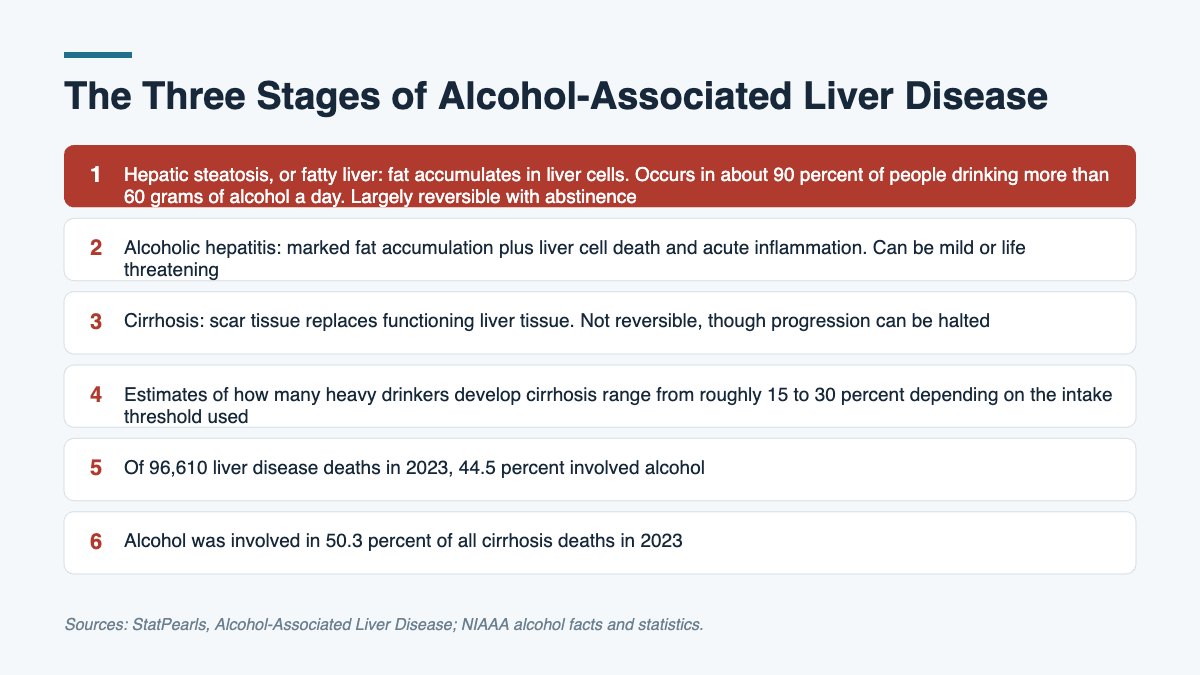
Alcohol-associated liver disease progresses through three stages, and the first one is largely reversible. Fatty liver occurs in roughly 90 percent of people drinking more than 60 grams of alcohol a day, which is about four to five standard drinks. Cirrhosis, the final stage, is not reversible. What separates those outcomes is often when someone stops.
Stage one: fatty liver
Hepatic steatosis means fat accumulating inside liver cells. Clinical references report it occurs in approximately 90 percent of patients drinking more than 60 grams per day.
Two things make this stage important. It is usually silent, producing no symptoms and often no abnormal liver enzymes, which is why it goes undetected for years. And it is largely reversible: the liver can clear the accumulated fat if drinking stops.
That combination is unfortunate. The stage most amenable to reversal is the stage least likely to prompt anyone to seek care.

Stage two: alcoholic hepatitis
This is marked fat accumulation combined with liver cell death and acute inflammation. Unlike fatty liver it is frequently symptomatic, and it spans a wide range of severity from mild to life threatening.
Severe alcoholic hepatitis can present suddenly, with jaundice, abdominal swelling and confusion, in someone who had no prior liver diagnosis. It is a medical emergency and carries substantial short term mortality.
Stage three: cirrhosis
Cirrhosis is the replacement of functioning liver tissue with scar tissue. It is not reversible, though progression can be slowed or halted and complications can be managed.
How many heavy drinkers reach it is genuinely disputed, and we want to be straight about that. One clinical reference reports cirrhosis in about 30 percent of people with long standing consumption above 40 grams a day. A separate review hosted by the National Institutes of Health states that only 15 to 20 percent of heavy drinkers will develop cirrhosis.
Those figures use different intake thresholds and different follow up periods, which is why they diverge. The honest summary is that a minority of heavy drinkers develop cirrhosis, with estimates ranging roughly 15 to 30 percent depending on how the question is framed. Anyone presenting either number as the definitive answer is overstating what is known.
What that range also means is that heavy drinking does not guarantee cirrhosis, and that genetics, sex, nutrition, obesity and viral hepatitis co-infection all influence individual risk.
The mortality figures
Of 96,610 liver disease deaths among people aged 12 and over in 2023, 44.5 percent, or 43,004, involved alcohol. That breaks down as 27,684 men and 15,319 women.
The alcohol related cirrhosis death rate in 2023 was 8.5 per 100,000, down 7.8 percent from 9.3 in 2022. Alcohol was involved in 50.3 percent of all cirrhosis deaths, 28,632 of them.
For wider context, 47,938 Americans died from alcohol induced causes in 2023, at an age adjusted rate of 12.6 per 100,000, down 7 percent from the prior year. Liver disease is the largest single component of that total.
Why withdrawal complicates stopping
There is a trap here worth naming. The people whose livers most need them to stop drinking are frequently the people for whom stopping abruptly is most dangerous.
Alcohol withdrawal can cause seizures and delirium, and roughly 3 to 5 percent of cases progress to alcohol withdrawal delirium, which can be fatal. Repeated withdrawal episodes lower the seizure threshold, meaning each attempt to stop unsupervised carries more risk than the last.
So the advice that follows from a liver diagnosis is not simply to stop drinking. It is to stop drinking with medical supervision. Those are different instructions and conflating them puts people in danger.
See our alcohol reference page and drug information library.
Takeaways
- Fatty liver occurs in about 90 percent of people drinking more than 60 grams a day and is largely reversible.
- It is usually silent, which is why the reversible stage so often goes undetected.
- Alcoholic hepatitis involves cell death and inflammation and can be life threatening.
- Cirrhosis is not reversible. Estimates of how many heavy drinkers reach it range from roughly 15 to 30 percent.
- Alcohol was involved in 44.5 percent of liver disease deaths and 50.3 percent of cirrhosis deaths in 2023.
- Do not stop heavy daily drinking abruptly without medical supervision. Withdrawal can cause seizures and can be fatal.
Sources
StatPearls, Alcohol-Associated Liver Disease, National Center for Biotechnology Information Bookshelf. National Institutes of Health hosted review on alcohol-associated liver disease. National Institute on Alcohol Abuse and Alcoholism, alcohol related emergencies and deaths in the United States, alcohol facts and statistics. StatPearls, Alcohol Withdrawal Syndrome, 2024.
Need help now? In an emergency call 911. If you are in crisis or thinking about suicide, call or text 988 (Suicide and Crisis Lifeline; veterans press 1). For free, confidential treatment referrals 24 hours a day, call the SAMHSA National Helpline at 1-800-662-4357. You can also search licensed programs at FindTreatment.gov, or use our rehab directory and state listings.
Addiction Now publishes health journalism and reference material. This page is not medical advice, a diagnosis, or a treatment plan. Do not stop a prescribed medication without talking to a clinician. Withdrawal from alcohol, benzodiazepines and barbiturates can cause seizures and can be fatal without medical supervision.