
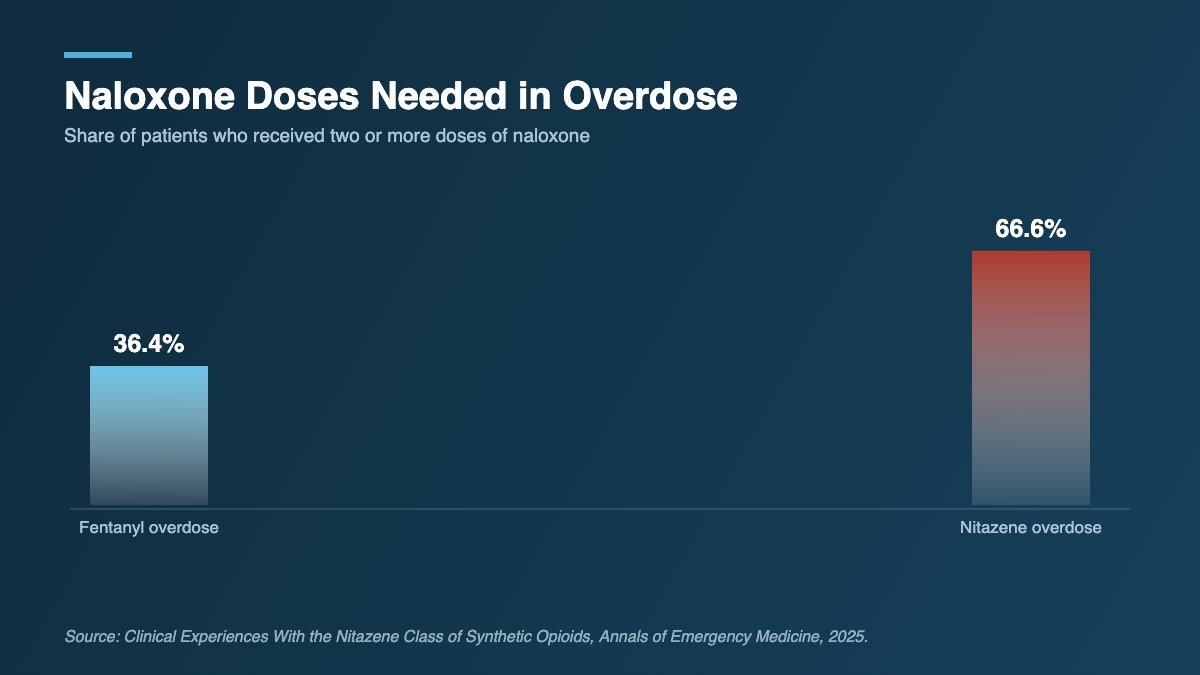
Nitazenes are synthetic opioids developed in the 1950s, never approved for medical use anywhere, and now appearing in the illicit supply of at least twenty countries. The clinically important finding is not their potency, which is widely misreported, but their response to naloxone: 66.6 percent of nitazene overdose patients needed two or more doses, against 36.4 percent for fentanyl.
What they are
Nitazenes are derived from 2-benzylbenzimidazole. They were first developed in the 1950s for pharmaceutical research and were never approved for medical use in the United States or any other country. They emerged on the recreational drug market beginning in 2019.
They are not a single drug but a family of analogs, with names including isotonitazene, metonitazene, protonitazene and etonitazene. Each has different properties, which is part of why generalizations about them go wrong.
Why we are not giving you a potency multiplier
The figures in circulation for nitazene potency relative to fentanyl are wildly inconsistent. We found claims of 50 times fentanyl, 5 to 9 times fentanyl, up to 40 times fentanyl, up to 500 times morphine, and 6 times and 125 times fentanyl for specific analogs. These cannot all be right.

A 2025 systematic review of 35 articles reported that metonitazene and isotonitazene exceed fentanyl potency by approximately 6 fold and 125 fold respectively in laboratory receptor assays. The same review then added the caveat that matters most: potency in human outcome studies is far lower than in the in vitro studies, and postmortem concentrations of many nitazenes are similar to postmortem concentrations of fentanyl, indicating a similar real world potency.
So the defensible statement is this. Some nitazene analogs are substantially more potent than fentanyl in laboratory assays, while human postmortem data suggests real world potency closer to fentanyl’s. The DEA’s own framing is that nitazenes can match or surpass the potency of fentanyl. Anyone publishing a single multiplier is choosing a number from a contradictory set.
The naloxone finding
This is the part with immediate practical value. A 2025 study in Annals of Emergency Medicine found that 66.6 percent of patients who overdosed on nitazenes received two or more doses of naloxone, compared with 36.4 percent of patients who overdosed on fentanyl.
The proposed mechanism is receptor kinetics. Slow dissociation from the mu opioid receptor correlates with reduced sensitivity to naloxone reversal, meaning the drug clings to the receptor and naloxone has a harder time displacing it.
The takeaway for anyone carrying naloxone is straightforward and does not require knowing what a nitazene is: one dose may not be enough, more than one device should be available, and 911 should be called regardless. That guidance was already sound for fentanyl. It matters more now.
One duration detail from the review: isotonitazene’s sedative effect lasted about 120 minutes against about 30 minutes for morphine, which means the window in which breathing can fail again after naloxone wears off is longer.
Where they have been detected
US surveillance is limited. CDC’s only dedicated report identified 52 nitazene involved fatal drug overdoses in Tennessee between 2019 and 2021: none in 2019, 10 in 2020 and 42 in 2021. That is single state surveillance data covering Tennessee only, and it should not be presented as a national figure or compared with national death certificate totals.
In that report CDC noted that the potency of certain analogs including isotonitazene, protonitazene and etonitazene greatly exceeds that of fentanyl, while metonitazene is similar to fentanyl. Again, the analogs differ.
Internationally the spread is better documented. Since 2019 at least 21 European countries have reported nitazenes to the European Union early warning system, and 16 distinct nitazenes have been identified in Europe. Of 88 new opioids identified on the European market since 2009, all seven substances notified in 2024 were nitazenes. Death and toxicity clusters have been reported in France in 2023 and Germany in 2024.
We should note that a widely repeated figure of 26 nitazene substances identified in 30 countries appears attributed to international drug monitoring bodies, and we were not able to confirm it against a primary source. Treat it as unverified.
Regulatory status
Isotonitazene was temporarily placed in Schedule I in 2020 and permanently scheduled in 2021. On August 15, 2025 the DEA published a temporary emergency scheduling order placing additional benzimidazole opioids in Schedule I on the basis of imminent hazard to public safety. Three nitazenes, isotonitazene, metonitazene and protonitazene, are also under international control.
See our fentanyl reference page, heroin page and drug information library.
Takeaways
- Nitazenes are 1950s synthetic opioids never approved for medical use, appearing in the illicit supply since 2019.
- Potency figures in circulation contradict each other. Laboratory assays and human postmortem data give very different answers.
- 66.6 percent of nitazene overdose patients needed two or more naloxone doses, against 36.4 percent for fentanyl.
- Carry more than one naloxone device, expect to need repeat dosing, and call 911 regardless.
- US surveillance is thin. The main CDC report covers Tennessee only, 2019 to 2021.
- All seven new opioids notified on the European market in 2024 were nitazenes.
Sources
Drug Enforcement Administration Diversion Control Division, nitazenes and benzimidazole opioids reference material. Nitazenes: review of comparative pharmacology and antagonist action, Clinical Toxicology, 2025. Clinical Experiences With the Nitazene Class of Synthetic Opioids, Annals of Emergency Medicine, 2025. Centers for Disease Control and Prevention, Notes from the Field: Nitazene-Related Deaths, Tennessee, 2019 to 2021, Morbidity and Mortality Weekly Report, 2022. European Union Drugs Agency, European Drug Report 2025. Federal Register, temporary scheduling order, August 2025.
Need help now? In an emergency call 911. If you are in crisis or thinking about suicide, call or text 988 (Suicide and Crisis Lifeline; veterans press 1). For free, confidential treatment referrals 24 hours a day, call the SAMHSA National Helpline at 1-800-662-4357. You can also search licensed programs at FindTreatment.gov, or use our rehab directory and state listings.
Addiction Now publishes health journalism and reference material. This page is not medical advice, a diagnosis, or a treatment plan. Do not stop a prescribed medication without talking to a clinician. Withdrawal from alcohol, benzodiazepines and barbiturates can cause seizures and can be fatal without medical supervision.