


Fentanyl is roughly 100 times more potent than morphine, and a dose of about 100 micrograms produces analgesia equivalent to 10 milligrams of morphine. Potency alone is not what makes it lethal, though. Speed of onset, a non-opioid rigidity effect and the unpredictability of street supply all compound it.
The potency numbers, stated carefully
The Drug Enforcement Administration describes fentanyl as approximately 100 times more potent than morphine and 50 times more potent than heroin as an analgesic. The National Institute on Drug Abuse gives a range of 50 to 100 times more potent than morphine.
The cleanest way to express it comes from clinical pharmacology rather than comparison ratios: 100 micrograms of fentanyl produces roughly the same analgesia as 10 milligrams of morphine. That is a hundredfold difference in the amount of substance required, which is why fentanyl is dosed in micrograms in medical settings and why small errors in illicit products matter so much.
NIDA, citing DEA material, notes that as little as 2 milligrams can be fatal, an amount comparable to a few grains of salt. Tolerance changes that figure enormously, so it should be read as an illustration of scale rather than a universal threshold.

Why breathing stops
All opioids suppress breathing through the same route. Mu opioid receptors in the brainstem, specifically in the region that generates the breathing rhythm, mediate opioid respiratory depression. Research has found this effect concentrated in a remarkably small population of neurons.
What distinguishes fentanyl is how fast it gets there. It is highly fat soluble, which allows rapid passage across the blood brain barrier. NIDA notes its effects can start more quickly than those of morphine or heroin. In practical terms that shortens the interval between use and respiratory arrest, and therefore the interval in which someone can notice and respond.
Chest wall rigidity
There is a second mechanism, less widely known, sometimes called wooden chest syndrome. It involves rigidity of the intercostal muscles, the diaphragm and the vocal cords, which can prevent effective breathing independently of the sedation.
Research has proposed that this operates through a non-opioid pathway, involving enhanced noradrenergic release acting at alpha-1 adrenergic receptors following mu receptor activation. That distinction matters because a non-opioid mechanism is not something naloxone reverses, and researchers have raised it as one explanation for cases where naloxone appears to fail.
We want to be precise about the limits of this evidence. The literature consists of case reports and anesthesia series, and we could not find any reliable incidence figure for how often chest wall rigidity occurs in illicit fentanyl overdose. Anyone quoting a percentage is going beyond what has been established. Clinical references do confirm that in cases of severe muscular rigidity an intravenous neuromuscular blocker may be used, which is a hospital intervention.
None of this is an argument against giving naloxone. It remains the correct first action, and multiple doses may be needed.
Where the death toll stands
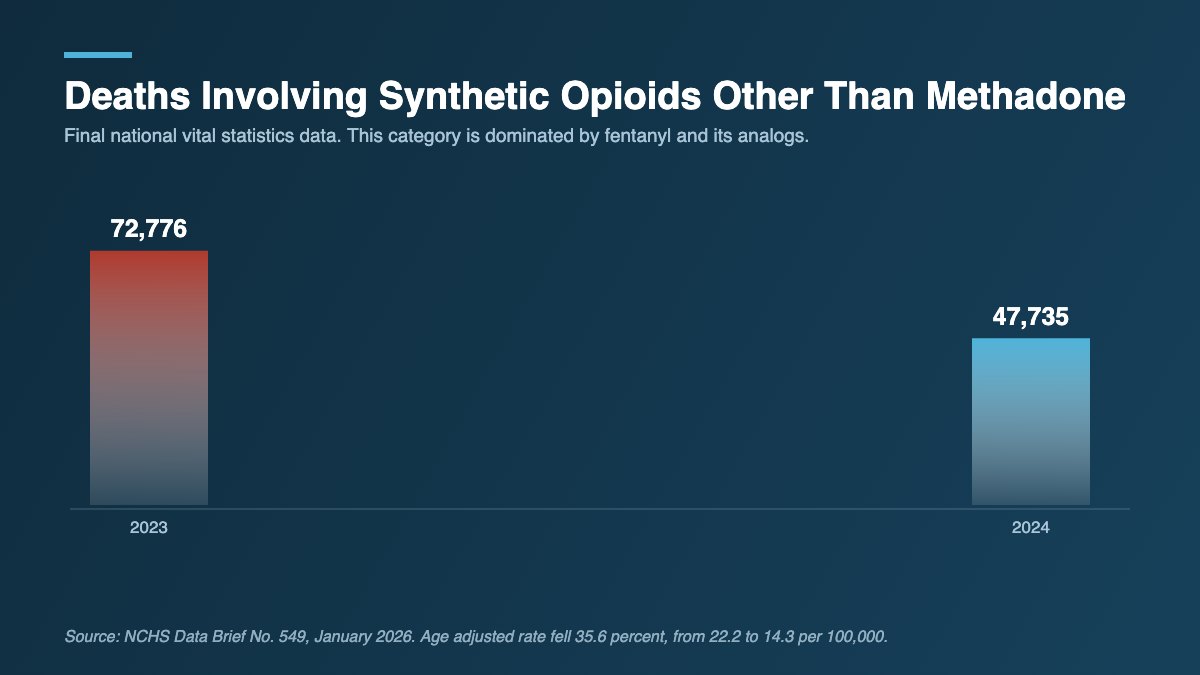
Final national data show 47,735 deaths involving synthetic opioids other than methadone in 2024, a category dominated by fentanyl and its analogs, at an age adjusted rate of 14.3 per 100,000. That is down 35.6 percent from 2023, when there were 72,776 such deaths at a rate of 22.2.
Total drug overdose deaths fell from 105,007 in 2023 to 79,384 in 2024, a 26.2 percent decline in the age adjusted rate. Ninety six percent of 2024 overdose deaths specified which drugs were involved.
Provisional estimates for 2025 put total overdose deaths at about 69,973, down roughly 14 percent from an estimated 81,313 for 2024, with opioid involved deaths falling from about 55,296 to about 44,564. These are provisional counts, incomplete by design, and will revise as data completes.
The decline is real and substantial. It is also not evenly distributed, and 47,735 deaths in a single year remains an extraordinary figure.
Why street fentanyl is unpredictable
Illicitly manufactured fentanyl is not distributed evenly through a batch. Two pills pressed from the same material can contain very different amounts, which is the practical reason dose control is impossible outside a pharmaceutical setting.
It also increasingly arrives alongside other substances, notably xylazine, which naloxone does not reverse. And fentanyl behaves unusually in the body over time: because it accumulates in fat and muscle tissue, it clears far more slowly in heavy users than its short half-life suggests, which affects both drug testing and the timing of starting buprenorphine.
See our fentanyl reference page, heroin page and drug information library.
Takeaways
- About 100 micrograms of fentanyl equals roughly 10 milligrams of morphine in analgesic effect.
- Its fat solubility means rapid brain entry and faster onset than morphine or heroin, shortening the window to respond.
- Chest wall rigidity is documented but its frequency in street overdose is unknown. Do not trust a quoted percentage.
- Deaths involving synthetic opioids fell from 72,776 in 2023 to 47,735 in 2024, a 35.6 percent drop in the rate.
- Provisional 2025 figures show a third consecutive annual decline, but remain provisional.
- Naloxone is still the right first response, more than one dose may be needed, and call 911 either way.
Sources
Drug Enforcement Administration, Drug Fact Sheet: Fentanyl. National Institute on Drug Abuse, Fentanyl research topic page, 2025. StatPearls, Fentanyl, 2023. Bachmutsky I and colleagues, eLife, 2020, on brainstem sites mediating opioid respiratory depression. Torralva R and Janowsky A, Journal of Pharmacology and Experimental Therapeutics, 2019, and Torralva R and colleagues, Journal of Clinical Pharmacy and Therapeutics, 2021, on chest wall rigidity. National Center for Health Statistics, Data Brief No. 549, January 2026, and NCHS provisional overdose release, May 2026.
Need help now? In an emergency call 911. If you are in crisis or thinking about suicide, call or text 988 (Suicide and Crisis Lifeline; veterans press 1). For free, confidential treatment referrals 24 hours a day, call the SAMHSA National Helpline at 1-800-662-4357. You can also search licensed programs at FindTreatment.gov, or use our rehab directory and state listings.
Addiction Now publishes health journalism and reference material. This page is not medical advice, a diagnosis, or a treatment plan. Do not stop a prescribed medication without talking to a clinician. Withdrawal from alcohol, benzodiazepines and barbiturates can cause seizures and can be fatal without medical supervision.