


In January 2025 the US Surgeon General issued an advisory identifying alcohol as the third leading preventable cause of cancer in the United States and calling for cancer risk to be added to the alcohol warning label. Eighteen months later the label is unchanged, and the federal dietary guidelines have moved in the opposite direction from what the advisory recommended.
What the advisory said
Published on 3 January 2025, the advisory identified a causal link between alcohol and at least seven cancers: breast in women, colorectum, esophagus, liver, mouth, pharynx and larynx. CDC’s current guidance lists the same seven, and notes evidence of elevated stomach and pancreatic cancer risk at three or more drinks a day and a possible association with prostate cancer.
The advisory estimated roughly 100,000 alcohol-linked cancer cases and about 20,000 alcohol-linked cancer deaths in the United States each year, and pointed out that the death figure exceeds the roughly 13,500 annual alcohol-related traffic deaths.
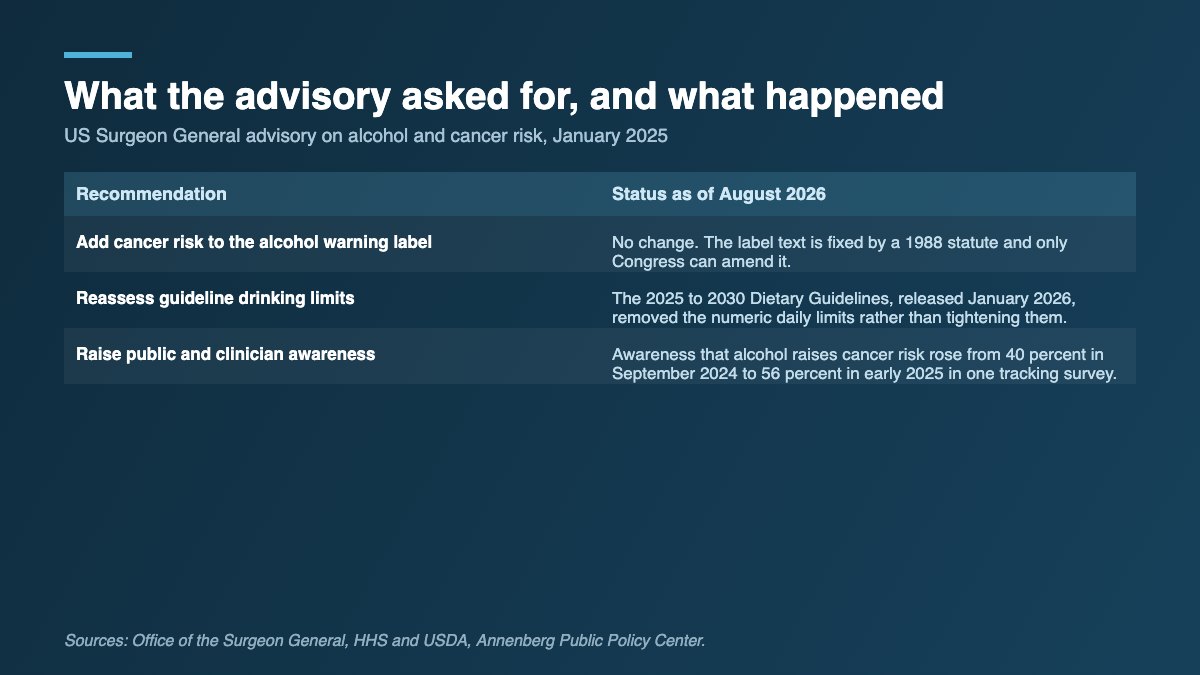
It made three recommendations: update the warning label to include cancer risk, reassess the guideline drinking limits in light of the cancer evidence, and increase public and clinician awareness.

A note on the numbers, because they get mixed up
CDC separately reports that more than 538,000 alcohol-associated cancers occurred in the United States in 2022. That figure counts cancers of the types associated with alcohol, not cancers estimated to have been caused by alcohol, and CDC says so explicitly. It is a much larger number measuring a different thing, and the two are routinely conflated in coverage.
A separate academic analysis estimated that alcohol-attributable cancer deaths roughly doubled between 1990 and 2021, reaching more than 23,000 a year. That is a different estimate from a different method than the advisory’s 20,000, not an update to it.
Why the label did not change
This is the part most coverage skipped, and it is a straightforward legal constraint rather than a political stalemate.
The text of the health warning on alcohol containers is set by the Alcoholic Beverage Labeling Act of 1988. The Alcohol and Tobacco Tax and Trade Bureau, which regulates alcohol labeling, cannot add cancer language on its own initiative. Amending the warning requires an act of Congress. The bureau can notify Congress if it believes the science warrants a change, and it has not done so.
A citizen petition asking for cancer warning language, filed in 2020 by eight public health and consumer organizations, remains pending. As of the end of July 2026 no rulemaking on that question had been opened. A separate set of proposed rules the bureau published in January 2025 concerns nutrient and allergen labeling and stems from a much older petition; it is not a cancer warning proposal, though it is sometimes reported as if it were.
The guidelines went the other way
The advisory’s second recommendation was to reassess the guideline drinking limits, which had stood at one drink a day for women and two for men.
The 2025 to 2030 Dietary Guidelines for Americans, released on 7 January 2026, removed the numeric daily limits altogether and replaced them with non-specific guidance to consume less alcohol for better overall health, recommending full avoidance only for people who are pregnant, in recovery, or taking interacting medications.
Whether that is a loosening or simply a different framing is contested. The American Association for the Study of Liver Diseases publicly objected that the change is weaker than the evidence in the Surgeon General’s own report supports, and authors writing in a hepatology journal made a similar argument. Supporters of the change note that numeric limits were never well supported as a bright line and can imply safety below the threshold.
Awareness did move
The third recommendation is the one with measurable progress. Tracking surveys by the Annenberg Public Policy Center found 40 percent of adults said alcohol increases cancer risk in September 2024, rising to 56 percent in a survey fielded shortly after the advisory in early 2025.
Other surveys put baseline awareness lower and vary by beverage: 2023 analysis found 32 percent aware for liquor, 25 percent for beer and 20 percent for wine. The figures differ enough by year and method that a single number should be treated with caution, but the direction after January 2025 was upward.
What to take from this
- The advisory identified a causal link between alcohol and seven cancers, and estimated about 20,000 alcohol-linked cancer deaths a year.
- A Surgeon General advisory is not binding. It carries no regulatory force.
- The warning label cannot be changed by the regulator. Only Congress can amend it, and it has not.
- No state or federal cancer-specific alcohol warning has been enacted anywhere in the United States.
- The 2025 to 2030 Dietary Guidelines removed numeric drink limits in January 2026, which several medical societies criticized.
- Public awareness of the link rose after the advisory, from 40 percent to 56 percent in one survey.
- Be careful with the 538,000 figure. It counts alcohol-associated cancer types, not cancers caused by alcohol.
For more on alcohol specifically, see our drug information library and the page on alcohol.
Sources
This article relies on the January 2025 Surgeon General advisory on alcohol and cancer risk, CDC guidance on alcohol and cancer, the Alcoholic Beverage Labeling Act and Tax and Trade Bureau rulemaking record, the 2025 to 2030 Dietary Guidelines for Americans published by HHS and USDA, a statement from the American Association for the Study of Liver Diseases, and awareness surveys from the Annenberg Public Policy Center.
Need help now? In an emergency call 911. If you are in crisis or thinking about suicide, call or text 988 (Suicide and Crisis Lifeline; veterans press 1). For free, confidential treatment referrals 24 hours a day, call the SAMHSA National Helpline at 1-800-662-4357. You can also search licensed programs at FindTreatment.gov, or use our rehab directory and state listings.
Addiction Now publishes health journalism and reference material. This page is not medical advice, a diagnosis, or a treatment plan. Do not stop a prescribed medication without talking to a clinician. Withdrawal from alcohol, benzodiazepines and barbiturates can cause seizures and can be fatal without medical supervision.