
A stimulant was involved in 59 percent of US overdose deaths recorded between January 2021 and June 2024, and 73 percent of those deaths also involved an opioid. That combination accounted for roughly 45 percent of all overdose deaths in the period. The overdose crisis is now, in the majority of cases, a polysubstance one.
What the surveillance data shows
The figures come from the State Unintentional Drug Overdose Reporting System, a CDC surveillance program that collects detailed toxicology and death scene information rather than relying on death certificates alone. Researchers led by Lauren Tanz analyzed 309,274 deaths across 49 states and the District of Columbia and published the results in the Morbidity and Mortality Weekly Report in August 2025. North Dakota is not funded for the system and is not included.
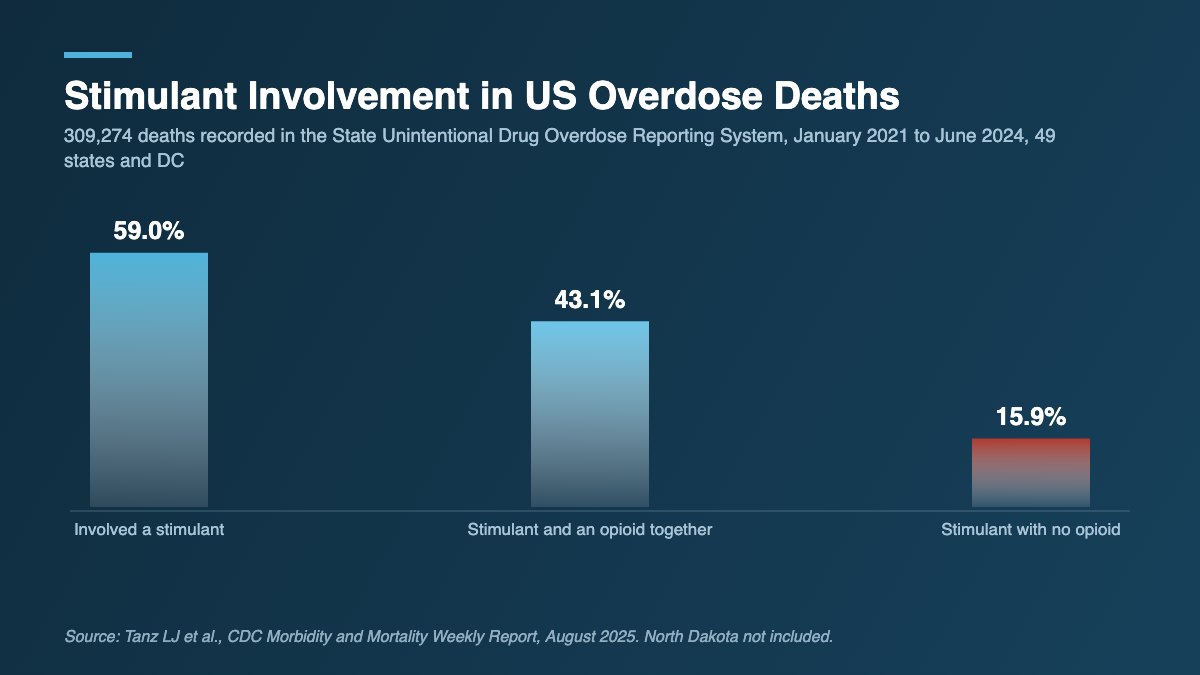
Of those deaths, 59.0 percent involved a stimulant. Methamphetamine appeared in 31.2 percent, cocaine in 30.0 percent, and both in 3.8 percent. When the two categories are combined with opioid involvement, 43.1 percent of all deaths involved a stimulant and an opioid together, while 15.9 percent involved a stimulant with no opioid detected.
Put another way: stimulants are now present in a majority of overdose deaths, but in most of those cases they are not acting alone. The dominant pattern is a stimulant plus illicitly manufactured fentanyl.

The stimulant only deaths are a different clinical problem
About 50,000 deaths in the study period, roughly 15 percent, involved stimulants with no opioid detected. Nearly 40 percent of that group had a documented history of cardiovascular disease, against roughly 10 percent of all US adults. Deaths in this category are not overdoses in the respiratory depression sense that naloxone addresses. They reflect cardiac and cerebrovascular events, hyperthermia and seizures.
That distinction matters for what a response looks like. Naloxone reverses opioid overdose and has no effect on a stimulant only event. For the 43 percent of deaths involving both, naloxone remains directly relevant, because the opioid is usually what stops breathing. A public health message built only around naloxone covers most but not all of the picture.
The trend by drug and by group
Looking at final national vital statistics rather than the surveillance subset, cocaine involved overdose deaths rose from 4,681 in 2011 to 29,449 in 2023. Deaths involving psychostimulants with abuse potential, primarily methamphetamine, rose from 2,266 to 34,855 over the same span. Age adjusted rates between 2018 and 2023 went from 4.5 to 8.6 per 100,000 for cocaine and from 3.9 to 10.4 for psychostimulants.
Two groups moved furthest. The psychostimulant involved death rate among American Indian and Alaska Native people rose from 11.0 to 32.9 per 100,000 between 2018 and 2023, the largest increase of any group. The cocaine involved rate among Black people rose from 9.1 to 24.3. In both cases the researchers attributed the increase largely to opioid co involvement rather than to a change in stimulant use alone.
Then the direction changed. Final data show psychostimulant involved deaths falling to 28,722 in 2024, an age adjusted decline of 19.8 percent, and cocaine involved deaths falling to 21,945, down 26.7 percent. Total overdose deaths fell from 105,007 in 2023 to 79,384 in 2024, the largest single year drop recorded in the decade through 2024. CDC provisional estimates put 2025 at about 69,973 deaths, down almost 14 percent from a provisional 81,313 for 2024. Provisional counts are subject to revision.
What the numbers do not explain
Surveillance data records what was present in the body, not what the person intended to take. It cannot distinguish someone who used both drugs deliberately from someone who bought a stimulant that contained fentanyl without knowing. Both patterns exist, and the data does not separate them.
Nor does co involvement establish sequence or cause of death in any individual case. The category is built from toxicology findings, and a substance being detected is not the same as that substance being what killed the person. Read at the population level, though, the pattern is stable across years and jurisdictions. For background on the individual substances, see our pages on methamphetamine, cocaine and fentanyl.
Takeaways
- Stimulants were involved in 59.0 percent of overdose deaths recorded from January 2021 through June 2024 in 49 states and DC.
- Of stimulant involved deaths, 73.0 percent also involved an opioid, amounting to about 45 percent of all overdose deaths.
- Roughly 15 percent of deaths involved a stimulant with no opioid; nearly 40 percent of that group had cardiovascular disease history.
- Naloxone addresses the opioid component and has no effect on a stimulant only event, which is why both messages are needed.
- Psychostimulant and cocaine involved deaths both fell in 2024 after years of increase, alongside a 26.2 percent drop in the overall age adjusted overdose rate.
- There is no medication approved for stimulant use disorder, which makes the treatment response different from opioid use disorder.
Sources
Tanz LJ and colleagues, Centers for Disease Control and Prevention, Morbidity and Mortality Weekly Report, August 2025, using the State Unintentional Drug Overdose Reporting System. National Center for Health Statistics, Data Brief No. 549, Drug Overdose Deaths in the United States, 2023 to 2024, January 2026. CDC National Center for Health Statistics provisional overdose estimates released May 2026. National Institute on Drug Abuse overdose death statistics drawn from CDC WONDER.
Need help now? In an emergency call 911. If you are in crisis or thinking about suicide, call or text 988 (Suicide and Crisis Lifeline; veterans press 1). For free, confidential treatment referrals 24 hours a day, call the SAMHSA National Helpline at 1-800-662-4357. You can also search licensed programs at FindTreatment.gov, or use our rehab directory and state listings.
Addiction Now publishes health journalism and reference material. This page is not medical advice, a diagnosis, or a treatment plan. Do not stop a prescribed medication without talking to a clinician. Withdrawal from alcohol, benzodiazepines and barbiturates can cause seizures and can be fatal without medical supervision.