

As of June 1, 2026, the federal government stopped letting the public search for individual buprenorphine prescribers on FindTreatment.gov. The tool was retired because the system behind it, built to track a waiver that no longer exists, had become obsolete. The change is administrative. Its effect on people trying to find care is not.
What was removed, and why
The Substance Abuse and Mental Health Services Administration decommissioned the Behavioral Waiver Notification System, the database that tracked which clinicians held a federal waiver to prescribe buprenorphine. Because the public prescriber search on FindTreatment.gov was built on that database, the search went with it.
The underlying logic is sound. The waiver the system tracked was abolished more than three years ago, so the list it produced had been steadily drifting away from reality ever since.
The waiver that no longer exists
For two decades, prescribing buprenorphine for opioid use disorder required a special federal authorization known as the DATA waiver, or more commonly the X waiver. Clinicians had to apply for it, complete additional training, and accept caps on how many patients they could treat: 30 in the first year, 100 after that.

The Consolidated Appropriations Act of 2023, signed on December 29, 2022, eliminated the requirement. Since then, any clinician with a standard Drug Enforcement Administration registration has been able to prescribe buprenorphine, and the patient caps are gone entirely. A separate provision took effect on June 21, 2023, requiring most DEA registrants to complete a one time eight hour training on treating substance use disorders.
The policy intent was to move treatment for opioid use disorder out of a specialty silo and into ordinary medical practice, where the number of potential prescribers is measured in the hundreds of thousands rather than the tens of thousands.
Why removing the list is a real loss anyway
Here is the tension. Expanding eligibility to every DEA registrant made the old list obsolete, but it did not produce a new one. Being permitted to prescribe and choosing to prescribe are different things, and there is no federal registry of clinicians who actually do.
For a person who has decided today that they want treatment, that gap is not abstract. The old list was incomplete and often out of date, but it returned names. What replaces it is a facility level search and a set of phone calls, which asks considerably more of someone at the hardest possible moment to be asking anything.
What the evidence says about access
Removing the waiver expanded the pool of eligible prescribers dramatically. Researchers who have examined the change have consistently found that eligibility alone has not translated into a proportionate increase in prescribing, and have pointed to the other barriers that the waiver repeal left untouched: pharmacy stocking and dispensing limits, prior authorization requirements, clinician discomfort with the population, and the simple fact that many practices do not want to take this on.
That is the more important finding. The waiver was one barrier among several, and it happened to be the one Congress could remove with a line in an appropriations bill.
How to find a prescriber now
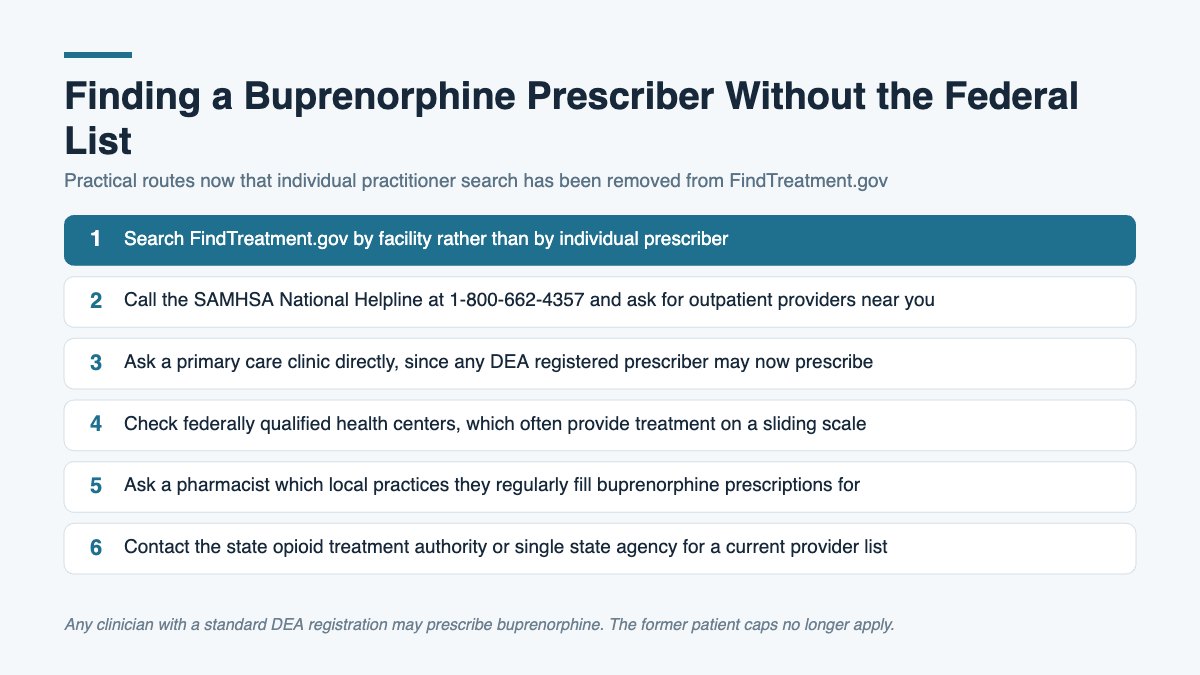
- FindTreatment.gov still works for facilities. It is the individual practitioner search that has been retired.
- The SAMHSA National Helpline is staffed 24 hours a day and can give referrals by location.
- Ask a primary care clinic directly. Many now prescribe, and many patients never think to ask.
- Federally qualified health centers frequently offer treatment on a sliding scale regardless of coverage.
- Pharmacists often know which local practices prescribe, because they fill the prescriptions.
- State opioid treatment authorities maintain provider lists that are usually more current than any federal source.
Our drug information library covers what to expect from medication treatment, including the difference between buprenorphine and full opioid agonists.
The barriers the repeal did not touch
Anyone helping a person find treatment should know where the remaining friction sits, because it is rarely at the point of the prescription itself.
Pharmacy supply is the most common surprise. A valid prescription is not much use if the pharmacy does not stock buprenorphine, and stocking decisions are influenced by wholesaler thresholds and by the scrutiny pharmacies face over controlled substance volumes. Calling ahead to confirm the pharmacy has it, before leaving the clinic, saves a great deal of trouble.
Insurance is the second. Some plans still require prior authorization for particular formulations, or prefer one product over another, and those requirements apply regardless of who wrote the prescription. Asking the prescriber to check the plan formulary at the visit avoids a rejected claim at the counter.
The third is less visible and harder to fix. Treating opioid use disorder requires a clinician willing to take it on, and eligibility does not create willingness. That is why a warm referral from a clinic that already prescribes tends to work better than cold calling a practice that may never have done it.
Sources
This report draws on Substance Abuse and Mental Health Services Administration notices regarding the Behavioral Waiver Notification System decommission and the MAT Act, the text of the Consolidated Appropriations Act of 2023, Drug Enforcement Administration registration and training guidance, and the Providers Clinical Support System summary of the DATA waiver removal.
Need help now? In an emergency call 911. If you are in crisis or thinking about suicide, call or text 988 (Suicide and Crisis Lifeline; veterans press 1). For free, confidential treatment referrals 24 hours a day, call the SAMHSA National Helpline at 1-800-662-4357. You can also search licensed programs at FindTreatment.gov, or use our rehab directory and state listings.
Addiction Now publishes health journalism and reference material. This page is not medical advice, a diagnosis, or a treatment plan. Do not stop a prescribed medication without talking to a clinician. Withdrawal from alcohol, benzodiazepines and barbiturates can cause seizures and can be fatal without medical supervision.