


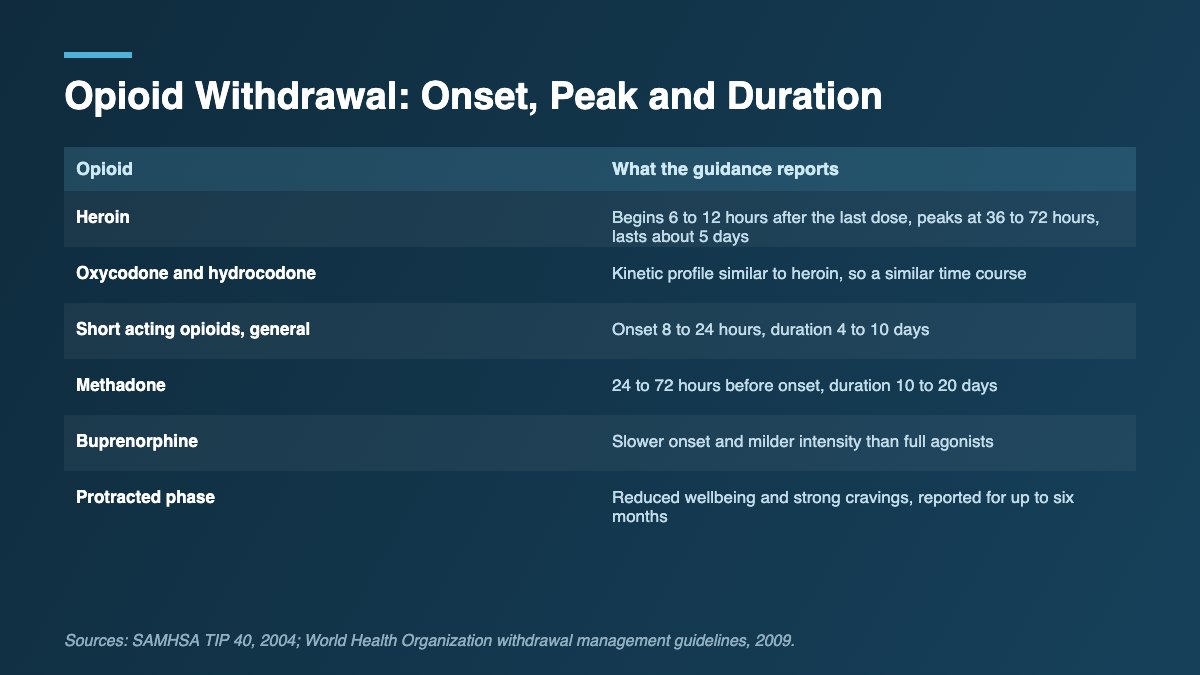
Opioid withdrawal follows a predictable shape, and which opioid was used decides almost everything about the timing. Heroin withdrawal typically begins 6 to 12 hours after the last dose and peaks at 36 to 72 hours. Methadone can take 24 to 72 hours to begin and run 10 to 20 days. Fentanyl behaves differently again, and that difference is now well documented.
The basic rule: half-life sets the clock
Federal treatment guidance puts it simply. Opioids with longer half-lives take longer before spontaneous withdrawal begins and longer to reach peak intensity. Short acting opioids produce a faster, sharper syndrome; long acting ones produce a slower, more drawn out one.
For heroin, SAMHSA guidance states that spontaneous withdrawal usually begins 6 to 12 hours after the last dose, peaks in intensity at 36 to 72 hours, and lasts approximately 5 days, though a milder protracted phase may continue longer. Oxycodone and hydrocodone have kinetic profiles similar to heroin, so the time course is similar.
World Health Organization guidance gives slightly wider windows for short acting opioids: onset 8 to 24 hours after last use, duration 4 to 10 days. For long acting opioids such as methadone it gives onset at 12 to 48 hours and duration of 10 to 20 days. Different sources land on slightly different numbers because they draw on different populations and settings, which is itself worth knowing when a single figure is quoted as fact.

What the symptoms actually are
Early symptoms are largely autonomic: yawning, sweating, watering eyes, runny nose, restlessness and difficulty sleeping. As it builds, people report muscle and bone aches, abdominal cramping, nausea, vomiting and diarrhea, goose bumps, dilated pupils, rapid heartbeat and raised blood pressure. Anxiety and intense craving run through the whole course.
The severity people describe is real, and the phrase often used clinically is that withdrawal feels like a severe influenza with an overwhelming urge to make it stop. That urge is the clinically dangerous part, because it drives a return to use.
Is opioid withdrawal dangerous?
Sources differ in emphasis and the distinction matters. World Health Organization guidance states that opioid withdrawal is not usually life threatening. Other clinical references describe it as potentially life threatening. The reconciliation is that uncomplicated opioid withdrawal is rarely fatal in itself, while the surrounding risks genuinely are.
Those risks are dehydration from persistent vomiting and diarrhea, aspiration, the effect on people with existing cardiac disease, precipitated withdrawal, and above all the loss of tolerance. WHO guidance warns explicitly that people who have withdrawn are at increased risk of overdose because of reduced opioid tolerance. A dose that was routine before withdrawal can be fatal after it.
This is different from alcohol and benzodiazepine withdrawal, which can cause seizures and can kill directly. Opioid withdrawal usually will not. What follows it often does.
Why fentanyl does not behave like other short acting opioids
Fentanyl is short acting in the clinical sense, but in people who use it heavily it does not clear like one. Fentanyl is highly fat soluble, and research published in 2023 describes distribution into muscle and adipose tissue producing a long terminal elimination, with the authors noting that if fentanyl accumulates in the periphery and is released from tissue stores over an extended period, it may effectively act like a long acting opioid.
A 2020 study of 12 people with opioid use disorder entering residential treatment measured mean clearance times of 7.3 days for fentanyl and 13.3 days for its metabolite norfentanyl, with one participant still testing positive for fentanyl at 19 days and norfentanyl at 26 days. The authors concluded that fentanyl clearance in this population is considerably longer than the typical 2 to 4 day clearance of other short acting opioids.
A 2024 comparison put 30 people with fentanyl exposure and 103 with other opioid exposure on an identical 7 day morphine stabilization protocol. The fentanyl group reported significantly higher withdrawal on days 2 through 5, showed higher observer rated withdrawal on days 2 through 6, and had higher rates of tachycardia and higher peak diastolic blood pressure. Withdrawal remained elevated for several days despite treatment.
The practical consequence is about starting medication. Standard guidance says buprenorphine should be started 12 to 18 hours after the last use of a short acting opioid such as heroin or oxycodone, and 24 to 48 hours after a long acting opioid such as methadone. Because fentanyl can behave like the latter, starting on the short acting schedule risks precipitated withdrawal, and clinicians increasingly plan fentanyl inductions differently. This is a decision for a prescriber, not something to work out alone.
What the numbers do not capture
Every published window is an average across a group. The actual course depends on the specific opioid, the dose, how long and how often it was used, the degree of physical dependence, the route, whether withdrawal is spontaneous or precipitated by a medication, and for fentanyl on body composition and how much has accumulated in tissue.
There is also a protracted phase. WHO guidance describes it lasting up to six months, marked by reduced sense of wellbeing and strong cravings. People who expect to feel normal at day 10 and do not are encountering something documented, not something wrong with them. For substance specific background see our pages on fentanyl, heroin and oxycodone.
Takeaways
- Heroin withdrawal typically starts 6 to 12 hours after the last dose, peaks at 36 to 72 hours and lasts about 5 days.
- Methadone withdrawal starts later, at 24 to 72 hours, and runs 10 to 20 days.
- Fentanyl clears far more slowly than other short acting opioids, with measured mean clearance of 7.3 days and up to 19 days in one case.
- People withdrawing from fentanyl reported significantly worse withdrawal on days 2 through 6 despite treatment.
- Uncomplicated opioid withdrawal is rarely fatal, but the loss of tolerance that follows it sharply raises overdose risk.
- Buprenorphine timing depends on the opioid involved, and fentanyl complicates it. That timing should be planned with a prescriber.
Sources
Substance Abuse and Mental Health Services Administration, Clinical Guidelines for the Use of Buprenorphine in the Treatment of Opioid Addiction, TIP 40. World Health Organization, Clinical Guidelines for Withdrawal Management and Treatment of Drug Dependence in Closed Settings, 2009. Bird HE and colleagues, Journal of Addiction Medicine, 2023, on fentanyl absorption, distribution, metabolism and excretion. Huhn AS and colleagues, Drug and Alcohol Dependence, 2020, on protracted renal clearance of fentanyl. Sharma A and colleagues, Journal of Addiction Medicine, 2024, on the severity and progression of illicitly manufactured fentanyl withdrawal. StatPearls, Opioid Withdrawal, 2023.
Need help now? In an emergency call 911. If you are in crisis or thinking about suicide, call or text 988 (Suicide and Crisis Lifeline; veterans press 1). For free, confidential treatment referrals 24 hours a day, call the SAMHSA National Helpline at 1-800-662-4357. You can also search licensed programs at FindTreatment.gov, or use our rehab directory and state listings.
Addiction Now publishes health journalism and reference material. This page is not medical advice, a diagnosis, or a treatment plan. Do not stop a prescribed medication without talking to a clinician. Withdrawal from alcohol, benzodiazepines and barbiturates can cause seizures and can be fatal without medical supervision.