


For most of Medicaid’s history, federal dollars could not pay for an adult’s stay in a residential addiction treatment facility with more than 16 beds. That rule has not been repealed. What changed is that 38 states and the District of Columbia have been approved to set it aside, and the result is a residential coverage map that now varies sharply depending on where a person lives.
The rule that created the gap
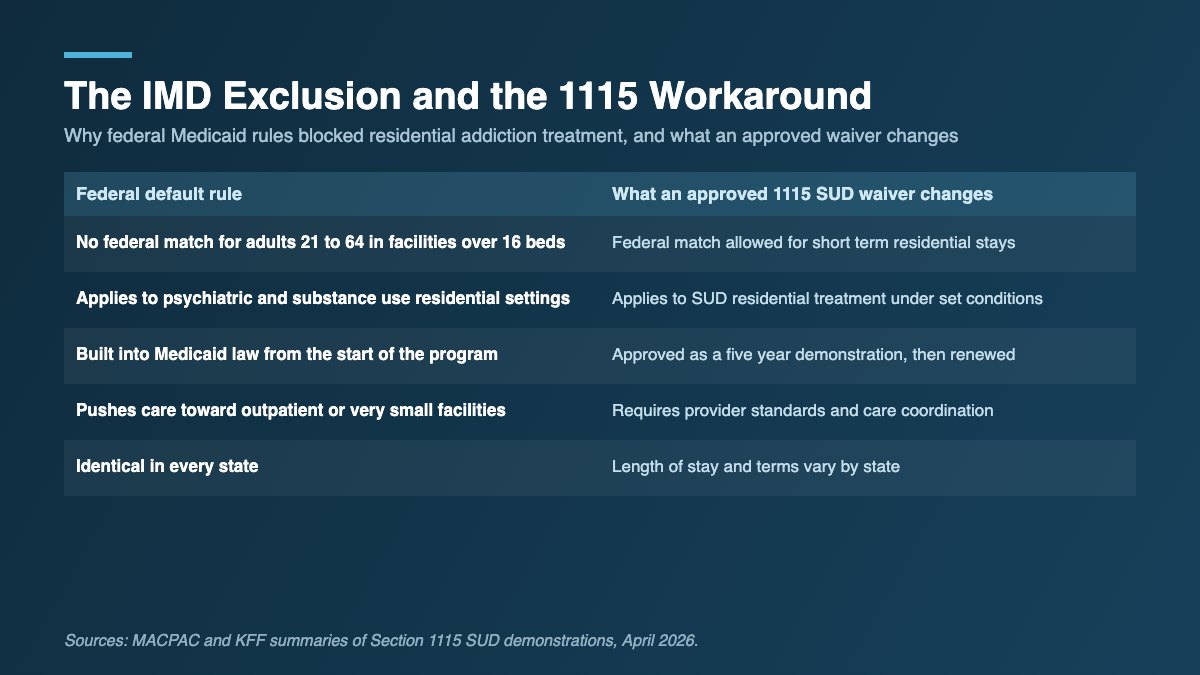
The provision is known as the Institution for Mental Diseases exclusion, usually shortened to the IMD exclusion. It bars federal financial participation in Medicaid for services delivered to enrollees between the ages of 21 and 64 in psychiatric or substance use residential facilities with more than 16 beds. It has been part of the program since Medicaid began.
The original reasoning was fiscal rather than clinical. Congress wanted states, not the federal government, to carry the cost of large institutional psychiatric care. The consequence for addiction treatment was not really intended: a great many residential programs run more than 16 beds, so for decades a large share of the country’s residential capacity sat outside what Medicaid would match.
That fell hardest on people whose substance use had progressed past what outpatient care could safely hold. Someone stabilizing after a severe alcohol or fentanyl problem could be clinically appropriate for residential care and still discover that their coverage stopped at the facility door.

How states worked around it
Section 1115 of the Social Security Act allows the Secretary of Health and Human Services to approve demonstration projects that waive certain Medicaid requirements so states can test different approaches to delivering care. Starting in the mid 2010s, states began using that authority to request federal match for short term residential substance use treatment in facilities the IMD exclusion would otherwise disqualify.
The distinction matters: these are demonstrations, not permanent law. They run for a defined period, commonly five years, and a state has to reapply to keep one going. A waiver is a negotiated arrangement between one state and the federal government, which is precisely why the rules differ so much from one border to the next.
Where the map stands now
As of April 2026, 38 states and the District of Columbia had approved substance use IMD waivers. Three more had applications pending. At least 20 states had received approval from the Centers for Medicare and Medicaid Services to extend demonstrations they already had for another five years.
The remaining states are a meaningful minority. In those places the exclusion still applies in full, and a Medicaid enrollee between 21 and 64 who needs residential treatment is generally limited to facilities with 16 beds or fewer, to whatever the state pays for with its own dollars, or to no residential option at all.
What states agree to in exchange
Approval is conditional. CMS attaches milestones that a state has to work toward and report on across the life of the demonstration. Across approved waivers those commitments have consistently included provider qualifications and capacity standards for residential treatment, opioid prescribing guidelines, improved access to naloxone, use of prescription drug monitoring programs, and care coordination between residential settings and community based services.
That last item is the one most often overlooked. The waivers were not designed to fund residential beds in isolation. They were built on the premise that a residential stay is one step in a longer arc of care, and states are evaluated partly on whether people actually connect to continuing treatment afterward.
What a waiver does not do
An approved waiver is not a blank check, and reading it that way leads to disappointment. Coverage under these demonstrations is generally for short term stays, with roughly 30 days a common benchmark, though the specific terms vary by state. A waiver also does not create capacity: permission to pay for a bed is not the same as a bed existing in the county where someone lives.
Nor does every licensed facility participate. A program has to be enrolled with the state Medicaid agency and meet the standards the waiver requires. And none of this touches commercial insurance, which operates under an entirely separate set of rules.
What to check where you live
- Confirm whether your state has an approved substance use IMD waiver, and whether it is currently active rather than expired or pending renewal.
- Ask the state Medicaid agency, not the facility, what the covered length of stay is. Facilities sometimes quote their program length rather than the covered length.
- Check whether the specific program is enrolled as a Medicaid provider for residential treatment. Being licensed by the state is a different thing.
- Ask what happens at the end of the covered stay, and get that answer before admission rather than during discharge planning.
- If your state has no waiver, ask about state funded treatment slots and about outpatient levels of care, which are covered everywhere.
For background on the substances most often involved in residential admissions, our drug information library covers withdrawal risk and treatment considerations for each.
Sources
This report draws on the Medicaid and CHIP Payment and Access Commission (MACPAC) tracking of Section 1115 substance use disorder waivers, KFF analysis of IMD waiver evaluations, the Congressional Research Service overview of the IMD exclusion, and Centers for Medicare and Medicaid Services demonstration approval records.
Need help now? In an emergency call 911. If you are in crisis or thinking about suicide, call or text 988 (Suicide and Crisis Lifeline; veterans press 1). For free, confidential treatment referrals 24 hours a day, call the SAMHSA National Helpline at 1-800-662-4357. You can also search licensed programs at FindTreatment.gov, or use our rehab directory and state listings.
Addiction Now publishes health journalism and reference material. This page is not medical advice, a diagnosis, or a treatment plan. Do not stop a prescribed medication without talking to a clinician. Withdrawal from alcohol, benzodiazepines and barbiturates can cause seizures and can be fatal without medical supervision.