

Buprenorphine works when people take it, and the strongest evidence for reduced overdose death comes from continued treatment rather than brief exposure. National dispensing data published in JAMA in 2023 found that only about one in five people who started buprenorphine remained in treatment for at least 180 days, a figure that barely moved across seven years.
The headline number and where it comes from
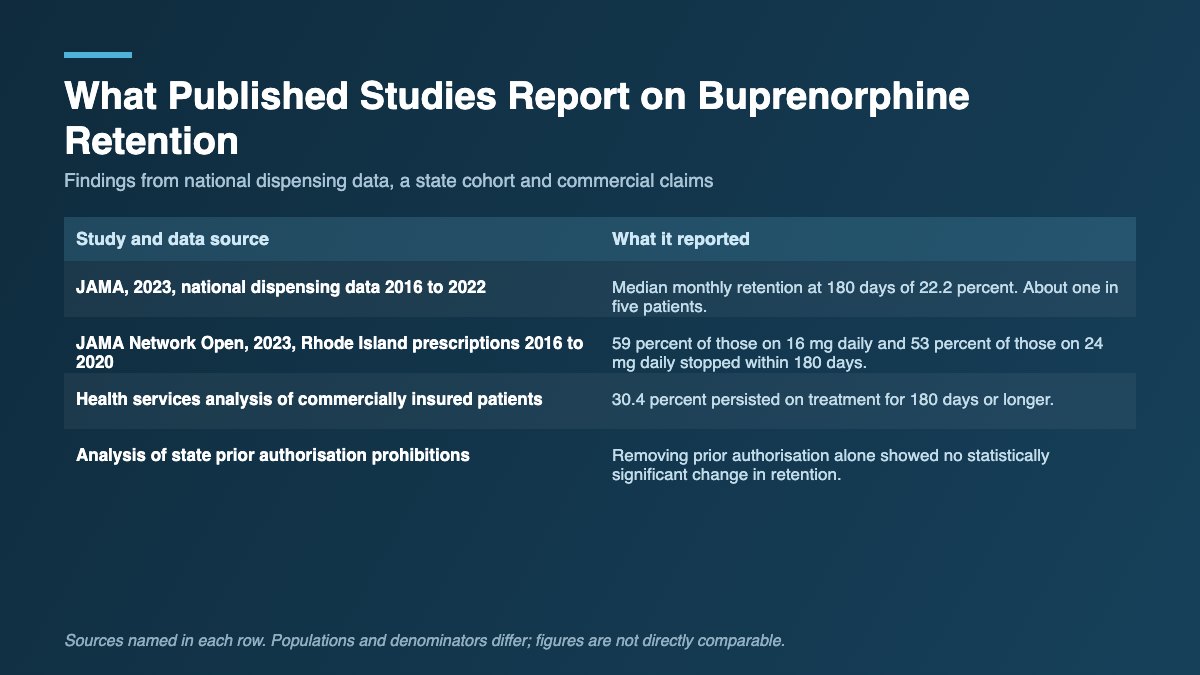
The most widely cited estimate comes from an analysis of national buprenorphine dispensing data covering January 2016 through 2022, published in JAMA in 2023. Across that period the median monthly retention rate at 180 days was 22.2 percent. Put plainly, roughly four out of five people who filled a first buprenorphine prescription were no longer filling prescriptions six months later.
Two things about that finding deserve emphasis. The first is that it did not improve over the study window, despite a period in which prescribing authority was being widened and telehealth pathways were opening. The second is that dispensing data measures whether a prescription was filled, not whether a person was doing well. Some people who stop are stable and choose to stop with clinical support. Others stop because a clinic closed, a prescription lapsed, a job was lost, or a prior authorisation expired. The data cannot distinguish between those.
Dose is one of the few modifiable factors with clear evidence
A study published in JAMA Network Open in 2023, conducted by researchers at Brown University with the National Institute on Drug Abuse and the Rhode Island Department of Health, examined people prescribed buprenorphine in Rhode Island between 2016 and 2020. Among those newly starting treatment, 59 percent of patients prescribed the 16 milligram daily dose recommended by the Food and Drug Administration discontinued within 180 days, compared with 53 percent of those prescribed 24 milligrams daily. People on the lower dose were about 20 percent more likely to discontinue.

That period matters. It covers the years in which fentanyl displaced other opioids in much of the illicit supply, and higher tolerance is the usual explanation offered for why a dose calibrated in an earlier era may be insufficient now. The finding is observational, so dose and patient characteristics are entangled, but it is one of the few results in this literature that points at a lever a prescriber can actually pull. Our reference page on fentanyl covers the potency question in more detail.
What insurance rules do and do not explain
It is tempting to attribute low retention to coverage barriers, and coverage barriers are real. But the evidence on removing one of them is instructive. Analyses of state Medicaid prior authorisation prohibitions found that adopting them was not associated with a statistically significant change in buprenorphine retention. Among commercially insured patients, one analysis found only 30.4 percent persisting on treatment for 180 days or longer, again with no significant effect from prior authorisation policy.
Researchers examining that result have offered a straightforward explanation. Prior authorisation is one component of utilisation management, and removing it leaves the rest in place: insurer mandated toxicology testing, counselling requirements attached to the prescription, quantity limits, and predefined tapering schedules. Several of those conditions are not supported by the evidence base for the medication itself, and a thematic analysis of state Medicaid buprenorphine requirements documented how widely they vary. Pulling one requirement out of a stack of them does not necessarily change what a patient experiences.
What the evidence suggests raises retention
The literature is more consistent about the shape of care than about any single policy. Low barrier and on demand models, in which a person can start medication at the first contact without a waiting period or a mandatory counselling schedule, are associated with higher engagement and retention, including among groups historically least likely to reach treatment. Adequate dosing appears repeatedly. So does continuity, meaning that the same prescriber or clinic remains available rather than requiring a handoff after an initial episode.
What does not appear in the evidence is any support for making the medication contingent on counselling attendance. Counselling helps many people and should be available. Requiring it as a condition of receiving a medication that reduces mortality is a different proposition, and one the research does not support.
Why retention is the right measure
Treatment systems often report initiations, because initiations are easier to count and easier to grow. Retention is the harder measure and the one connected to mortality. A person who fills one prescription and disengages has had their tolerance changed without gaining durable protection, which is a particular concern for people returning to a supply dominated by illicitly manufactured fentanyl rather than the heroin or diverted oxycodone of an earlier period.
That is why the flat line in the JAMA data is the important finding rather than any individual percentage. Access expanded. Retention did not follow. Whatever is limiting the second thing is not the same as what was limiting the first.
Key takeaways
- National dispensing data published in JAMA in 2023 found median 180 day retention of 22.2 percent between 2016 and 2022, with no improvement over the period.
- A Rhode Island study published in JAMA Network Open in 2023 found lower discontinuation among patients on 24 milligrams daily than on 16 milligrams daily.
- Among commercially insured patients, one analysis found about 30 percent persisting at 180 days.
- Removing prior authorisation on its own did not produce a measurable retention gain, most likely because other utilisation management requirements remained.
- Low barrier, same day initiation and continuity of prescriber are the service design features most consistently associated with better retention.
- Dispensing data cannot tell you why someone stopped, so every one of these figures should be read as a measure of the system rather than of the patient.
Sources
This article draws on studies published in JAMA and JAMA Network Open in 2023, research conducted by Brown University with the National Institute on Drug Abuse and the Rhode Island Department of Health, published health services analyses of Medicaid prior authorisation policy and commercial claims, and thematic analysis of state Medicaid buprenorphine coverage requirements. Figures are attributed in the text to the study and period they describe.
Need help now? In an emergency call 911. If you are in crisis or thinking about suicide, call or text 988 (Suicide and Crisis Lifeline; veterans press 1). For free, confidential treatment referrals 24 hours a day, call the SAMHSA National Helpline at 1-800-662-4357. You can also search licensed programs at FindTreatment.gov, or use our rehab directory and state listings.
Addiction Now publishes health journalism and reference material. This page is not medical advice, a diagnosis, or a treatment plan. Do not stop a prescribed medication without talking to a clinician. Withdrawal from alcohol, benzodiazepines and barbiturates can cause seizures and can be fatal without medical supervision.