

Naloxone reverses an opioid overdose by physically displacing the opioid from the receptor. It works within minutes, it is available over the counter without a prescription, and it cannot harm someone who has not taken opioids. It also wears off faster than the drugs it reverses, which is the single most important thing to understand about it.
How it works
Naloxone binds to opioid receptors more strongly than heroin, fentanyl or oxycodone do, but without activating them. It knocks the opioid off and occupies the space, and because it produces no opioid effect itself, the suppression of breathing lifts.
Given as a nasal spray it begins working within about two to three minutes. Injected, slightly faster. Breathing returns first, followed by consciousness, sometimes abruptly.
Because it does not activate the receptor, naloxone has essentially no effect on someone who has not taken opioids. That is what makes it safe to give when you are unsure, and uncertainty is common.
The duration problem
Naloxone lasts roughly thirty to ninety minutes. Many opioids last considerably longer.
Fentanyl is stored in fatty tissue and released back into the blood over an extended period. Methadone is long acting by design. When the naloxone wears off while the opioid is still present, the person can stop breathing again, a pattern clinicians call re-narcotisation.
This is why the instruction to call 911 is not a formality and why leaving someone once they wake up is dangerous. Someone who was revived, felt fine, and was left to sleep can be found unresponsive an hour later. Stay, and let them be assessed.
It is also why multiple doses are frequently needed with fentanyl. If there is no response after two to three minutes, give another dose.
What it does not touch
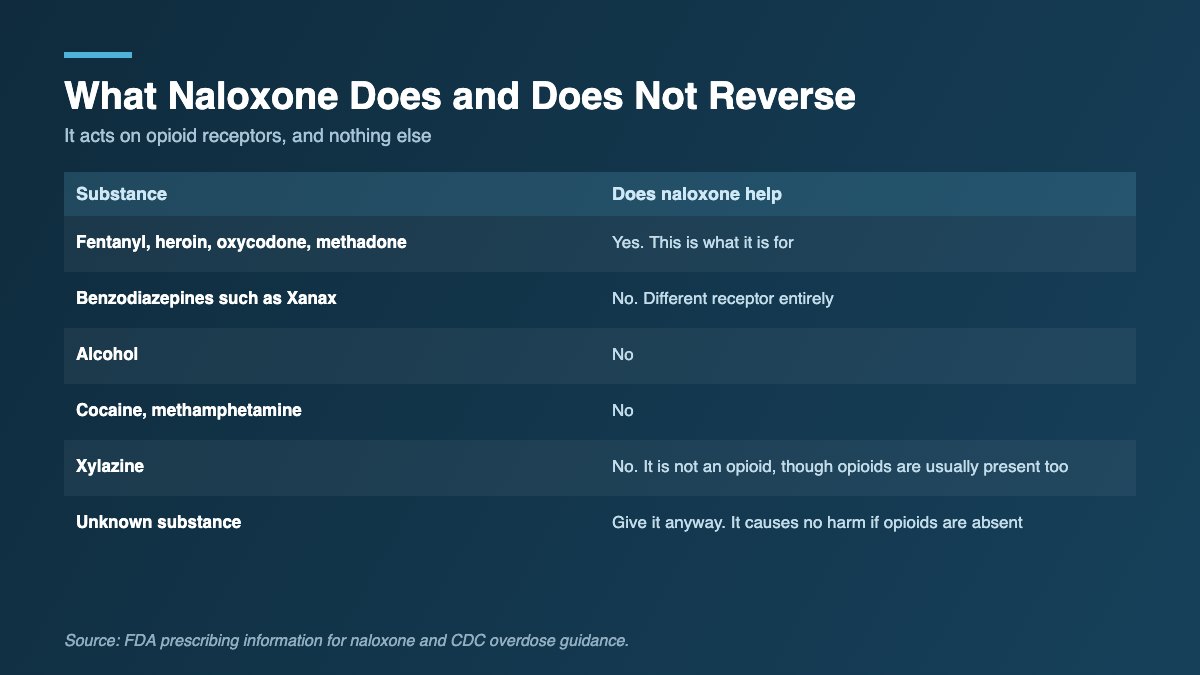
Naloxone acts on opioid receptors and nothing else, so it does nothing for benzodiazepines, alcohol, cocaine, methamphetamine, or ketamine.
Xylazine deserves specific mention because it now appears widely in the opioid supply. It is a veterinary sedative, not an opioid, and naloxone does not reverse it. In practice you still give naloxone, because an opioid is almost always present alongside it, but someone may remain heavily sedated afterwards. That sedation is not a sign the naloxone failed, and it is not a reason to withhold further help.
Mixed overdoses are common enough that the practical rule is simply to give naloxone whenever an overdose is suspected and let the clinicians sort out what was involved.
It will cause withdrawal, and that is expected
In someone physically dependent on opioids, naloxone strips the receptors and precipitates immediate withdrawal: nausea, vomiting, cramping, sweating, agitation and severe distress.
People often wake frightened, confused and angry, and sometimes leave. This is worth anticipating so that it is not mistaken for a complication. It is uncomfortable rather than dangerous, and breathing is the priority.
Vomiting while not fully alert is a real hazard, which is why someone should be placed on their side after the dose is given.
Using it
The nasal spray is designed for people with no training. Peel the packaging, place the nozzle in one nostril until your fingers touch the nose, and press the plunger firmly. Each device delivers one dose.
Recognise the situation first: unresponsive to shouting or a firm shake, breathing that is slow, absent, or sounds like snoring or gurgling, and blue or grey lips and fingertips. Call 911, give naloxone, put the person on their side, and give another dose after two to three minutes if nothing changes. Rescue breathing helps if you know how.
Every state has some form of Good Samaritan protection for people who call for help at an overdose, and the details vary. Our pages on fentanyl and heroin cover the drugs most often involved.
Where to get it
Naloxone nasal spray is available over the counter in pharmacies without a prescription. Many health departments, syringe service programmes and community organisations distribute it free, and mail programmes exist in a number of states.
Cost and availability vary, and the free routes are frequently faster than the retail ones. It is worth obtaining more than one device, since multiple doses are often needed and since the one at home is no help in a car or at work.
Practical points
- Keep it wherever opioids are, including prescriptions. Prescribed opioids cause overdoses too.
- Tell someone else where it is. You will not be able to use it on yourself.
- Always call 911, even after it works. Naloxone wears off first.
- Be ready to give more than one dose. Fentanyl frequently needs it.
- Expect withdrawal and distress on waking. That is the medication working.
- Give it even when you are unsure. It cannot harm someone who has not taken opioids.
Sources
This article draws on Food and Drug Administration prescribing information for naloxone nasal spray and injection, Centers for Disease Control and Prevention guidance on recognising and responding to opioid overdose, and published clinical literature on re-narcotisation and on xylazine in the illicit opioid supply. It is reference information, not medical advice.
Need help now? In an emergency call 911. If you are in crisis or thinking about suicide, call or text 988 (Suicide and Crisis Lifeline; veterans press 1). For free, confidential treatment referrals 24 hours a day, call the SAMHSA National Helpline at 1-800-662-4357. You can also search licensed programs at FindTreatment.gov, or use our rehab directory and state listings.
Addiction Now publishes health journalism and reference material. This page is not medical advice, a diagnosis, or a treatment plan. Do not stop a prescribed medication without talking to a clinician. Withdrawal from alcohol, benzodiazepines and barbiturates can cause seizures and can be fatal without medical supervision.