


Oxycodone and hydrocodone are the two most commonly prescribed opioids in the United States, and they are considerably more similar than their reputations suggest. Both are semi synthetic opioids, both are Schedule II, and both kill in exactly the same way. The difference that matters most in practice is not the opioid at all.
What each one is
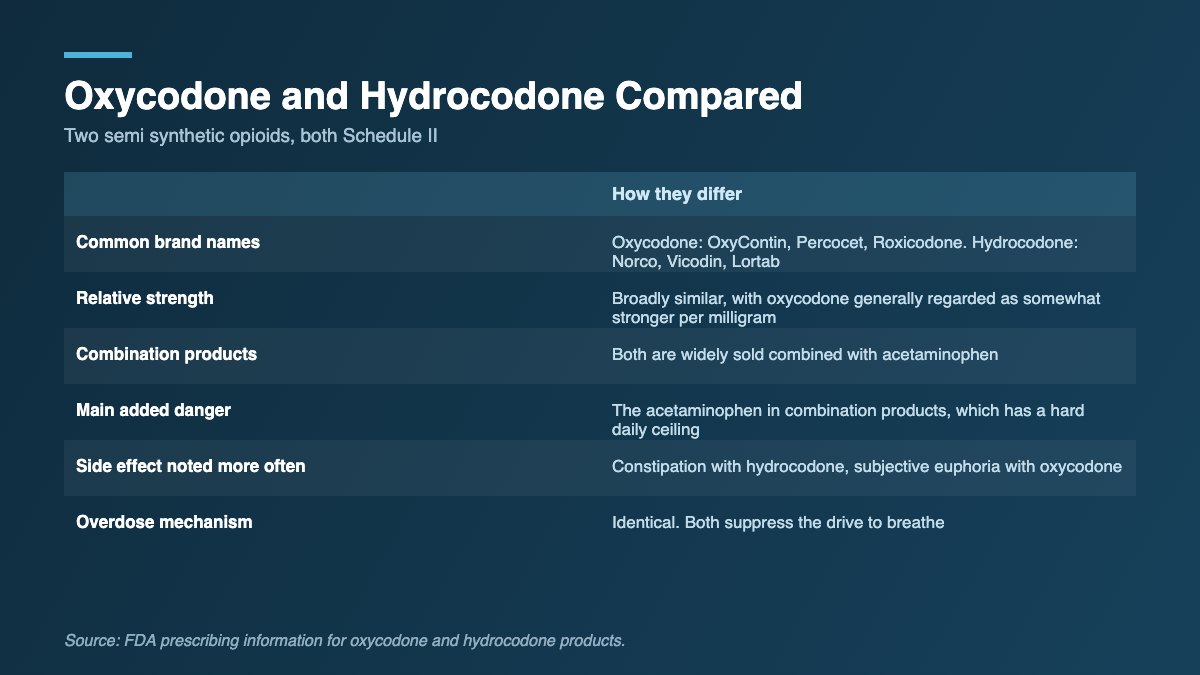
Oxycodone appears alone as OxyContin in extended release form and Roxicodone in immediate release, and combined with acetaminophen as Percocet. Hydrocodone is most familiar in combination products such as Norco, Vicodin and Lortab, and also exists in extended release single ingredient forms.
Both are derived from opium alkaloids and modified, and both act as full agonists at the mu opioid receptor. That is the same receptor heroin, morphine and fentanyl act on, and it is why the effects, the tolerance, the dependence and the overdose mechanism are shared across the whole class.
Are they different in strength
Marginally, and less than the folklore suggests. Oxycodone is generally regarded as somewhat more potent per milligram, so an equivalent dose is a little lower. In practice the prescribed dose matters far more than the molecule: a high dose of hydrocodone is more opioid than a low dose of oxycodone.

Subjective reports differ, with oxycodone more often described as producing a stronger euphoric effect and hydrocodone more often associated with constipation. These are tendencies rather than rules, and individual variation is wide enough that they are poor guides for any particular person.
One real pharmacological difference: hydrocodone depends more heavily on a liver enzyme to convert into its more active metabolite, and people vary considerably in how much of that enzyme they have. That means hydrocodone can be unusually weak or unusually strong in a given individual, which is a plausible explanation when someone reports a very different experience from the same prescription.
The acetaminophen problem
This is the difference worth actually worrying about, and it applies to combination products of both drugs.
Acetaminophen has a hard daily ceiling above which it causes liver injury, and that injury can be severe and irreversible. Someone taking extra tablets for pain relief, which is a very ordinary thing to do, can reach a dangerous acetaminophen dose long before reaching a dangerous opioid dose.
The risk multiplies when other acetaminophen containing products are in the mix. Cold and flu remedies, sleep aids and over the counter painkillers frequently contain it, and people do not think of those as medication in the same way. Alcohol raises the risk further.
Anyone taking a combination opioid should know the acetaminophen content per tablet and the daily limit, and should read the labels on everything else in the cupboard. This is the most common avoidable harm associated with these two drugs.
Overdose is identical
Whatever differences exist elsewhere, they vanish here. Both suppress the brainstem drive to breathe. Breathing slows, becomes shallow, and stops, with lips and fingertips turning blue or grey. Naloxone reverses both.
The risk rises sharply in combination with benzodiazepines or alcohol, which suppress breathing through a different mechanism, so tolerance to opioids offers no protection against the combination. It also rises after any break in use, because tolerance falls quickly.
Extended release formulations carry a specific hazard: crushing, chewing or splitting them delivers a dose intended for twelve hours all at once.
What long term use does
Tolerance and physical dependence develop with sustained use of either, which is expected pharmacology rather than evidence of misuse. Constipation is persistent and does not fade with tolerance. Reduced testosterone and disrupted menstrual cycles are common and often reverse on stopping.
Opioid induced hyperalgesia, in which long term opioid use increases sensitivity to pain, is recognised and can produce the confusing situation of pain worsening as the dose rises. Our pages on oxycodone and drug information cover further background.
How long each one lasts
Immediate release forms of both begin working within about twenty to thirty minutes and last roughly four to six hours, which is why they are typically prescribed several times a day.
Extended release formulations spread the same dose across a much longer window, commonly twelve hours. That difference matters for withdrawal as well as for pain: shorter acting drugs produce sharper troughs between doses, and those troughs are experienced as early withdrawal by anyone who is dependent.
Practical points
- Know the acetaminophen content of your tablets. It is the ceiling that binds first.
- Check every other medicine for acetaminophen. Cold remedies are the usual culprit.
- Never crush an extended release tablet. It delivers twelve hours at once.
- Do not combine with benzodiazepines or alcohol. The mechanisms stack.
- Do not restart at your old dose after a break. Tolerance falls within days.
- Keep naloxone in the house. Prescribed opioids cause overdoses too.
Sources
This article draws on Food and Drug Administration prescribing information for oxycodone and hydrocodone products, including boxed warnings on respiratory depression and hepatotoxicity in combination products, and on National Institute on Drug Abuse material on prescription opioid effects. It is reference information, not medical advice.
Need help now? In an emergency call 911. If you are in crisis or thinking about suicide, call or text 988 (Suicide and Crisis Lifeline; veterans press 1). For free, confidential treatment referrals 24 hours a day, call the SAMHSA National Helpline at 1-800-662-4357. You can also search licensed programs at FindTreatment.gov, or use our rehab directory and state listings.
Addiction Now publishes health journalism and reference material. This page is not medical advice, a diagnosis, or a treatment plan. Do not stop a prescribed medication without talking to a clinician. Withdrawal from alcohol, benzodiazepines and barbiturates can cause seizures and can be fatal without medical supervision.