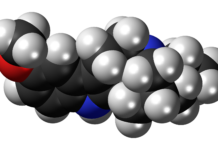


Cocaine damages the nose by cutting off its blood supply. Every time it is snorted, the blood vessels feeding the lining of the nose clamp down, and the tissue goes without oxygen for a while. Repeat that often enough and the tissue dies. The early stages recover; a perforated septum does not.
The mechanism
Cocaine is a powerful vasoconstrictor, which is why it was historically used in nasal surgery to reduce bleeding. That property is useful in a controlled clinical setting and destructive when repeated.
The lining of the nose and the cartilage of the septum depend on a thin blood supply running through the overlying tissue. Cartilage itself has no direct blood supply of its own. Constrict those vessels repeatedly and the cartilage is starved, the lining ulcerates, and the structure underneath begins to break down.
The powder itself contributes as well. Cocaine is acidic and irritating, and whatever it has been cut with is being introduced into the same tissue.

What happens first
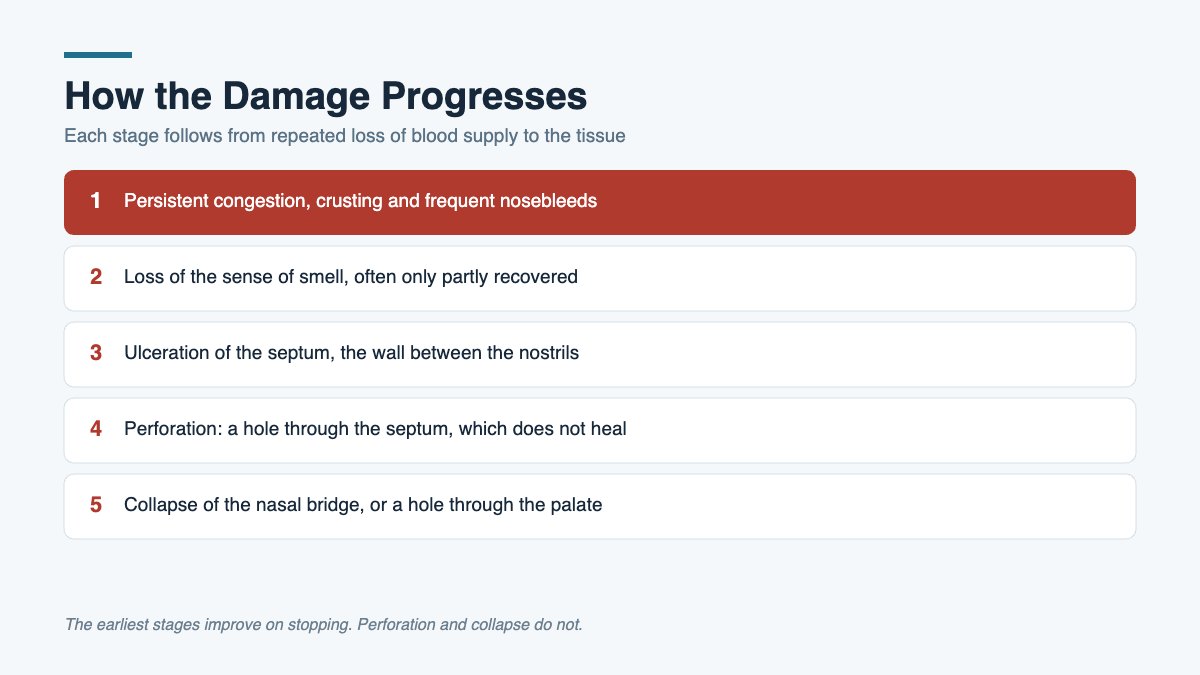
The early signs are easy to attribute to something else: persistent congestion that does not clear, crusting, frequent nosebleeds, a runny nose, sinus infections that keep recurring.
Loss of smell follows, and with it much of the sense of taste. This is often the first change people find genuinely distressing, and it recovers only partly if at all once established.
At this point the damage is still largely reversible. Stopping allows the lining to recover, and this window is the most useful thing anyone reading this can act on.
Perforation and what comes after
Continued use leads to ulceration and then to perforation: a hole through the septum, the wall separating the two nostrils. It typically presents as whistling when breathing, worsening crusting, persistent bleeding, and a sense that airflow is wrong.
A perforation does not close on its own. Surgical repair is possible but technically difficult, frequently unsuccessful, and no surgeon will attempt it while someone is still using, because the repair will fail for the same reason the tissue failed.
Beyond the septum, the damage can extend to the structures around it. Loss of septal support causes the bridge of the nose to collapse inward, producing the deformity described as saddle nose. In more advanced cases the destruction extends into the palate, creating a hole between the nose and the mouth that affects speech and allows food and liquid to pass upward. This requires major reconstructive surgery.
Levamisole makes it worse
A large share of the cocaine supply has been adulterated for years with levamisole, a veterinary deworming agent. It is used because it is cheap, white, and appears to potentiate cocaine’s effects.
Levamisole causes serious problems of its own. It can suppress the bone marrow’s production of white blood cells, leaving someone dangerously vulnerable to infection, a condition that can present as repeated mouth ulcers, sore throat and fever. It also causes a vasculitis, an inflammation of blood vessels, that produces distinctive purple patches of dying skin, often on the ears, cheeks and legs.
Crucially, levamisole associated vasculitis accelerates the destruction of nasal and midfacial tissue. The most severe cases of facial destruction seen clinically are generally in people exposed to both. Anyone using cocaine who develops unexplained fevers, mouth ulcers or purple skin patches should be assessed, and should mention the cocaine, because the diagnosis is otherwise easily missed.
What recovery looks like
Stopping is the treatment, and it is the only one that changes the trajectory. Saline rinses, nasal moisturisers and treatment of infection help the lining recover, but none of it works while the vasoconstriction continues.
Smell may return partially over months. Congestion and crusting usually improve. Structural damage that has already occurred stays. Our page on cocaine covers the wider effects, including the cardiac risks that arrive far sooner than the nasal ones.
Why it is often hidden until late
Nasal damage progresses without much pain, which is the main reason people present late. The lining loses sensation as it deteriorates, so ulceration and even perforation can develop with nothing more than congestion and crusting to signal it.
People also tend not to mention cocaine to an ear, nose and throat clinician, and the early picture looks like ordinary chronic rhinitis. Being direct about it changes what gets examined and how quickly.
Practical points
- Nosebleeds and lost smell are early warnings. That stage still recovers.
- Whistling or a change in airflow suggests perforation. Get it examined.
- Never share snorting equipment. Hepatitis C transmission through shared straws is documented.
- Rinse with saline and keep the lining moist. Helpful, but not a substitute for stopping.
- Report fevers, mouth ulcers or purple skin patches. Levamisole effects are serious and treatable.
- Surgery will not be offered while you are using. The repair fails otherwise.
Sources
This article draws on published otolaryngology and clinical literature on cocaine induced midline destructive lesions and septal perforation, and on Centers for Disease Control and Prevention and clinical reporting on levamisole adulteration of cocaine and its haematological and dermatological effects. It is reference information, not medical advice.
Need help now? In an emergency call 911. If you are in crisis or thinking about suicide, call or text 988 (Suicide and Crisis Lifeline; veterans press 1). For free, confidential treatment referrals 24 hours a day, call the SAMHSA National Helpline at 1-800-662-4357. You can also search licensed programs at FindTreatment.gov, or use our rehab directory and state listings.
Addiction Now publishes health journalism and reference material. This page is not medical advice, a diagnosis, or a treatment plan. Do not stop a prescribed medication without talking to a clinician. Withdrawal from alcohol, benzodiazepines and barbiturates can cause seizures and can be fatal without medical supervision.