

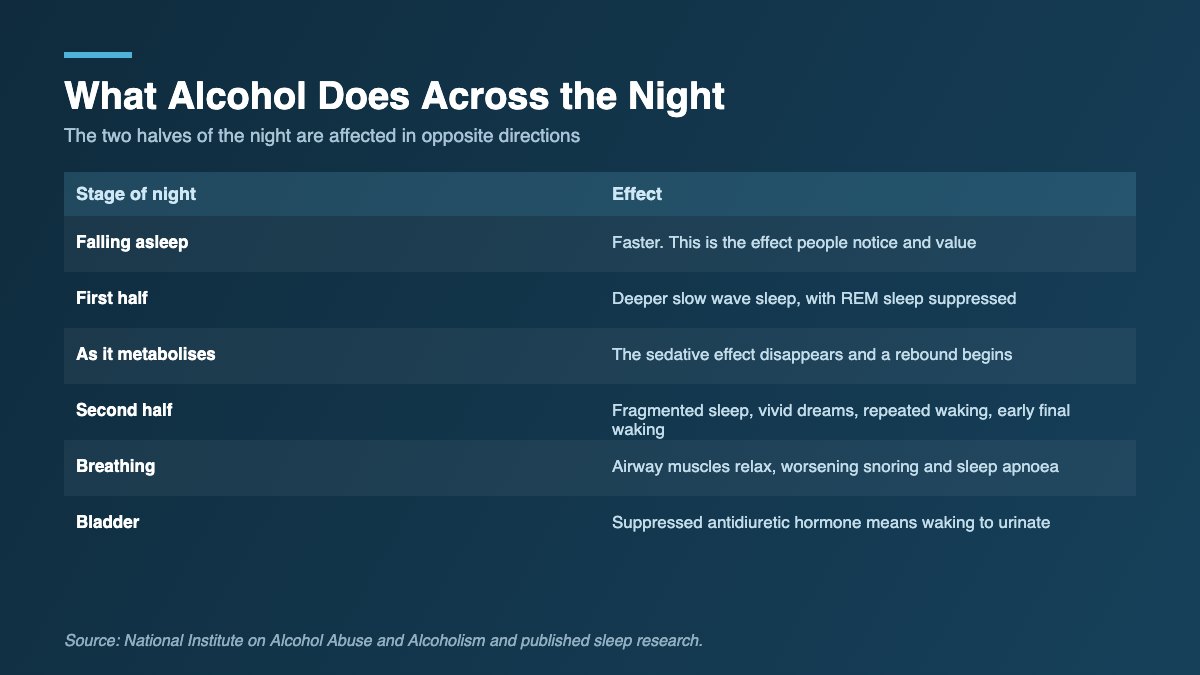
Alcohol is the most widely used sleep aid there is, and it reliably makes sleep worse. It shortens the time taken to fall asleep, which is the effect people notice, and then degrades almost everything that happens afterwards. Waking at four in the morning unable to get back to sleep is not a coincidence; it is the predictable second half of the trade.
The first half of the night
Alcohol is a sedative, and it does what sedatives do. Sleep arrives faster, and the early part of the night contains more slow wave sleep, the deepest stage.
At the same time it suppresses REM sleep, the stage associated with dreaming and with consolidating emotional memory. So the first half of the night is deeper in one sense and incomplete in another, and the balance between stages is shifted rather than improved.
What happens when it metabolises
The body clears alcohol at a fairly steady rate, and by the middle of the night much of it is gone. The sedative effect disappears, and what replaces it is a rebound in the opposite direction.

The suppressed REM sleep returns in a rush, producing vivid or unpleasant dreams. Sleep becomes light and fragmented, with repeated brief awakenings that may or may not be remembered. Heart rate is elevated. Many people wake fully at three or four in the morning, alert and uncomfortable, and cannot get back down.
The result is a night that felt like it began well and delivered poor quality sleep overall, which is the pattern behind next day fatigue that seems out of proportion to the amount drunk.
Breathing and the bladder
Two additional mechanisms make the picture worse, and both are physical rather than neurological.
Alcohol relaxes the muscles of the upper airway. In someone who snores, it makes snoring worse; in someone with sleep apnoea, it lengthens and deepens the episodes where breathing stops. Alcohol is one of the most reliable ways to worsen untreated apnoea, and it can produce apnoea in people who do not otherwise have it.
Alcohol also suppresses the hormone that limits urine production overnight, which is why people wake to urinate after drinking. That is not incidental: each waking is another interruption to an already fragmented second half.
Why tolerance makes this worse rather than better
Tolerance to the sedative effect develops quickly, within days of regular use. Tolerance to the disruption of sleep architecture does not develop nearly as fast.
So the useful part fades while the harmful part persists. Someone using alcohol to get to sleep finds that it stops working for that purpose within a couple of weeks and continues wrecking the second half of the night indefinitely. The usual response is to drink more, which increases the disruption without restoring the sedation.
What happens when you stop
Sleep after stopping regular drinking is frequently worse before it is better, and this catches people out badly.
Rebound insomnia is common in the first days to weeks, along with intense and unpleasant dreams as REM sleep returns in surplus. In someone physically dependent, disturbed sleep is part of a withdrawal syndrome that can also involve tremor, sweating and, in severe cases, seizures, which is why heavy daily drinkers should not stop abruptly without medical advice. Our alcohol page covers this in more detail.
For most people the disruption settles over a few weeks and sleep quality then improves beyond its previous baseline. Knowing that the bad stretch is expected and temporary is what gets people through it, because the obvious interpretation of a terrible week of sleep is that the drinking was helping.
The daytime consequence
Fragmented sleep in the second half of the night produces a specific kind of next day tiredness: functional but flat, with poor concentration and low frustration tolerance, often mistaken for a mild hangover even after modest drinking.
That tiredness then makes an evening drink more appealing, which is a small self sustaining loop worth recognising for what it is. People who stop drinking commonly report that the change they notice first is not in their liver or their weight but in how they feel at eleven in the morning.
Practical points
- Stop drinking three to four hours before bed if you are drinking at all. Clearing it earlier reduces the rebound.
- Do not use alcohol as a sleep aid. Tolerance to the sedation arrives within about a week.
- Take snoring seriously. Alcohol worsens apnoea, and untreated apnoea has its own consequences.
- Expect a bad fortnight after stopping. Rebound insomnia and vivid dreams are temporary.
- Do not stop abruptly if you drink heavily every day. Speak to a clinician first.
- Ask about cognitive behavioural therapy for insomnia. It works, and it does not carry any of this.
Sources
This article draws on National Institute on Alcohol Abuse and Alcoholism material on alcohol and sleep, published sleep research on alcohol’s effects on sleep architecture and REM rebound, and clinical literature on alcohol and obstructive sleep apnoea. It is reference information, not medical advice.
Need help now? In an emergency call 911. If you are in crisis or thinking about suicide, call or text 988 (Suicide and Crisis Lifeline; veterans press 1). For free, confidential treatment referrals 24 hours a day, call the SAMHSA National Helpline at 1-800-662-4357. You can also search licensed programs at FindTreatment.gov, or use our rehab directory and state listings.
Addiction Now publishes health journalism and reference material. This page is not medical advice, a diagnosis, or a treatment plan. Do not stop a prescribed medication without talking to a clinician. Withdrawal from alcohol, benzodiazepines and barbiturates can cause seizures and can be fatal without medical supervision.