

There is no medication approved by the Food and Drug Administration for stimulant use disorder. The intervention with the strongest randomised trial evidence is contingency management, which pays people small, escalating incentives for verified abstinence or attendance. For years the binding constraint on it was not the evidence. It was federal fraud and abuse law.
What the trials actually show
Contingency management applies operant conditioning to treatment: a verified behaviour, usually a negative urine test or a kept appointment, produces an immediate reward, and the reward escalates with each consecutive success. It is unusual in addiction research for having been tested repeatedly in randomised form over several decades.
A meta-analysis of 50 randomised clinical trials published in 2018 found that contingency management was the only intervention associated with a significant reduction in stimulant use. A later systematic review and meta-analysis covering 74 randomised trials reported associations with abstinence from psychomotor stimulants and with improved treatment attendance and medication adherence. Pooled effect sizes for abstinence compared with no treatment or standard treatment have been reported around 0.42 using a fixed effect model and 0.49 using a random effects model.
Those are moderate effects, not transformative ones, and honesty about that matters. The more important comparison is not against a hypothetical ideal but against the alternatives available for people who use methamphetamine or cocaine, where no pharmacological option has cleared regulatory approval. Against that comparison, a moderate effect from a well studied behavioural intervention is the best available evidence in the field.
Meta-analyses have also looked at durability. Analyses pooling randomised trials that followed participants for up to a year after incentives stopped find some persistence of benefit, though the effect attenuates once payment ends. That is a real limitation and it is one reason programmes are usually designed as a defined course rather than an indefinite arrangement.
The payment problem, explained properly
The reason contingency management remained rare in the United States despite this evidence is regulatory rather than clinical. The federal anti kickback statute prohibits exchanging anything of value to induce referrals or purchases paid for by federal health care programmes. Separately, the beneficiary inducements civil monetary penalty provision allows penalties against anyone who offers something of value to a Medicare or Medicaid beneficiary that is likely to influence their choice of provider.
Neither law was written with addiction treatment in mind, but both plainly cover paying a patient. The practical workaround has been the Office of Inspector General policy on gifts of nominal value. In December 2016 the OIG raised those thresholds to 15 dollars per item and 75 dollars in aggregate per patient per year, up from 10 dollars and 50 dollars. That 75 dollar annual figure, an inflation adjustment to a general anti fraud rule, became the de facto ceiling on what a federally funded contingency management programme could pay.
The trial protocols that produced the evidence base used considerably more than 75 dollars a year. So programmes were being asked to reproduce a result using roughly a tenth of the input that generated it.
What changed in January 2025
SAMHSA published an advisory titled Using SAMHSA Funds to Implement Evidence Based Contingency Management Services, catalogued as PEP24-06-001, on 8 January 2025. It raised the total per patient incentive limit for SAMHSA grant recipients to 750 dollars per year, with no cap on any individual incentive, so that grantees can choose the model that fits their setting. The advisory also set conditions: programmes must demonstrate fidelity to established evidence based models, and it includes safeguards intended to limit fraud and abuse risk.
The change applies to programmes funded through SAMHSA grants. It does not by itself rewrite the anti kickback statute or the beneficiary inducements provision, and it does not settle the question for every payer. The OIG has issued favourable advisory opinions covering specific contingency management arrangements, including one delivered through a digital health platform, but an advisory opinion protects only the party that requested it.
Medicaid is the other route, and it is state by state
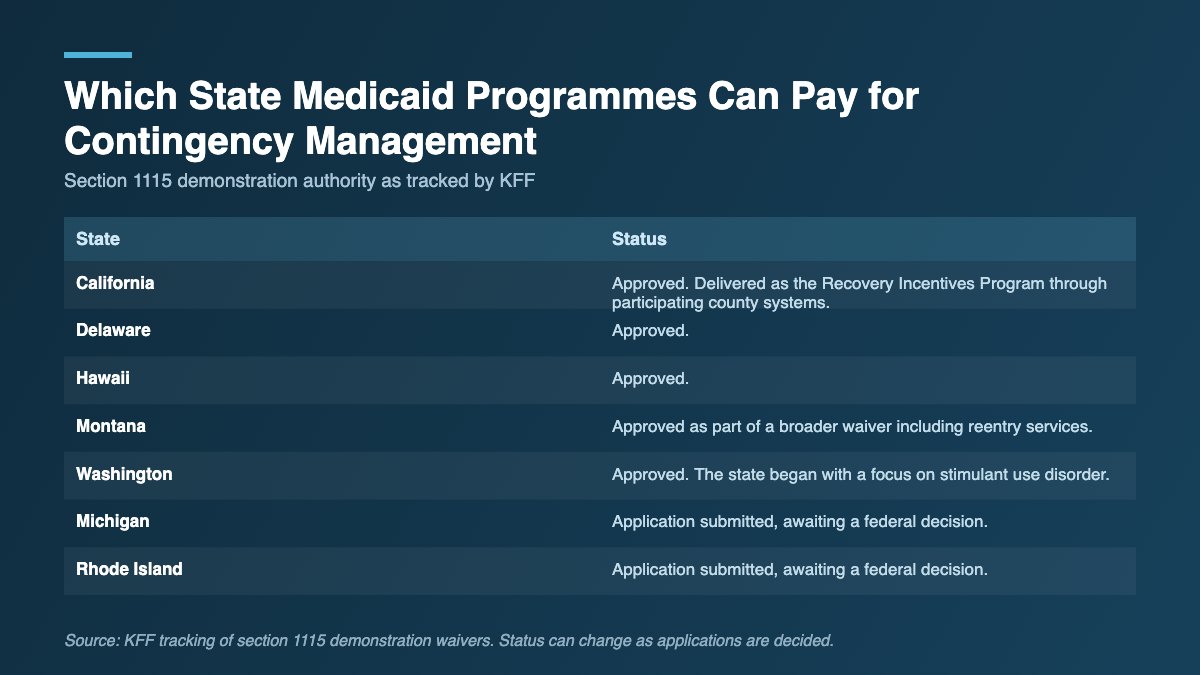
The second path is Medicaid authority under a section 1115 demonstration waiver. KFF tracking indicates that five states have approved authority to operate Medicaid funded contingency management programmes: California, Delaware, Hawaii, Montana and Washington. Two more, Michigan and Rhode Island, have submitted applications awaiting a federal decision.
California has the longest running example. Its Recovery Incentives Program was piloted in participating county behavioural health systems beginning in 2023 under the state CalAIM demonstration, and the state extended the programme beyond the original pilot end date, tying it to the demonstration period that runs to the end of 2026. State reporting indicates that 3,255 people received contingency management services between the programme launch in April 2023 and June 2024. Washington wrote its waiver to cover multiple substances but began operations focused on stimulant use disorder.
This is why coverage is so uneven. Contingency management is not a benefit a person can generally request; it exists where a state has obtained specific federal authority and a county or provider has chosen to stand up a programme. For readers wanting background on the substances involved, our reference pages on prescription stimulants and methamphetamine set out the pharmacology.
The objections worth taking seriously
Two criticisms recur. The first is that paying people to stop using drugs is objectionable in principle. That objection is not evidence based, but it is politically real and it shapes which legislatures will fund this. The second is more substantive: incentives work while they are running and weaken afterwards, so a programme that ends abruptly may leave a person no better placed than before. The literature supports the second concern more than the first, and it argues for building a transition rather than for withholding the intervention.
There is also a delivery question. Fidelity matters in contingency management more than in most behavioural interventions, because the schedule, the immediacy of the reward and the verification method are the active ingredients. A programme that tests weekly and pays a month later is not doing the thing that was tested.
Key takeaways
- Contingency management has the strongest randomised trial evidence of any behavioural treatment for stimulant use disorder, with pooled effect sizes reported around 0.42 to 0.49.
- No medication is approved by the Food and Drug Administration for stimulant use disorder, which is why this intervention matters so much.
- The 75 dollar annual ceiling came from an OIG nominal value policy updated in December 2016, not from any clinical judgement.
- SAMHSA raised the limit for its grant recipients to 750 dollars per patient per year in an advisory published on 8 January 2025.
- Five state Medicaid programmes have federal authority to cover contingency management, with two more applications pending, according to KFF tracking.
- Benefits attenuate after incentives end, so programme design should include what happens next.
Sources
This article draws on the SAMHSA advisory Using SAMHSA Funds to Implement Evidence Based Contingency Management Services; Office of Inspector General policy on gifts of nominal value and published advisory opinions; KFF tracking of Medicaid section 1115 demonstration waivers; California Department of Health Care Services material on the Recovery Incentives Program; a Congressional Research Service overview of contingency management; and meta-analyses of randomised contingency management trials published in peer reviewed journals. Figures are attributed in the text to the body that published them.
Need help now? In an emergency call 911. If you are in crisis or thinking about suicide, call or text 988 (Suicide and Crisis Lifeline; veterans press 1). For free, confidential treatment referrals 24 hours a day, call the SAMHSA National Helpline at 1-800-662-4357. You can also search licensed programs at FindTreatment.gov, or use our rehab directory and state listings.
Addiction Now publishes health journalism and reference material. This page is not medical advice, a diagnosis, or a treatment plan. Do not stop a prescribed medication without talking to a clinician. Withdrawal from alcohol, benzodiazepines and barbiturates can cause seizures and can be fatal without medical supervision.