

Searching for how to use your Medi-Cal benefits for rehab in Ontario, California? The key fact is that substance use treatment is authorized by San Bernardino County rather than by your managed care plan. Here are the numbers and the sequence.
How Medi-Cal actually pays for addiction treatment
Medi-Cal is California’s Medicaid program, and for most members it is delivered through a managed care plan rather than directly by the state. Substance use treatment, however, usually runs through a separate county system rather than through your medical plan. This is the most confusing part of the process, and it is why calling your health plan sometimes produces an unhelpful answer.
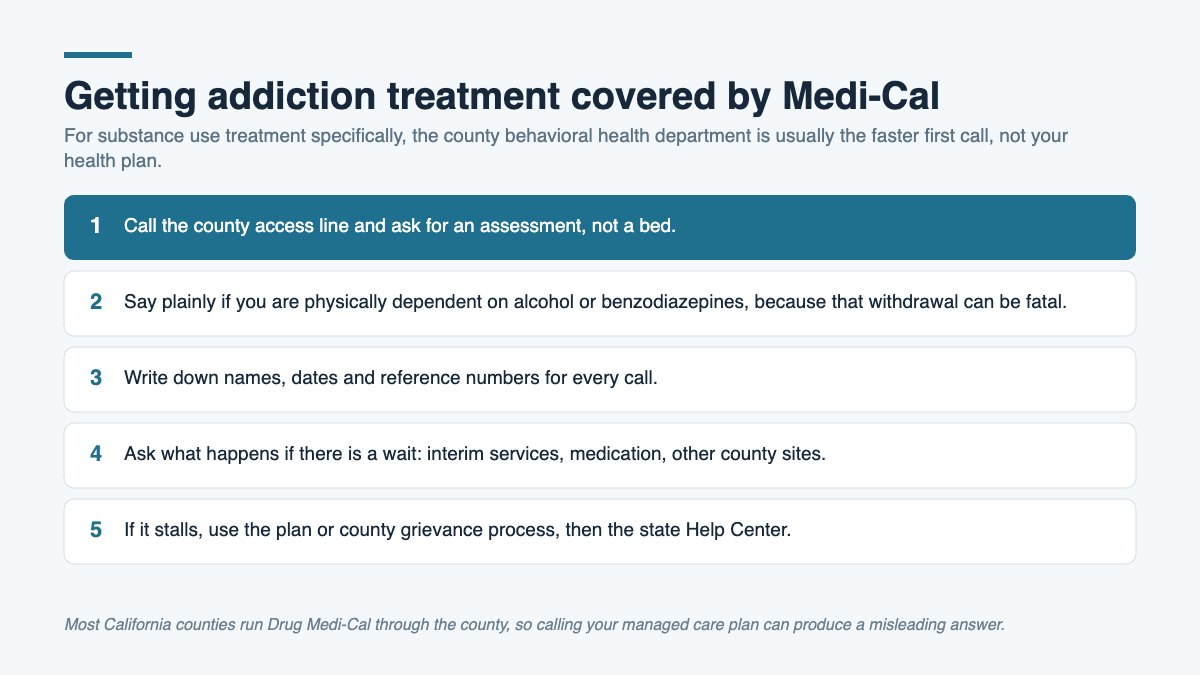
Most California counties operate under the Drug Medi-Cal Organized Delivery System, which means the county behavioral health department, not your managed care plan, arranges and authorizes substance use treatment. The practical consequence is simple: for addiction treatment specifically, the county access line is usually the faster and more accurate first call.
What Medi-Cal covers
Under Drug Medi-Cal, covered services generally include screening and assessment, medically supervised withdrawal management (what most people mean by detox), residential treatment, intensive outpatient and standard outpatient treatment, medication for opioid use disorder including buprenorphine, methadone and naltrexone, recovery services after the main course of treatment ends, and case management.
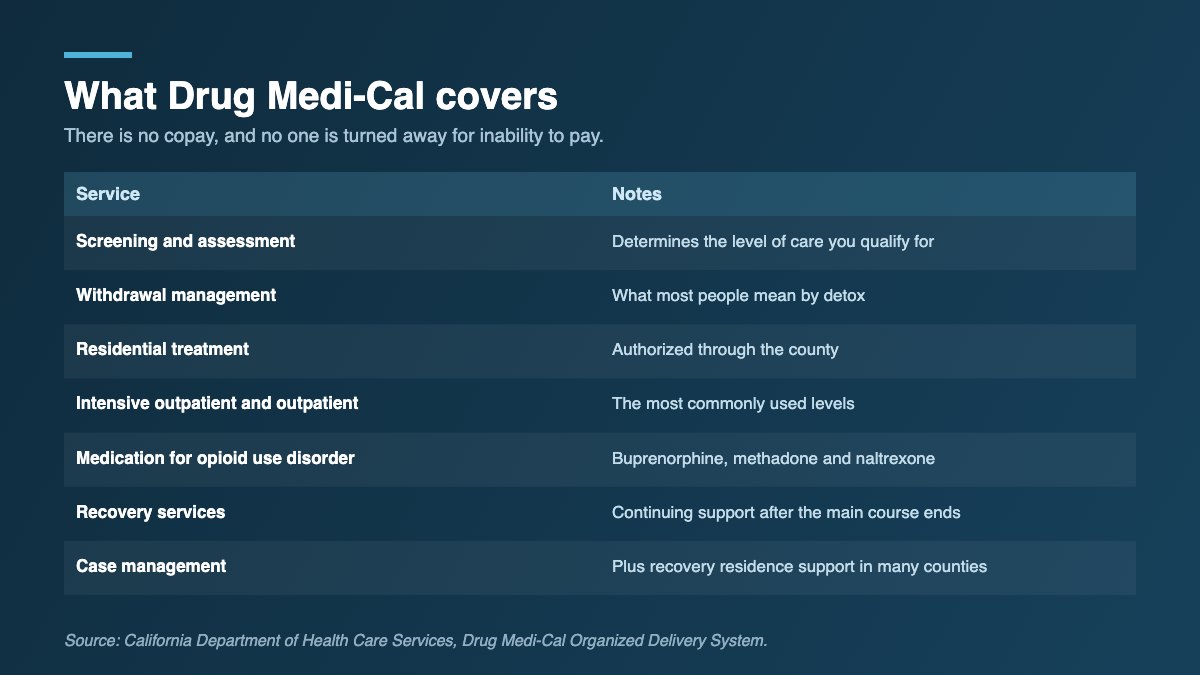
There is no copay for Drug Medi-Cal services, and no one is turned away for inability to pay. Under federal rules, pregnant women and people who inject drugs receive priority admission.
How to get treatment arranged in Ontario
- Call the county access line first. San Bernardino County residents can reach the Screening, Assessment and Referral Center on 1-800-968-2636 for a free, confidential substance use assessment, available 24 hours a day. The county behavioral health access line on 1-888-743-1478 also runs 24 hours a day for crisis support and referrals.
- Ask for an assessment, not a bed. The assessment determines the level of care you qualify for, and it is what unlocks authorization. Asking directly for residential treatment before an assessment often slows things down.
- Say plainly if the situation is urgent. If you are physically dependent on alcohol or benzodiazepines, say so, because withdrawal from those can cause seizures and can be fatal, and it changes the priority of your case. Mention any recent overdose too.
- Write down names, dates and reference numbers for every call. If something stalls later, that record is what moves it.
- Ask what happens if there is a wait. Ask specifically about interim services, medication while you wait, and whether another county site has capacity sooner.
- Escalate if you get stuck. Every Medi-Cal plan and county behavioral health department has a grievance process, and the California Department of Managed Health Care Help Center takes complaints about plan delays and denials.
What to ask any program before accepting a placement
- Are you licensed or certified by the California Department of Health Care Services, and are you Drug Medi-Cal certified?
- Do you offer medication for opioid use disorder? If the answer is no, or that the program prefers an abstinence-based approach, be cautious. Buprenorphine and methadone roughly halve mortality in opioid use disorder compared with counseling alone, so declining to offer them means declining the intervention with the strongest evidence for keeping people alive.
- Will I be able to continue my psychiatric medication?
- How do you handle a relapse during treatment? Am I discharged?
- What is the plan for after this level of care ends, and who arranges it?
- Will I be billed for anything at all?
A warning about how placement gets sold
Some websites that look like local providers are lead generation operations that sell your phone call to whichever facility bid highest. Ask directly whether you are speaking to the treatment program or to a call center. Treat any offer of something valuable in exchange for enrolling, such as paid travel or waived costs, as a reason to stop: paying for patient referrals is illegal in California.
One more thing worth knowing. Detox on its own is not treatment. Completing withdrawal without follow-on care has poor outcomes, and with opioids it raises overdose risk because tolerance falls while nothing else about the situation has changed. Ask what comes after detox before you start it.
Keep naloxone regardless of coverage
Naloxone nasal spray reverses opioid overdose. It is sold over the counter without a prescription and is free through California’s Naloxone Distribution Project and many county harm reduction programs. It matters even where opioids are not the main concern, because counterfeit pills, cocaine and methamphetamine are now commonly contaminated with fentanyl, and people with no opioid tolerance are the most likely to die from it. Fentanyl overdoses frequently need more than one dose.
Sources
- California Department of Health Care Services, Drug Medi-Cal Organized Delivery System
- County behavioral health departments for the access lines cited above
- SAMHSA National Helpline, 1-800-662-4357, and FindTreatment.gov
- Federal regulations on priority admission for pregnant women and people who inject drugs
- National Institute on Drug Abuse, medications to treat opioid use disorder
Need help now? In an emergency call 911. If you are in crisis or thinking about suicide, call or text 988 (Suicide and Crisis Lifeline; veterans press 1). For free, confidential treatment referrals 24 hours a day, call the SAMHSA National Helpline at 1-800-662-4357. You can also search licensed programs at FindTreatment.gov, or use our rehab directory and state listings.
Addiction Now publishes health journalism and reference material. This page is not medical advice, a diagnosis, or a treatment plan. Do not stop a prescribed medication without talking to a clinician. Withdrawal from alcohol, benzodiazepines and barbiturates can cause seizures and can be fatal without medical supervision.
Updated July 30, 2026. Coverage rules and county contact details change, so confirm current details with the county or your plan before relying on them.