

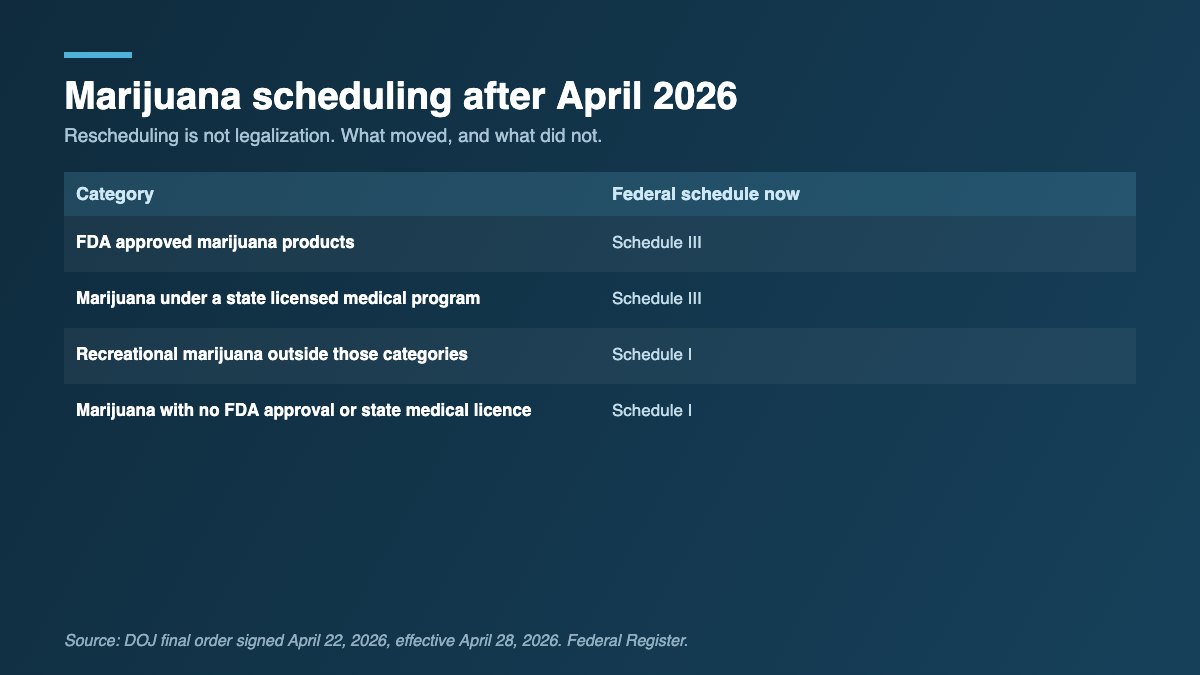
On April 22, 2026 the Department of Justice signed a final order moving FDA approved marijuana products and marijuana handled under state licensed medical programs from Schedule I to Schedule III, effective April 28, 2026. Recreational marijuana outside those categories remains Schedule I. Rescheduling is not legalization, and that distinction matters more than most coverage suggested.
What the order actually did
The Controlled Substances Act sorts drugs into five schedules. Schedule I is reserved for substances with no accepted medical use and a high potential for abuse, and it carries the heaviest restrictions on research. Schedule III sits considerably lower, alongside substances such as ketamine and anabolic steroids.
The April order did not move the whole category. It moved two specific things: FDA approved drug products containing delta-9 THC derived from Cannabis sativa L., and marijuana handled under a state licence authorizing manufacture, distribution or dispensing for medical purposes. Everything else, including the adult use market outside those categories, stayed in Schedule I.
Alongside the order, the Department of Justice opened a further administrative hearing to consider broader rescheduling, including adult use marijuana. Those hearings ran from June 29 to July 15, 2026, and the outcome will determine whether this split framework persists.

Why a split framework is awkward in practice
The same plant can now sit in two different schedules depending on the licence attached to it. For dispensaries, employers, researchers and clinicians that creates a question which did not exist before: not what is this substance, but under which authority was this particular product handled.
For patients the practical effect is smaller than the headlines implied. State law still governs what you can buy and where. Federal illegality still applies to most of the market. And nothing in the order changes how the drug behaves in the body.
What does change
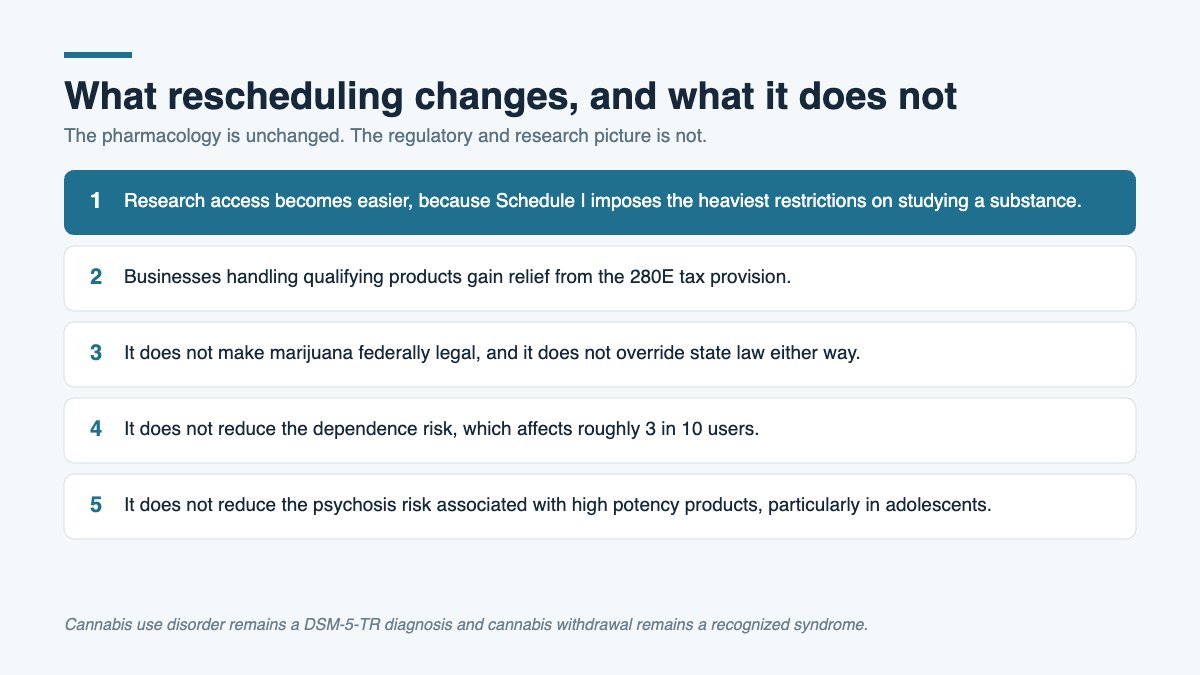
Research. This is the most consequential effect. Schedule I status has made cannabis research slow and administratively punishing for decades. Moving qualifying products to Schedule III lowers that barrier, which matters because the evidence base on cannabis is thinner than the size of the market would suggest.
Tax treatment. Section 280E of the tax code bars businesses trafficking Schedule I or II substances from deducting ordinary business expenses. Qualifying operations move outside that restriction.
What does not change
The clinical picture is exactly as it was on April 21. Cannabis use disorder remains a diagnosis in the DSM-5-TR, and roughly 3 in 10 people who use cannabis develop some degree of it. Cannabis withdrawal remains a recognized syndrome: irritability, insomnia with vivid unpleasant dreams, appetite loss, depressed mood and craving, beginning within 24 to 72 hours and peaking around days two to six.
The dose-response relationship between high potency products and psychosis risk is unchanged, and remains most pronounced in adolescents and people with a family history. Cannabinoid hyperemesis syndrome, the cyclic vomiting relieved temporarily by hot showers, is unchanged and still frequently misdiagnosed for years. Driving impairment is unchanged.
Potency is the variable that has actually shifted, and it shifted long before this order. Flower in the 1990s typically contained under 5 percent THC. Modern dispensary flower commonly runs 15 to 25 percent, concentrates can exceed 80 to 90 percent, and CBD content in high THC cultivars has fallen. See our marijuana reference page for the detail.
Practical takeaways
- Rescheduling is not legalization. If you are relying on it for a legal position, get advice specific to your state and your licence.
- It is not a safety signal. Ketamine and anabolic steroids are Schedule III. The schedule reflects abuse potential and accepted medical use, not harmlessness.
- The clinical risks are unchanged, and the products on the market are far stronger than the ones most older research studied.
- Watch the broader hearing outcome, because a split framework is unstable and unlikely to be the end state.
Sources
- Federal Register, Schedules of Controlled Substances: Rescheduling of Marijuana, April 28, 2026
- Drug Enforcement Administration, marijuana rescheduling regulatory actions
- National Institute on Drug Abuse, cannabis research report
- DSM-5-TR, cannabis use disorder and cannabis withdrawal criteria
Need help now? In an emergency call 911. If you are in crisis or thinking about suicide, call or text 988 (Suicide and Crisis Lifeline; veterans press 1). For free, confidential treatment referrals 24 hours a day, call the SAMHSA National Helpline at 1-800-662-4357. You can also search licensed programs at FindTreatment.gov, or use our rehab directory and state listings.
Addiction Now publishes health journalism and reference material. This page is not medical advice, a diagnosis, or a treatment plan. Do not stop a prescribed medication without talking to a clinician. Withdrawal from alcohol, benzodiazepines and barbiturates can cause seizures and can be fatal without medical supervision.