


Alcohol and alprazolam act on the same inhibitory system in the brain, so taking them together does not simply add two mild effects. It produces deep sedation, dense memory loss and suppressed breathing, and unlike an opioid overdose there is no naloxone that will reverse it.
Why the effects stack
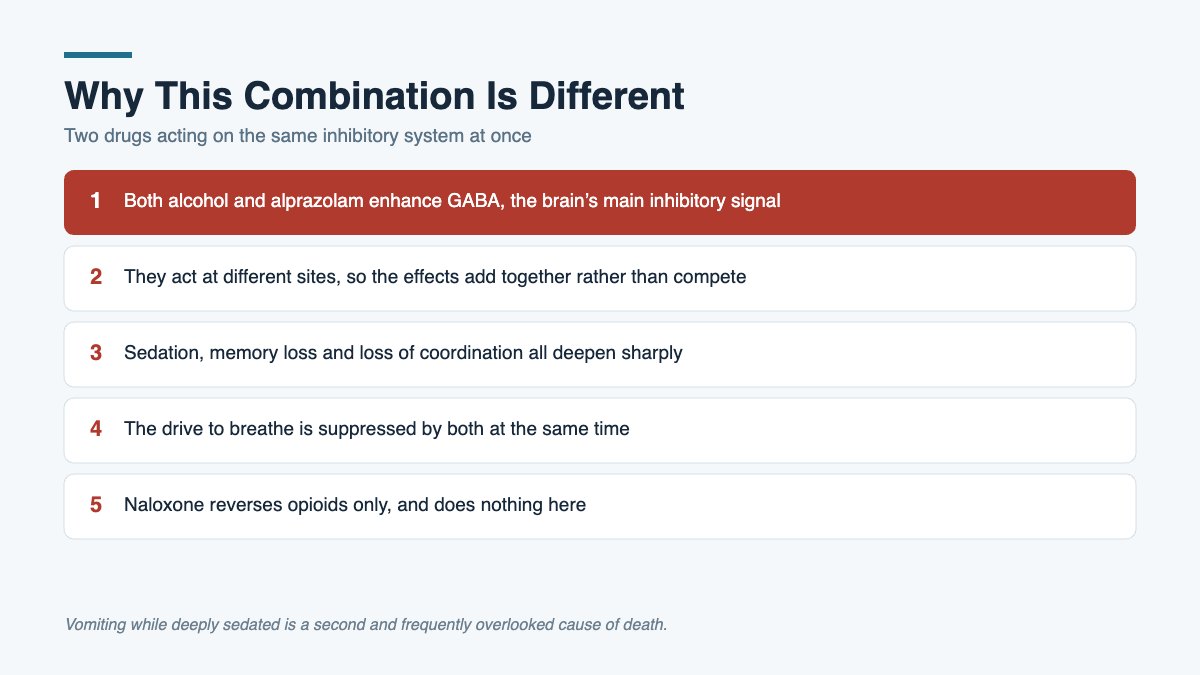
GABA is the brain’s main inhibitory neurotransmitter, the signal that quietens neural activity. Alprazolam, sold as Xanax, enhances GABA’s effect at one site on the receptor. Alcohol enhances it too, through a partly different route.
Because they act at different sites rather than competing for the same one, the effects combine. The practical result is that a modest dose of each can produce sedation equivalent to a much larger dose of either alone, and that the combined effect is difficult to predict from experience with either drug separately.
Tolerance does not rescue you here. Someone with a high alcohol tolerance has adapted to alcohol, not to alprazolam, and the combination reaches past the adaptation.

The two ways this kills
The first is respiratory depression. Both drugs suppress the brainstem mechanism that drives automatic breathing. Together, breathing can slow and stop in someone who simply appears heavily asleep.
The second is less discussed and kills a substantial number of people: vomiting while deeply sedated. Alcohol frequently induces vomiting, and profound sedation suppresses the gag reflex that would normally protect the airway. Someone lying on their back can aspirate and die without any respiratory depression at all. This is why the recovery position matters and why leaving someone to sleep it off is dangerous advice.
Naloxone will not help
This deserves stating plainly, because the widespread availability of naloxone has created an assumption that overdoses are reversible.
Naloxone displaces opioids from opioid receptors. Neither alcohol nor alprazolam acts on opioid receptors, so naloxone does nothing for this combination. It is still worth giving if opioids might also be involved, since mixed overdoses are common and it causes no harm if opioids are absent. But it is not a rescue for this pairing.
Flumazenil reverses benzodiazepines, and it is used cautiously and rarely, because in someone who is benzodiazepine dependent it can precipitate seizures. It is a hospital decision, not a take home option.
Blackouts get much worse
Both drugs interfere with the hippocampus, the structure that converts experience into memory that can be retrieved later. Alcohol does this, and benzodiazepines do it strongly enough that they are used deliberately for that property before medical procedures.
Combined, they produce dense anterograde amnesia: a person can be awake, walking, talking and making decisions while forming no memory of any of it. This is not the same as passing out, and it is the reason people wake with hours missing rather than with a gap around falling asleep.
The practical danger is that someone in this state appears functional enough to be left alone, to drive, or to take another dose because they do not remember the first.
Adding an opioid
If an opioid is also present, the risk rises again. Opioids suppress breathing by a third route, and combinations of an opioid with a benzodiazepine and alcohol appear repeatedly in overdose death data.
Anyone prescribed both an opioid and a benzodiazepine should know this combination carries a specific warning, and that adding alcohol on top of it is the most dangerous version. Our pages on benzodiazepines and alcohol cover each in more detail.
What an emergency looks like
- Slow, shallow, or noisy breathing. Snoring or gurgling in someone who cannot be woken is not sleep.
- Blue or grey lips and fingertips.
- Unresponsive to a firm shake or a shout.
- Vomiting while not fully conscious.
Call 911. Put the person on their side in the recovery position so that if they vomit it drains rather than being inhaled. Give naloxone if there is any chance opioids are involved, and stay until help arrives, because their level of consciousness can continue to fall as more alcohol is absorbed.
If you take both regularly
Combined dependence on alcohol and a benzodiazepine is a specific clinical situation, and stopping either abruptly carries a seizure risk. This is not a case for quietly cutting down on your own.
Be candid with a prescriber about both, with real quantities. Withdrawal from this combination is one of the clearer indications for medically supervised detox, and an accurate account is what makes a safe plan possible.
Sources
This article draws on Food and Drug Administration prescribing information for alprazolam, including its boxed warning on concomitant use with opioids, National Institute on Alcohol Abuse and Alcoholism material on alcohol interactions, and published clinical literature on sedative overdose and alcohol induced amnesia. It is reference information, not medical advice.
Need help now? In an emergency call 911. If you are in crisis or thinking about suicide, call or text 988 (Suicide and Crisis Lifeline; veterans press 1). For free, confidential treatment referrals 24 hours a day, call the SAMHSA National Helpline at 1-800-662-4357. You can also search licensed programs at FindTreatment.gov, or use our rehab directory and state listings.
Addiction Now publishes health journalism and reference material. This page is not medical advice, a diagnosis, or a treatment plan. Do not stop a prescribed medication without talking to a clinician. Withdrawal from alcohol, benzodiazepines and barbiturates can cause seizures and can be fatal without medical supervision.