


Adderall is a mixture of amphetamine salts that increases dopamine and noradrenaline signalling in the brain. At therapeutic doses it improves attention without producing a high. At higher doses the same molecule produces euphoria, and the risks change accordingly. Both facts are true, and confusing them causes most of the argument about this drug.
What it does mechanically
Amphetamine increases the release of dopamine and noradrenaline into the synapse and blocks their reuptake, so more of both remains available. Dopamine is central to motivation, reward and attentional filtering. Noradrenaline drives arousal and alertness.
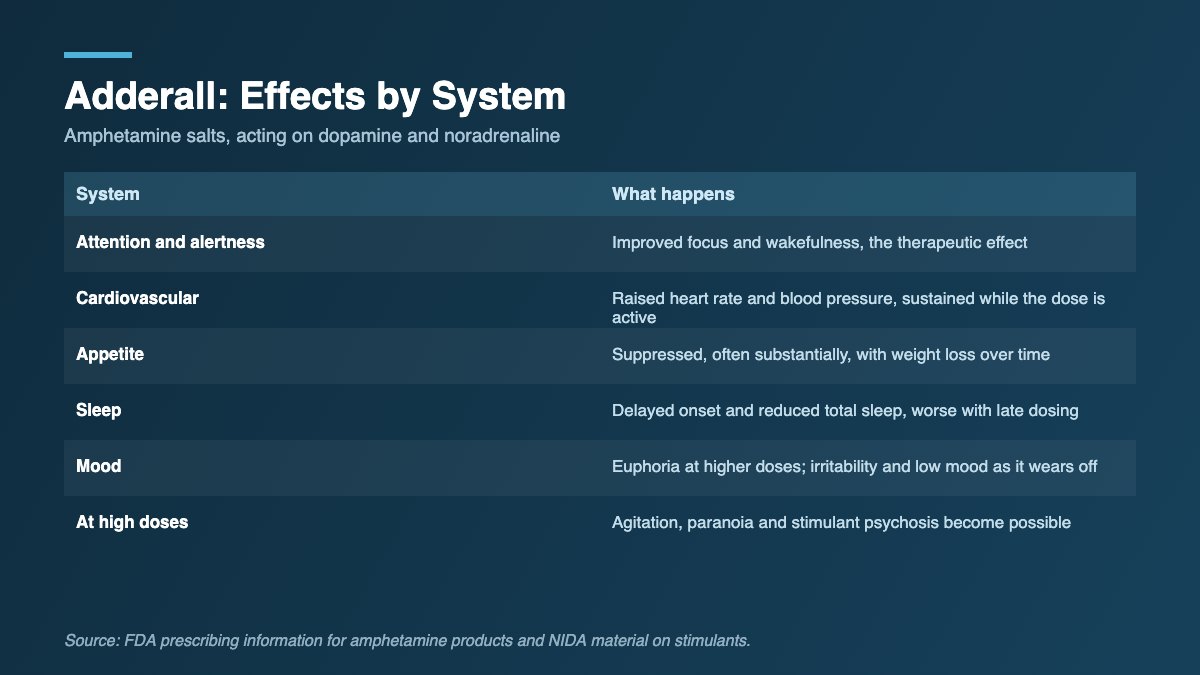
The result in the prefrontal cortex is improved sustained attention and reduced distractibility. Elsewhere it produces the effects that make amphetamine a stimulant generally: wakefulness, suppressed appetite, elevated heart rate and blood pressure.
Route and dose determine whether that becomes a high. Taken orally at a therapeutic dose, levels rise gradually and the reward system is engaged modestly. Taken at a large dose, or crushed and insufflated, levels spike, and a steep rise in dopamine is what euphoria consists of.

How long it lasts
Immediate release Adderall typically begins working within about thirty minutes and lasts roughly four to six hours. The extended release form spreads delivery across about ten to twelve hours.
The end of a dose is not neutral. As levels fall, many people experience a comedown: fatigue, irritability, low mood and a temporary worsening of concentration below baseline. Taking another dose to avoid it is one of the ordinary routes into escalation.
The cardiovascular effects
These are present at every dose, including prescribed ones, and are the reason blood pressure and heart rate should be checked when someone is on a stimulant long term.
Amphetamine raises both, and sustained elevation over years carries the same implications elevated blood pressure carries generally. Serious cardiac events are rare, and are concentrated in people with underlying structural heart problems, which is why a cardiac history is asked about before prescribing.
Anyone experiencing chest pain, palpitations, fainting or severe shortness of breath while taking a stimulant should treat that as a reason to seek assessment rather than to reduce the dose privately.
Sleep and appetite
Appetite suppression is close to universal and can be substantial. Over months that produces meaningful weight loss, and in adolescents there has been longstanding attention to effects on growth. Eating on a schedule rather than by hunger is the usual practical response, since hunger is the signal that has been switched off.
Sleep disruption is the other predictable effect, and it compounds everything else. Reduced sleep worsens attention, mood and impulse control, which are the very things the medication is being taken to improve. Late dosing is the common culprit, and it is worth examining before concluding the dose is wrong.
What high dose use adds
Beyond therapeutic ranges the picture changes. Tolerance develops to the euphoric effect, prompting escalation. Sleep deprivation accumulates, often across several days of continuous use.
Stimulant psychosis, involving paranoia and hallucinations, is a recognised consequence of high dose use combined with sleep loss. It generally resolves as the drug clears and sleep returns, and it requires medical care while it lasts. Agitation, elevated temperature and dangerous blood pressure spikes also become possible.
Amphetamine and methamphetamine differ by a single methyl group, which lets methamphetamine enter the brain faster and hit harder. The mechanism is otherwise closely related, which is worth knowing for anyone treating prescription stimulants as categorically safe. Our pages on prescription stimulants and methamphetamine cover this further.
Tolerance, dependence and stopping
Tolerance to the euphoric and appetite suppressing effects develops with sustained use. Tolerance to the therapeutic attention effect develops far less, which is why many people take a stable dose for years without escalation.
Stopping after regular use produces a withdrawal that is uncomfortable rather than dangerous: heavy fatigue, long sleep, large appetite, low mood and poor concentration, lasting days to a couple of weeks. There is no seizure risk and no medication is needed for safety.
The complication for anyone with genuine attention difficulties is that withdrawal fog and returning symptoms look identical in the first weeks, and cannot reliably be told apart until time has passed.
Practical points
- Take it early. Late doses cost sleep, and lost sleep undoes the benefit.
- Eat on a schedule. Hunger is suppressed, not absent.
- Have blood pressure checked periodically. The effect is present at therapeutic doses.
- Report chest symptoms rather than self adjusting.
- Never crush an extended release capsule. It converts a twelve hour dose into a spike.
- Treat the comedown as expected. Redosing to avoid it is how escalation usually starts.
More background is available on our drug information pages.
Sources
This article draws on Food and Drug Administration prescribing information for amphetamine products, including cardiovascular and psychiatric warnings, and on National Institute on Drug Abuse material on prescription stimulants. It is reference information rather than medical advice, and no prescribed medication should be changed without speaking to a clinician.
Need help now? In an emergency call 911. If you are in crisis or thinking about suicide, call or text 988 (Suicide and Crisis Lifeline; veterans press 1). For free, confidential treatment referrals 24 hours a day, call the SAMHSA National Helpline at 1-800-662-4357. You can also search licensed programs at FindTreatment.gov, or use our rehab directory and state listings.
Addiction Now publishes health journalism and reference material. This page is not medical advice, a diagnosis, or a treatment plan. Do not stop a prescribed medication without talking to a clinician. Withdrawal from alcohol, benzodiazepines and barbiturates can cause seizures and can be fatal without medical supervision.