

Overdose deaths in the United States fell 26.2 percent between 2023 and 2024, the largest single-year drop in a decade. That is the headline, and it is accurate. Underneath it, the improvement arrived years later for some groups than others, and one population has had the highest death rate in the country throughout.
The national picture, in final numbers
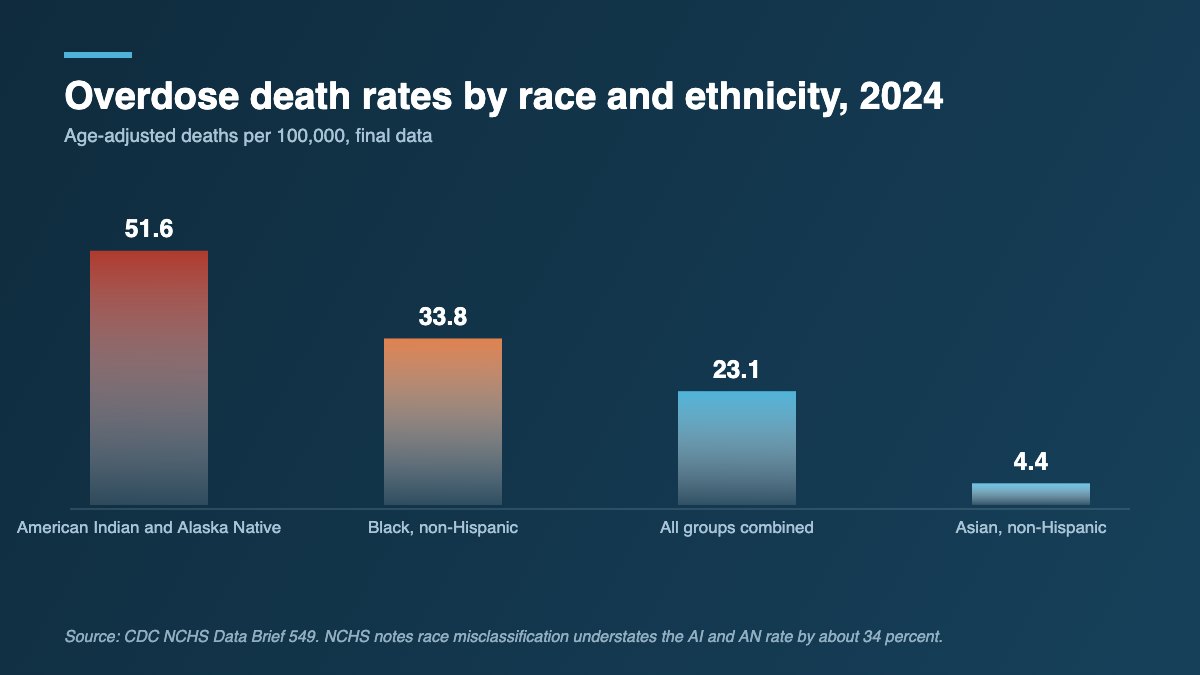
CDC’s National Center for Health Statistics reports an age-adjusted overdose death rate of 31.3 per 100,000 in 2023, falling to 23.1 in 2024. In absolute terms, 105,007 people died of overdose in 2023 and 79,384 in 2024.
Provisional counts for 2025, published in May 2026, estimate a further decline to 69,973 deaths, down almost 14 percent. Provisional and final figures are calculated differently and get revised, so the two series should not be read as a single continuous line.
The year the averages hid a divergence
2023 is the year worth examining, because the national rate fell 4 percent while several populations were still getting worse.

The decline that year was concentrated among White non-Hispanic people, whose rate fell 7 percent, from 35.6 to 33.1. Over the same period the rate for Black non-Hispanic people rose, from 47.5 to 48.9. The rate for Native Hawaiian and Other Pacific Islander non-Hispanic people rose 39.4 percent, from 18.8 to 26.2, the largest increase of any group. Rates for American Indian and Alaska Native, Asian and Hispanic populations did not change significantly.
Age broke the same way. Rates fell for people aged 15 to 54 but rose for those aged 55 to 64, from 48.1 to 49.2, and for those 65 and over, from 13.2 to 14.7, an 11.4 percent increase.
So for a year, “overdose deaths are falling” and “overdose deaths are rising” were both true statements, depending on which population you were describing.
2024: everyone improved, unevenly
The most recent final data is better news, and it is genuinely broad. Every racial and ethnic group and every age group saw a decline.
Black non-Hispanic people recorded the largest percentage decline of any racial or ethnic group, 30.9 percent, from 48.9 to 33.8. That is a substantial reversal from the year before, and it deserves to be reported as such.
American Indian and Alaska Native people had the highest rate of any group in both years, 65.0 in 2023 and 51.6 in 2024, and their roughly 21 percent decline was below the 26.2 percent national figure. NCHS adds a caveat that makes this worse rather than better: race misclassification on death certificates understates the rate for American Indian and Alaska Native people by about 34 percent, and by about 3 percent for Asian and Hispanic people. The true gap is wider than the published one.
By age, people aged 15 to 24 improved most, down 37 percent from 13.5 to 8.5. Adults 65 and over improved least, down 8.8 percent from 14.7 to 13.4. Adults aged 35 to 44 had the highest rate of any age group in both years.
The stimulant trend running the other way
One category has not followed the decline. A peer-reviewed analysis published in the journal Addiction in June 2026, using CDC mortality data, found that deaths involving stimulants without fentanyl rose from 18,142 in 2023 to 18,907 in 2024. Because the overall total fell so sharply, that category grew from 17.3 percent of all overdose deaths to 23.8 percent.
The same analysis reported that cocaine-involved deaths fall disproportionately on Black Americans and methamphetamine-involved deaths disproportionately on American Indian and Alaska Native communities, which connects the drug-specific trend to the demographic one. A national response built around opioid reversal and opioid medications does not have an equivalent to offer for stimulants, where no approved medication treatment exists.
State-level provisional data for 2025 shows the same unevenness geographically. Rhode Island, New York, North Carolina, Alabama and Vermont each fell 25 percent or more, while New Mexico, Arizona and Colorado rose 10 percent or more.
What to take from this
- The 26.2 percent national decline from 2023 to 2024 is real and is the largest in a decade.
- In 2023, rates were still rising for Black and Native Hawaiian and Pacific Islander populations, and for adults over 55, while the national average fell.
- In 2024 every group improved, with Black Americans recording the largest percentage decline.
- American Indian and Alaska Native people have had the highest rate throughout, and the published figure understates it by roughly a third.
- Adults 65 and over have improved least, in both years.
- Deaths involving stimulants without fentanyl rose in 2024 and now account for close to a quarter of all overdose deaths.
- Any claim about overdose trends should name the population and the year, because the direction changes depending on both.
For background on the substances behind these figures, see our drug information library and the pages on fentanyl and methamphetamine.
Sources
This article relies on CDC National Center for Health Statistics Data Briefs 522 and 549, which report final National Vital Statistics System mortality data, the NCHS provisional overdose release of May 2026, and a peer-reviewed analysis of CDC mortality data published in the journal Addiction in June 2026. Rates are age-adjusted deaths per 100,000. Provisional figures are subject to revision.
Need help now? In an emergency call 911. If you are in crisis or thinking about suicide, call or text 988 (Suicide and Crisis Lifeline; veterans press 1). For free, confidential treatment referrals 24 hours a day, call the SAMHSA National Helpline at 1-800-662-4357. You can also search licensed programs at FindTreatment.gov, or use our rehab directory and state listings.
Addiction Now publishes health journalism and reference material. This page is not medical advice, a diagnosis, or a treatment plan. Do not stop a prescribed medication without talking to a clinician. Withdrawal from alcohol, benzodiazepines and barbiturates can cause seizures and can be fatal without medical supervision.