


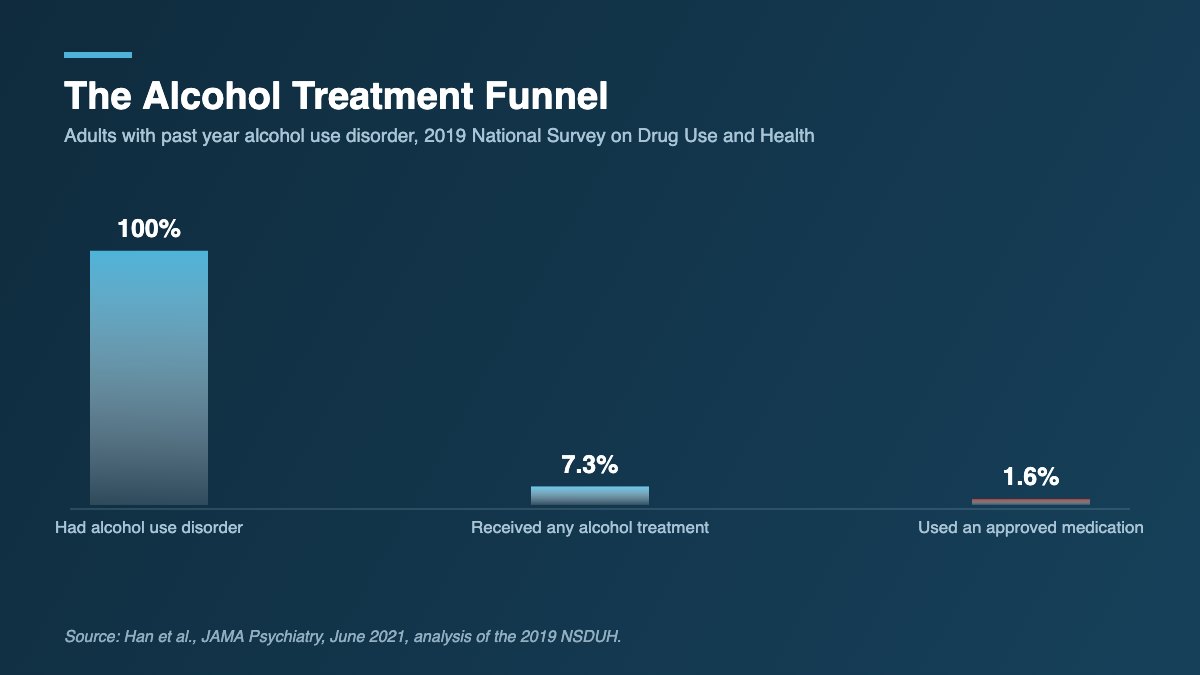
Federal regulators have approved three medications to treat alcohol use disorder. When a national survey asked adults with the disorder whether they had used one, 1.6 percent said yes. That works out to roughly 223,000 people out of an estimated 14.1 million, and it is the clearest measure available of how rarely these drugs reach the people they were approved for.
What the survey measured
The figure comes from the 2019 National Survey on Drug Use and Health, the annual federal survey that tracks substance use and mental health care across the country. That year was the first time the survey asked people who had received alcohol treatment whether a physician or other health professional had prescribed medication to help them reduce or stop drinking. A research team led by Beth Han at the National Institute on Drug Abuse analyzed responses from nearly 43,000 adults and published the results in JAMA Psychiatry in June 2021.
Two numbers came out of it. About 5.6 percent of American adults, or 14.1 million people, met criteria for alcohol use disorder in the previous year. Among that group, 7.3 percent reported receiving any treatment at all for alcohol use, and 1.6 percent reported using one of the approved medications.
The ordering matters. The medication gap sits inside a much larger treatment gap. More than nine in ten people who met criteria for the disorder did not receive any form of alcohol treatment in the year they were surveyed, medication or otherwise.
The three approved medications
Naltrexone is available as a daily pill and as a monthly extended release injection. Acamprosate is taken orally, typically three times a day. Disulfiram, the oldest of the three, causes an unpleasant physical reaction if a person drinks while taking it. None of the three is a controlled substance and none carries a risk of dependence, a point the study authors emphasized because it distinguishes these drugs from the medications used to treat opioid use disorder, where prescribing has long been shaped by controlled substance rules.
That distinction is worth sitting with. There is no federal registration requirement for prescribing naltrexone or acamprosate, no patient limit, and no separate license. Any clinician with prescribing authority can write for them. The barriers that produced the 1.6 percent figure are therefore not the regulatory barriers that dominate discussion of opioid treatment. For more on how substances differ in their treatment pathways, see our drug information library and its alcohol reference page.
Who was using them
The study identified several characteristics associated with medication use. People taking an approved medication were more likely to have received mental health care, and more likely to report three or more emergency room visits in the past year. They were also more likely to live in a large metropolitan area.
The authors read the first two associations as a signal about severity. Medication use appeared concentrated among people whose alcohol use disorder was serious enough to generate repeated acute care contacts and to co-occur with other psychiatric or medical conditions. In other words, these drugs were not functioning as an early intervention. They were reaching a subset of people already deep into the medical system.
The metropolitan finding points at supply. Specialty alcohol treatment services, and the clinicians most comfortable prescribing for alcohol use disorder, are not evenly distributed. That geography shows up repeatedly in addiction treatment data, and it is one reason national averages can understate how thin access is outside of cities.
What the data does not settle
A survey of this kind captures what people report, not what clinicians offered. It cannot separate a person who was never told medication existed from a person who declined it, or from a person who was prescribed it and stopped. It also reflects a single year, 2019, which means it predates the pandemic period and the expansion of telehealth prescribing that followed.
Nor does the survey establish why any individual clinician did not prescribe. Researchers and federal agencies have pointed to a mix of contributing factors, including limited training in addiction medicine among general practitioners and a treatment culture that historically separated counseling from medical care. The survey itself does not measure those things, and it would be a mistake to read a cause into a number that only describes an outcome.
What the survey does establish is a floor for the size of the problem. Whatever the mechanism, the drugs were approved, available at ordinary pharmacies, unrestricted by prescribing licenses, and used by fewer than two people in a hundred who had the condition they treat.
Takeaways
- Three medications are approved for alcohol use disorder: naltrexone, acamprosate and disulfiram. None is a controlled substance.
- In the 2019 NSDUH, 1.6 percent of adults with alcohol use disorder reported using one, about 223,000 people out of 14.1 million.
- The wider problem is that only 7.3 percent received any alcohol treatment at all that year.
- Medication use was concentrated among people with repeated emergency room visits, co-occurring mental health care, and large metropolitan addresses.
- Because these drugs carry no special prescribing license, the access barrier is clinical practice and awareness rather than federal regulation.
- Anyone considering one of these medications should raise it with a prescribing clinician, who can weigh it against other conditions and medications.
Sources
National Institutes of Health, reporting on research supported by the National Institute on Drug Abuse and the National Institute on Alcohol Abuse and Alcoholism. Han B, Jones CM, Einstein EB, Powell PA, Compton WM, “Use of Medications for Alcohol Use Disorder in the US: Results From the 2019 National Survey on Drug Use and Health,” JAMA Psychiatry, June 2021. Survey data from the Substance Abuse and Mental Health Services Administration, National Survey on Drug Use and Health.
Need help now? In an emergency call 911. If you are in crisis or thinking about suicide, call or text 988 (Suicide and Crisis Lifeline; veterans press 1). For free, confidential treatment referrals 24 hours a day, call the SAMHSA National Helpline at 1-800-662-4357. You can also search licensed programs at FindTreatment.gov, or use our rehab directory and state listings.
Addiction Now publishes health journalism and reference material. This page is not medical advice, a diagnosis, or a treatment plan. Do not stop a prescribed medication without talking to a clinician. Withdrawal from alcohol, benzodiazepines and barbiturates can cause seizures and can be fatal without medical supervision.