
Sewage can be tested for drugs and their metabolites, giving a near real time read on what a whole city is consuming. A national program doing exactly that covers roughly 35 million Americans. It is not run by the CDC, whose wastewater system monitors respiratory viruses and tracks no drugs at all.
How it works
When a person uses a drug, the body excretes both the parent compound and specific breakdown products. Those metabolites arrive at a wastewater treatment plant, where a sample can be analysed and the concentration converted into an estimated mass load for the catchment, then divided by the population served to produce a per capita figure.
The distinction between parent compound and metabolite is what makes the method credible. Finding cocaine itself in sewage is ambiguous, because someone may have flushed a supply. Finding the metabolite that only forms after passing through a human liver indicates consumption. Programs that report consumption rather than presence are measuring metabolites for this reason.
What it is good at
Speed is the main advantage. Overdose mortality data runs months behind, and survey data runs a year or more behind. A wastewater sample reflects last week. For detecting that a new adulterant has entered a local supply, that lag difference is the whole value.

It also sidesteps the biases that limit every other method. Nobody has to consent, disclose, remember accurately or come into contact with a service to be counted. Surveys miss people who are homeless, incarcerated or simply unwilling to answer, and those are the people whose drug use matters most for overdose. Sewage does not care.
What it cannot do
It cannot say how many people are using, only how much of a substance is being consumed in aggregate. A hundred people using a small amount and ten people using a great deal produce similar signals. Prevalence claims derived from wastewater data should be treated sceptically.
The denominator is also softer than it looks. The population served by a treatment plant fluctuates with commuting, tourism, seasonal work and student terms, and per capita figures inherit that uncertainty. Industrial discharge, rainfall dilution, sewer transit time and in pipe degradation all affect what arrives at the sampling point. And metabolite specificity varies by substance, which is why methamphetamine and cocaine are easier to interpret than some synthetic opioids.
The CDC confusion is worth correcting
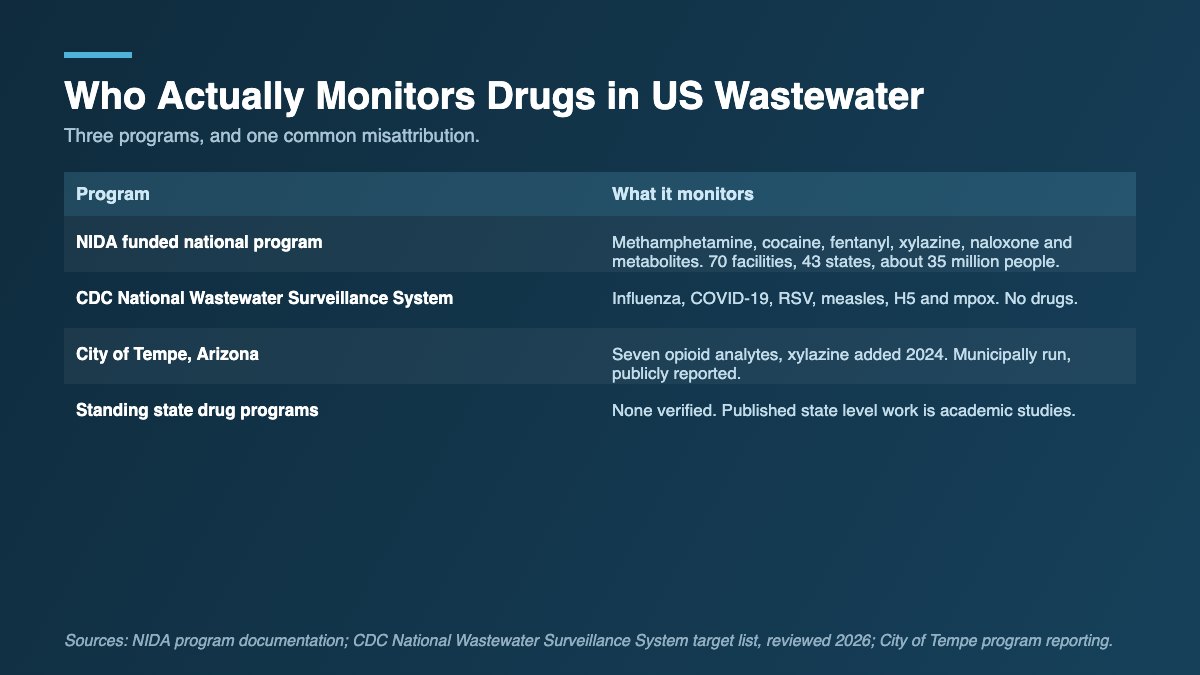
The CDC does operate a National Wastewater Surveillance System, and it is well known from the pandemic. Its current targets are influenza, COVID-19, RSV, measles, H5 influenza and mpox. It does not monitor fentanyl, methamphetamine, xylazine or any other drug.
The national drug monitoring is a separate arrangement: a program funded through the National Institute on Drug Abuse and delivered by a private analytics company, reaching full enrollment at 70 treatment facilities across 43 states in late 2023, and measuring methamphetamine, cocaine, fentanyl, xylazine and naloxone along with their metabolites. Statements that the CDC tracks drugs in sewage are simply incorrect, and they appear often enough to be worth flagging.
There is also genuinely municipal work. The City of Tempe, Arizona runs its own program covering seven opioid analytes, added xylazine in 2024, and publishes results publicly. That is unusual: most local efforts are academic studies with fixed end dates rather than standing municipal programs.
The governance question
A national drug surveillance capability delivered by a private contractor under a research award is a fragile arrangement. Research funding is time limited and renewals are not guaranteed, which means a monitoring system that public health officials have begun to rely on has no statutory basis and no permanent appropriation. That is a policy vulnerability independent of whether the science is sound.
Scale also raises a privacy line. At the level of a treatment plant serving hundreds of thousands of people, no individual is identifiable and the ethical objections are weak. Applied to a single building, dormitory or facility, the same technique starts to resemble surveillance of a small identifiable group, and the fact that it is technically feasible is not an argument that it is appropriate.
Takeaways
- A NIDA funded program monitors drugs in wastewater at 70 treatment facilities across 43 states, covering about 35 million people.
- It measures methamphetamine, cocaine, fentanyl, xylazine and naloxone along with metabolites.
- The CDC National Wastewater Surveillance System tracks respiratory viruses and mpox. It does not track any drug.
- Measuring metabolites rather than parent compounds is what distinguishes consumption from disposal.
- Wastewater shows how much is consumed, not how many people are using. It cannot produce prevalence.
- The national capability rests on a research contract rather than a statutory program, which makes continuity uncertain.
Sources
National Institute on Drug Abuse funded national wastewater monitoring program documentation and enrollment announcements; Centers for Disease Control and Prevention National Wastewater Surveillance System pathogen target list, reviewed 2026; City of Tempe, Arizona Wastewater BioIntel Program public reporting; peer reviewed wastewater based epidemiology methods literature.
Need help now? In an emergency call 911. If you are in crisis or thinking about suicide, call or text 988 (Suicide and Crisis Lifeline; veterans press 1). For free, confidential treatment referrals 24 hours a day, call the SAMHSA National Helpline at 1-800-662-4357. You can also search licensed programs at FindTreatment.gov, or use our rehab directory and state listings.
Addiction Now publishes health journalism and reference material. This page is not medical advice, a diagnosis, or a treatment plan. Do not stop a prescribed medication without talking to a clinician. Withdrawal from alcohol, benzodiazepines and barbiturates can cause seizures and can be fatal without medical supervision.