

Naloxone nasal spray has been available without a prescription since 2023. In the largest national audit since, callers reached 1,108 pharmacies and 61.4 percent could supply it the same day, at an average cost of about 52 dollars. Legal access and actual access turned out to be different problems.
What changed in 2023
The Food and Drug Administration approved the first over the counter naloxone nasal spray in March 2023, and a second product later that year. When the first went on sale that August, its manufacturer set a suggested retail price of 44.99 dollars for a two dose carton, roughly 22.50 dollars per dose. Retailers set their own shelf prices, so that figure was a starting point rather than what people paid.
The national picture, measured
A secret shopper study published in JAMA Network Open in July 2026 contacted 1,108 retail pharmacies across the country between January and April 2024. It found 61.4 percent could provide naloxone the same day without a prescription, at a mean cost of 52.07 dollars.
Where the product sat in the store varied: 58 percent kept it behind the pharmacy counter, about 32 percent in self service aisles, and 9 percent at front checkout. Corporate chains were more likely to stock it than independents. So were pharmacies in communities with higher proportions of White residents.
An over the counter product kept behind the counter is still over the counter in a legal sense. It is not over the counter in the sense that matters to someone who does not want to ask.
Did the switch actually help
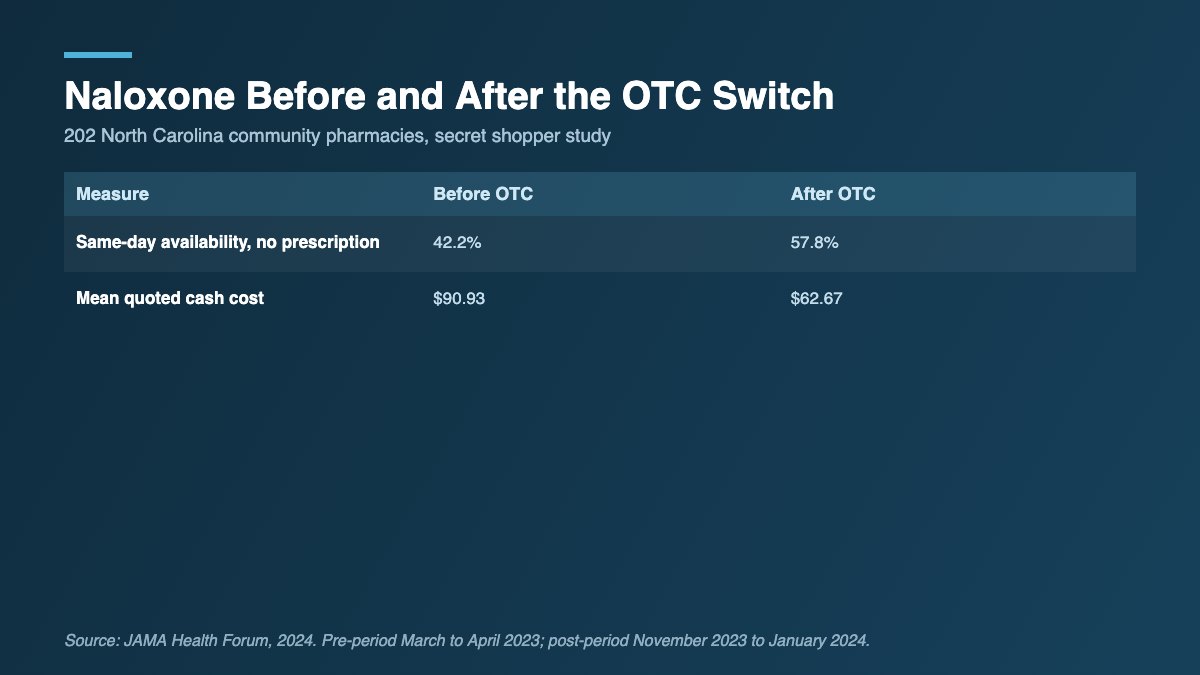
The clearest before and after evidence comes from a study of 202 North Carolina community pharmacies published in JAMA Health Forum in 2024. Same day availability without a prescription rose from 42.2 percent before the switch to 57.8 percent after. Mean quoted cash cost fell from 90.93 dollars to 62.67 dollars.
So yes, measurably better on both counts. And still short of universal.
Cost gaps persisted after the switch and followed a familiar shape. Independent pharmacies quoted 77.59 dollars on average against 57.74 at chains. Suburban pharmacies quoted 88.67 dollars and rural 65.43, against 53.58 in urban areas.
Sales did not surge either. A separate analysis of North Carolina retail sales from September 2023 through November 2024 found price per unit fell by about 49 cents and sales fell roughly 2 percent per quarter, with lower sales in non metropolitan areas and in areas with higher proportions of Black residents.
The legal pathways that existed before, and still matter
Over the counter status did not replace the older mechanisms. According to the Pew Charitable Trusts, most states have at least one of three arrangements. Standing orders let pharmacies dispense naloxone under the authority of a state level medical professional, and in some states let non pharmacy settings dispense it too. Protocol orders authorize dispensing under a licensing board or state board of health. Collaborative practice agreements let designated pharmacies dispense under a formal agreement with a prescriber.
These still matter because they are what allow community distribution, and because all state Medicaid programs cover some form of naloxone, which is a different route than paying cash at a counter.
Stocking is a separate problem from legality
A 2022 study of nearly 5,000 pharmacies, cited by Pew, found 30.5 percent did not stock prescription naloxone nasal spray at all. Independents and pharmacies in states with lower overdose rates were less likely to have it.
Some states have tried to force the issue. Massachusetts requires pharmacies in high overdose areas to maintain a continuous supply, and in January 2024 the state board of pharmacy declared the entire state a high overdose area, making the requirement statewide. Colorado runs a bulk purchase fund so organizations can distribute naloxone without paying retail.
What this means in practice
- Do not assume the nearest pharmacy has it. In the national audit, nearly four in ten could not supply it the same day.
- Call ahead and ask whether it is in stock and what the cash price is, because the spread between pharmacies is large.
- Ask whether it is on the shelf or behind the counter if you would rather not request it.
- Community distribution programs and health departments often supply it free, which is usually cheaper than any retail price.
- If you have Medicaid, ask about coverage rather than paying cash.
- Naloxone reverses opioid overdose only. It does not work on overdoses that do not involve opioids.
For background on the drugs naloxone does and does not act on, see our pages on fentanyl, oxycodone and drug information.
Sources
Approval and product information come from the Food and Drug Administration and from the manufacturer’s public pricing statement. National availability and price figures come from Eldridge and colleagues in JAMA Network Open, July 2026. Before and after comparisons come from a study of North Carolina pharmacies published in JAMA Health Forum in 2024, and retail sales figures from the Journal of Substance Use and Addiction Treatment. Standing order mechanics, stocking rates, Medicaid coverage and state requirements come from a Pew Charitable Trusts issue brief published in September 2025, along with the Massachusetts board of pharmacy and the Colorado Department of Public Health and Environment. The strongest national dataset was collected in early 2024; nothing more recent at national scale was available.
Need help now? In an emergency call 911. If you are in crisis or thinking about suicide, call or text 988 (Suicide and Crisis Lifeline; veterans press 1). For free, confidential treatment referrals 24 hours a day, call the SAMHSA National Helpline at 1-800-662-4357. You can also search licensed programs at FindTreatment.gov, or use our rehab directory and state listings.
Addiction Now publishes health journalism and reference material. This page is not medical advice, a diagnosis, or a treatment plan. Do not stop a prescribed medication without talking to a clinician. Withdrawal from alcohol, benzodiazepines and barbiturates can cause seizures and can be fatal without medical supervision.