
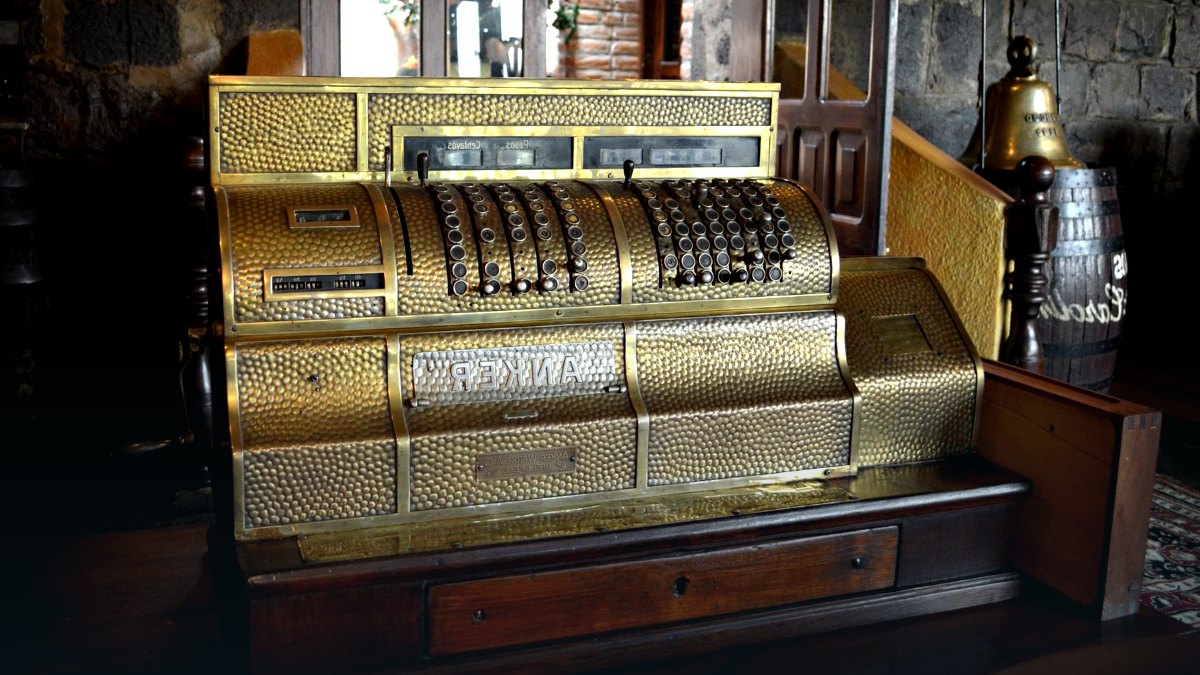
Naloxone vending machines have spread across the United States over the past four years. How many exist, and in how many states, is not known. The figure most commonly repeated in national coverage cannot be traced to anyone who counted, and the best available published figure is explicitly described by its authors as not a census.
The number that does not exist
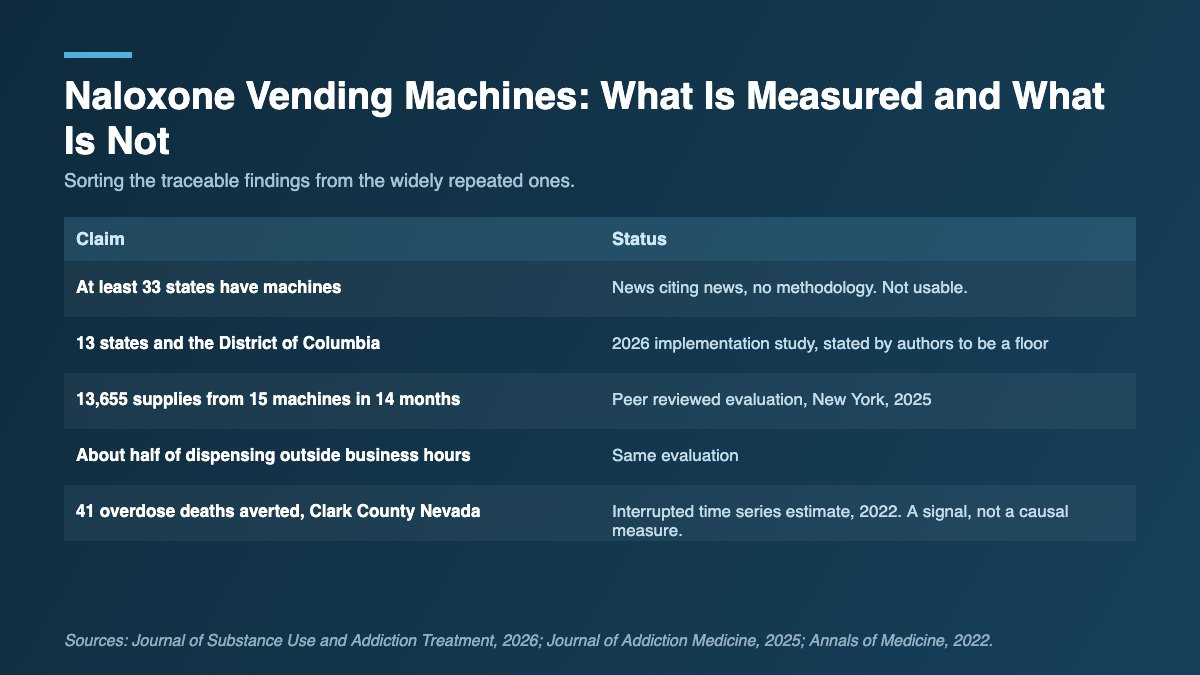
You will frequently read that at least 33 states have naloxone vending machines. Following that claim back leads to a health news article, which cites an earlier television news article, which cites nobody. There is no survey, no registry and no stated methodology behind it. It may well be true. It is not a measurement, and a data desk should not repeat it as one.
The reason no reliable count exists is structural. Machines are installed by county health departments, hospitals, universities, tribal health programs, syringe services programs and individual nonprofits. Several are funded from opioid settlement money, which is administered differently in every state. Nobody is required to register a machine with anyone, and no federal agency has been tasked with tracking them.
What can actually be said
An implementation study published in 2026 identified programs across 13 states and the District of Columbia. Its authors are clear that this reflects the programs they could identify and document, not a national inventory. That makes 13 a floor rather than a count, and the true figure is certainly higher.
For dispensing volume, the most useful published evidence comes from New York. Across 15 machines operated under a state program, more than 13,655 supplies were dispensed over 14 months, averaging around 529 naloxone kits per month. That is a real number from a peer reviewed evaluation with a defined denominator, which is what makes it worth more than the state count.
The after hours finding is the interesting one
The same New York evaluation reported that roughly half of dispensing occurred outside normal business hours. That single finding does more to justify vending machines than any total.
A pharmacy, a health department and a syringe services program are all closed at two in the morning. Overdoses are not distributed evenly across the working day, and the people least able to attend a weekday appointment are frequently the people at highest risk. A machine is not better than a human handing over naloxone with instructions. It is better than a locked door, and about half of its use is in exactly that circumstance.
This complements rather than duplicates the pharmacy channel, where our own reporting found that four in ten pharmacies could not supply over the counter naloxone the same day.
What a deaths averted estimate can claim
An analysis in Clark County, Nevada estimated that a vending machine program was associated with 41 overdose deaths averted, using an interrupted time series design. That method compares the trend before an intervention with the trend after it, and it is a reasonable approach when a randomised trial is impossible.
It is also vulnerable in specific ways worth naming. It cannot separate the machines from everything else that changed in the same period, including broader naloxone distribution, shifts in the drug supply and the arrival of over the counter sales. The estimate is a useful signal and it is not a causal measurement, and the difference matters when a figure like 41 starts appearing in funding requests without its method attached.
Why the counting gap matters
This is not a pedantic complaint. Settlement funds are being allocated partly on the basis of what is already deployed and what appears to work. Without a count, nobody can say which communities have coverage, whether machines are concentrated in places that already have services, or whether the rural counties with the worst pharmacy access have any at all. The absence of a denominator makes the equity question unanswerable.
Takeaways
- There is no authoritative national count of naloxone vending machines in the United States.
- The widely repeated claim of at least 33 states traces to news coverage citing news coverage, with no methodology. Do not use it.
- A 2026 implementation study documented programs in 13 states and DC, and describes that as a floor rather than a census.
- Fifteen machines in New York dispensed more than 13,655 supplies over 14 months, about 529 naloxone kits a month.
- Roughly half of that dispensing happened outside business hours, which is the strongest argument for the format.
- A Nevada analysis estimated 41 deaths averted using interrupted time series, which is a signal rather than a causal measurement.
Sources
Journal of Substance Use and Addiction Treatment implementation study of naloxone vending machine programs, 2026; Journal of Addiction Medicine evaluation of the New York MATTERS vending machine program, 2025; Annals of Medicine interrupted time series analysis of a Clark County, Nevada vending machine program, 2022; KFF Health News coverage of vending machine expansion, 2024.
Need help now? In an emergency call 911. If you are in crisis or thinking about suicide, call or text 988 (Suicide and Crisis Lifeline; veterans press 1). For free, confidential treatment referrals 24 hours a day, call the SAMHSA National Helpline at 1-800-662-4357. You can also search licensed programs at FindTreatment.gov, or use our rehab directory and state listings.
Addiction Now publishes health journalism and reference material. This page is not medical advice, a diagnosis, or a treatment plan. Do not stop a prescribed medication without talking to a clinician. Withdrawal from alcohol, benzodiazepines and barbiturates can cause seizures and can be fatal without medical supervision.