


Urine drug test positivity in the general United States workforce was 4.3 percent in 2025, down slightly from 4.4 percent the year before. You may also have seen that nearly one in five American workers tested positive. Both come from the same annual report. They are different tests on different populations, and the gap between them is the most instructive thing in the data.
What this index is, and what it is not
The figures come from the Quest Diagnostics Drug Testing Index, whose 2026 edition covers data year 2025. It is compiled from the laboratory results Quest actually processed, which is a large volume of tests and not a probability sample of American workers.
That distinction is not a technicality. Employers who test are not a random selection of employers: testing is concentrated in safety sensitive industries, in larger companies and in states and sectors where it is customary or legally required. Workers in those settings know they will be tested, which changes behaviour. So the index describes the tested population, and generalising from it to the workforce as a whole is an error the report itself does not make.
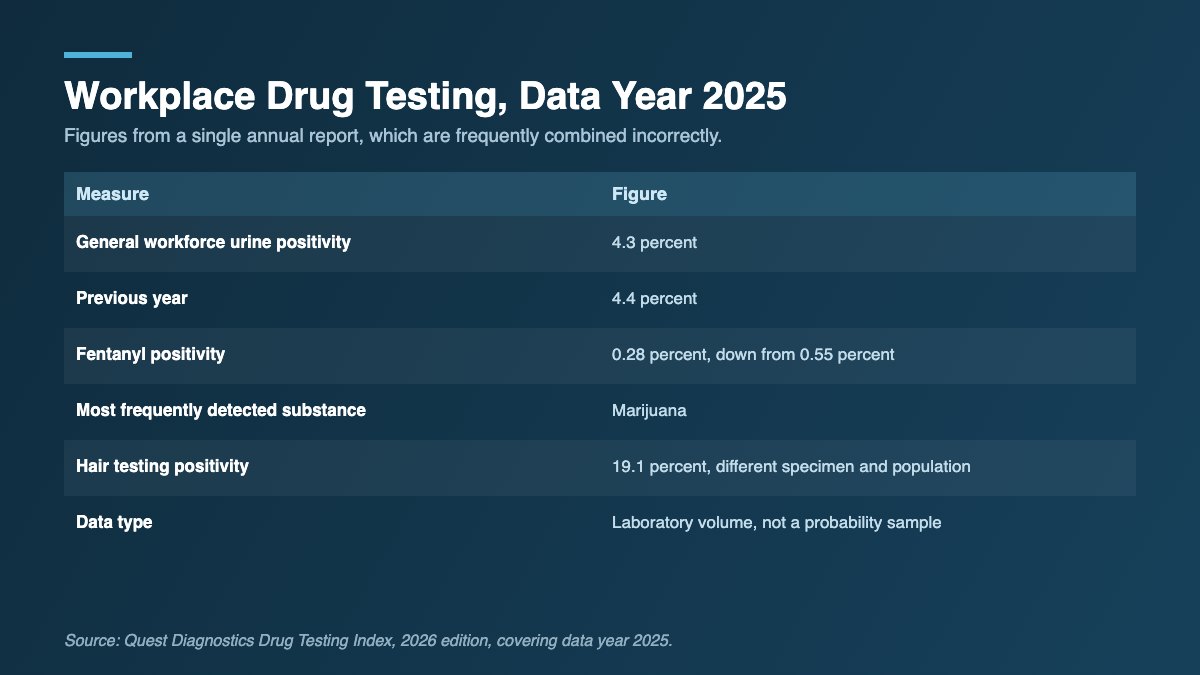
The specimen explains the one in five figure
Urine positivity was 4.3 percent. Hair testing positivity was 19.1 percent. Those numbers are not in conflict and neither is wrong.

Urine detects recent use, generally a window of days for most substances. Hair grows slowly and captures a window measured in months, so it will catch use that urine has long since cleared. Hair testing is also used by a different and smaller set of employers, for different purposes, which means the population being tested is not the same either. A longer detection window applied to a different group produces a higher positivity rate more or less automatically.
Any article that presents 19.1 percent as the share of American workers using drugs has combined a specimen type, a detection window and a self selected employer population into a claim about the country. Oral fluid testing, which detects a window between the two, produces its own separate figure for the same reason.
The fentanyl movement
The largest single change in the latest data was fentanyl, where positivity fell from 0.55 percent to 0.28 percent, a decline of roughly half in one year. That is a striking move, and it is directionally consistent with the national overdose mortality decline over the same period.
Two cautions before reading too much into it. Fentanyl is not on every standard testing panel, so the denominator for that figure is narrower and more variable than for long established panel drugs. And a positivity rate below one percent moves easily on small changes in which employers are testing for what.
The marijuana measurement trap
Marijuana remains the most frequently detected substance in workplace testing, and it is the one where the measure interacts most awkwardly with the law. As states have restricted pre employment marijuana screening and as employers in tight labour markets have removed it from panels voluntarily, those tests leave the denominator entirely.
This produces a genuine interpretation problem. A change in reported marijuana positivity can reflect a change in use, or a change in who is being tested for it, and the index cannot separate the two. The same logic applies in reverse to any substance newly added to panels. Reported positivity rates for substances whose testing coverage is shifting should be treated as weak evidence about consumption.
How to read a positivity rate
Four questions make these numbers usable. Which specimen: urine, hair or oral fluid. Which population: general workforce, or federally mandated safety sensitive roles, which are reported separately and run lower. Whether the substance is on standard panels or tested selectively. And whether testing coverage for that substance changed during the period.
Without those four, a positivity rate is a number without a referent. For detection windows by substance, see our drug information section.
Takeaways
- General workforce urine positivity was 4.3 percent in 2025, down from 4.4 percent.
- Hair testing positivity was 19.1 percent. It is a different specimen, a longer detection window and a different employer population.
- Fentanyl positivity halved, from 0.55 to 0.28 percent, though it sits on a narrow and variable denominator.
- Marijuana is still the most frequently detected substance, and shifting testing coverage makes its trend hard to interpret.
- This is laboratory volume data from employers who choose to test, not a sample of the American workforce.
Sources
Quest Diagnostics Drug Testing Index, 2026 edition covering data year 2025, including the published industry tables and methodology notes on specimen types and testing populations.
Need help now? In an emergency call 911. If you are in crisis or thinking about suicide, call or text 988 (Suicide and Crisis Lifeline; veterans press 1). For free, confidential treatment referrals 24 hours a day, call the SAMHSA National Helpline at 1-800-662-4357. You can also search licensed programs at FindTreatment.gov, or use our rehab directory and state listings.
Addiction Now publishes health journalism and reference material. This page is not medical advice, a diagnosis, or a treatment plan. Do not stop a prescribed medication without talking to a clinician. Withdrawal from alcohol, benzodiazepines and barbiturates can cause seizures and can be fatal without medical supervision.