
Heroin acts within minutes, producing euphoria followed by heavy sedation and slowed breathing. That respiratory effect is what kills people. The long term damage is less about the opioid itself than about how it is taken and what it is cut with, and in the current supply that increasingly means fentanyl.
What happens immediately
Heroin is diacetylmorphine. Its chemical structure lets it cross into the brain far faster than morphine does, where it converts back to morphine and binds to opioid receptors. The speed of that crossing is why the effect is described as a rush.
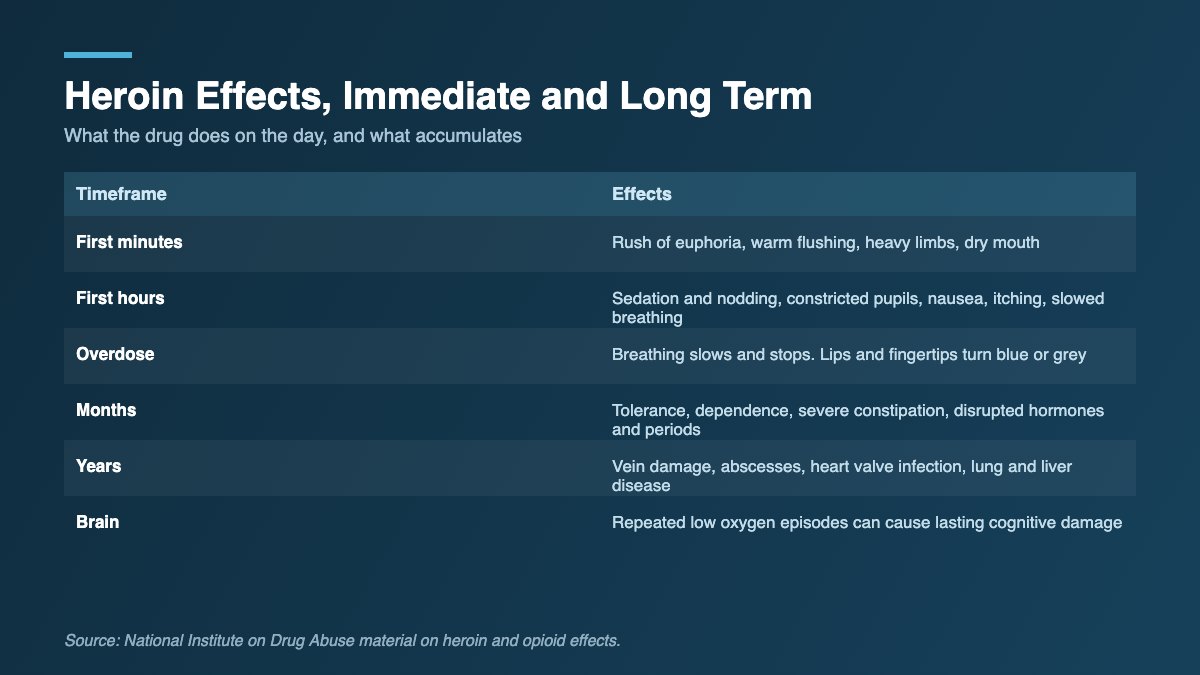
The first minutes bring euphoria, a warm flushing of the skin, a sensation of heaviness in the arms and legs, and dry mouth. Nausea and vomiting are common, particularly in people with low tolerance. Itching is common too, caused by histamine release rather than by anything on the skin.
What follows is a drowsy, semi conscious state often called nodding, drifting between wakefulness and sleep. Pupils constrict to pinpoints. Thinking slows, and so does breathing.

How overdose actually happens
Opioid receptors in the brainstem regulate the automatic drive to breathe. Enough opioid suppresses that drive, and breathing slows, becomes shallow, and stops.
It is rarely dramatic. Someone becomes very sedated, breathing becomes slow and noisy or snoring, and lips and fingertips turn blue or grey. From there, hypoxia damages the brain within minutes even where the person survives, which is why some people who are revived are left with lasting cognitive impairment.
Naloxone reverses this by displacing the opioid from the receptor. It works, it is available over the counter, and it wears off faster than many opioids do, which is why calling 911 remains necessary after giving it.
What accumulates over months and years
Tolerance develops quickly, and dependence with it, so that using becomes about avoiding withdrawal rather than seeking euphoria. Constipation is close to universal and can become severe, because opioid receptors in the gut are not spared by tolerance the way the euphoric effects are.
Hormonal effects are common and rarely discussed: reduced testosterone in men, irregular or absent periods in women, and lowered libido in both. These often reverse with treatment, which is worth knowing because people frequently assume the change is permanent.
Repeated episodes of low oxygen, including non fatal overdoses, are associated with lasting damage to white matter and to memory and decision making. This is a cumulative harm that does not require a single catastrophic event.
The harm that comes from injecting rather than from heroin
A large share of serious heroin related illness is a consequence of the route rather than the pharmacology. Repeated injection scars and collapses veins. Bacteria introduced through the skin cause abscesses, cellulitis, and infections of the heart valves, which is a life threatening condition requiring weeks of intravenous antibiotics and sometimes surgery.
Shared equipment transmits hepatitis C and HIV. Particles from crushed tablets or insoluble adulterants lodge in the lungs. Wound botulism and tetanus occur.
The practical implication is that these harms respond to changes in practice, sterile equipment, not sharing, cleaning the skin, in a way the opioid effects do not. That is the entire logic behind harm reduction services.
What the supply is now
The most important change is that much of what is sold as heroin contains fentanyl, or is fentanyl with no heroin at all. Fentanyl is far more potent by weight, acts faster, and is unevenly distributed through a batch, so two portions of the same powder can differ substantially.
This means dose is not predictable from experience, and the interval between using and losing consciousness can be very short. Our page on fentanyl covers this in more detail, and our heroin page has further background.
What reduces the risk
- Never use alone. The single most consistent factor in fatal overdoses.
- Carry naloxone, and tell someone where it is. It works regardless of tolerance.
- Assume tolerance is gone after any break. Days without using is enough.
- Do not mix with benzodiazepines or alcohol. They suppress breathing by a separate route.
- Use sterile equipment every time. Most of the long term damage travels this way.
- Get any fever, redness or swelling looked at quickly. Heart valve infection starts as something minor.
Further reference material is available on our drug information pages.
Sources
This article draws on National Institute on Drug Abuse material on heroin and opioid pharmacology, Centers for Disease Control and Prevention material on injection related infections and overdose, and published clinical literature on hypoxic brain injury following non fatal overdose. It is reference information, not medical advice.
Need help now? In an emergency call 911. If you are in crisis or thinking about suicide, call or text 988 (Suicide and Crisis Lifeline; veterans press 1). For free, confidential treatment referrals 24 hours a day, call the SAMHSA National Helpline at 1-800-662-4357. You can also search licensed programs at FindTreatment.gov, or use our rehab directory and state listings.
Addiction Now publishes health journalism and reference material. This page is not medical advice, a diagnosis, or a treatment plan. Do not stop a prescribed medication without talking to a clinician. Withdrawal from alcohol, benzodiazepines and barbiturates can cause seizures and can be fatal without medical supervision.