


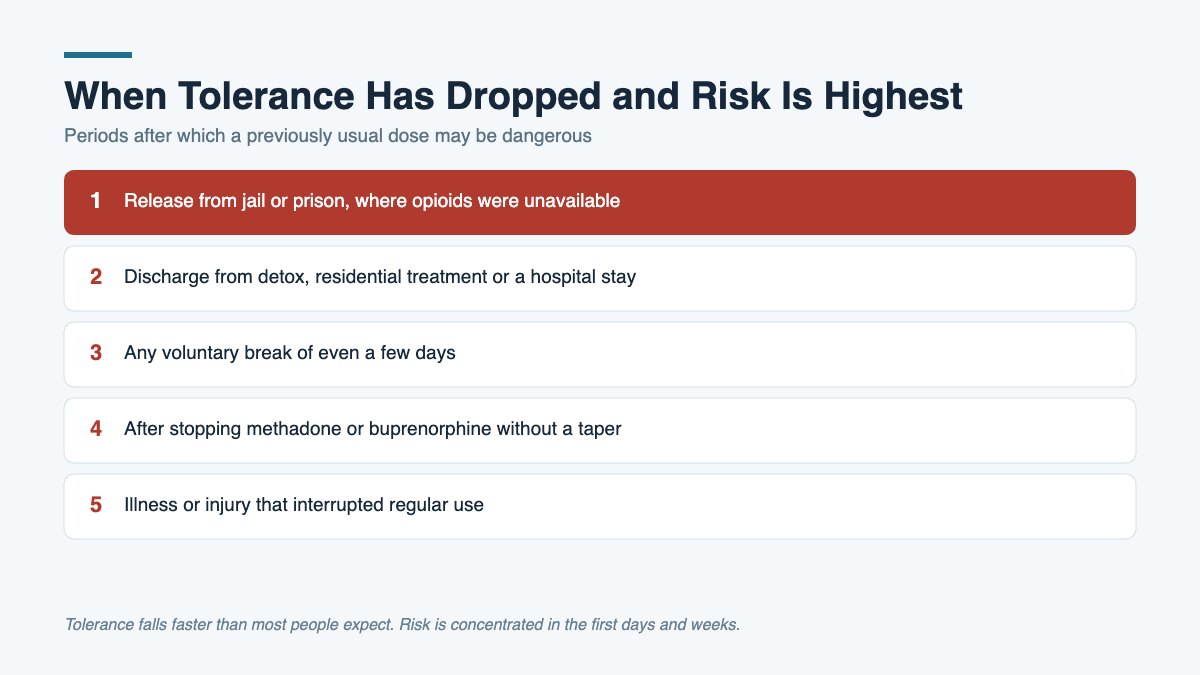
Opioid tolerance falls much faster than it builds. After even a short break, a dose that was routine weeks earlier can stop someone’s breathing. This is why the period right after jail, detox or a hospital stay is the most dangerous stretch in opioid use, and why the risk is so often invisible to the person taking the dose.
What tolerance actually is
Regular opioid use changes how the body responds. Receptors in the brain and brainstem become less sensitive, so achieving the same effect takes more drug. That adaptation is what tolerance means, and it develops unevenly across different effects.
This is the part that kills people. Tolerance to the euphoric effect builds quickly. Tolerance to respiratory depression, the slowing of breathing, builds more slowly and incompletely. So the gap between the dose that produces the desired effect and the dose that suppresses breathing narrows over time rather than widening.
When use stops, the adaptation reverses. Receptor sensitivity returns toward baseline within days to weeks. The body forgets the tolerance long before the person forgets the dose.

The two week window after release
The clearest evidence comes from people leaving incarceration. Research on post-release mortality has found the risk of fatal overdose in the first two weeks after release from jail or prison to be more than twelve times that of the general population.
The mechanism is not mysterious. Opioids are largely unavailable inside, tolerance drops across weeks or months of enforced abstinence, and on release a person returns to the amount they used before. Interviews with recently incarcerated people with opioid use disorder show they often understand this risk in the abstract while still misjudging it in the moment, partly because tolerance loss is invisible and partly because the old dose is the only reference point available.
Detox carries the same risk, for the same reason
Detox without ongoing medication produces the same physiology as incarceration: a period of abstinence, a fall in tolerance, then a return to previous use for a substantial share of people. A short medically supervised withdrawal, on its own, lowers tolerance without changing anything about the underlying disorder.
This is why continuing medication matters rather than simply completing withdrawal. Methadone and buprenorphine maintain a level of tolerance while blunting craving, which removes the tolerance cliff entirely. Evidence on medications for opioid use disorder started or continued during incarceration shows reduced overdose risk after release, and maintaining tolerance is part of how that works.
Fentanyl has made the margin smaller
Everything above was true in the heroin era. Fentanyl compresses it.
Fentanyl is far more potent by weight and acts faster, so the interval between taking a dose and losing the ability to breathe can be very short. It is also distributed unevenly through powders and counterfeit pills, meaning two portions from the same batch can differ substantially. Reduced tolerance plus an unpredictable dose is the combination behind a large share of deaths. Our page on fentanyl covers the potency and onset questions in more detail.
Mixing compounds it further. Benzodiazepines and alcohol suppress breathing through a separate mechanism, so combining them with opioids raises risk beyond what either does alone, and tolerance to one offers no protection against the other. See our reference pages on benzodiazepines and drug information.
How long does it take for tolerance to drop
There is no single number, and anyone offering one precise figure is overstating what is known. Tolerance is not one mechanism but several, operating on different timescales, and the rate of reversal varies with how long and how heavily someone used, which opioid was involved, and individual metabolism.
What can be said with confidence is that the direction is fast and the practical assumption should be conservative. Meaningful loss occurs within days rather than weeks. People who have been off opioids for a matter of days have died taking what had recently been an ordinary amount. A gap of two or three days is not a safe gap.
The reverse is also worth knowing: tolerance does not return instantly on resuming use. Someone who restarts after a break spends a further period at elevated risk while their tolerance rebuilds, which is why the danger extends beyond a single first dose.
What reduces the risk
- Assume tolerance is gone after any break. Days, not months, is enough for a meaningful drop.
- Never use alone. Almost everyone who dies of an overdose is alone at the time, because there is nobody present to respond.
- Have naloxone within reach and make sure someone else knows where it is. It is available over the counter, and it works on opioids regardless of tolerance.
- Use far less than the old amount, and wait. Onset with fentanyl is fast, and the previous dose is not a safe reference.
- Ask about medication before leaving detox or custody, not after. Methadone and buprenorphine remove the tolerance cliff rather than postponing it.
- Do not combine with benzodiazepines or alcohol. The mechanisms stack and tolerance does not transfer.
Sources
This article draws on peer reviewed research on post-release overdose mortality and tolerance loss published in the Harm Reduction Journal and the Health and Justice journal, research on medications for opioid use disorder during incarceration, and overdose surveillance work by the Vera Institute of Justice. Figures on relative post-release mortality risk come from published studies of people leaving jail and prison, and estimates vary between study populations.
Need help now? In an emergency call 911. If you are in crisis or thinking about suicide, call or text 988 (Suicide and Crisis Lifeline; veterans press 1). For free, confidential treatment referrals 24 hours a day, call the SAMHSA National Helpline at 1-800-662-4357. You can also search licensed programs at FindTreatment.gov, or use our rehab directory and state listings.
Addiction Now publishes health journalism and reference material. This page is not medical advice, a diagnosis, or a treatment plan. Do not stop a prescribed medication without talking to a clinician. Withdrawal from alcohol, benzodiazepines and barbiturates can cause seizures and can be fatal without medical supervision.