The Food and Drug Administration approved over-the-counter naloxone in March 2023, and the expectation was that removing the prescription would remove the barrier. Three years on, the evidence suggests two other things now decide who actually gets it: what it costs and whether the store keeps it on a shelf you can reach.
What changed, and when
FDA approved Narcan nasal spray for nonprescription sale on 29 March 2023, the first naloxone product ever cleared for over-the-counter use. A second product, RiVive, followed on 28 July 2023. The first cartons reached retail shelves around the end of August 2023.
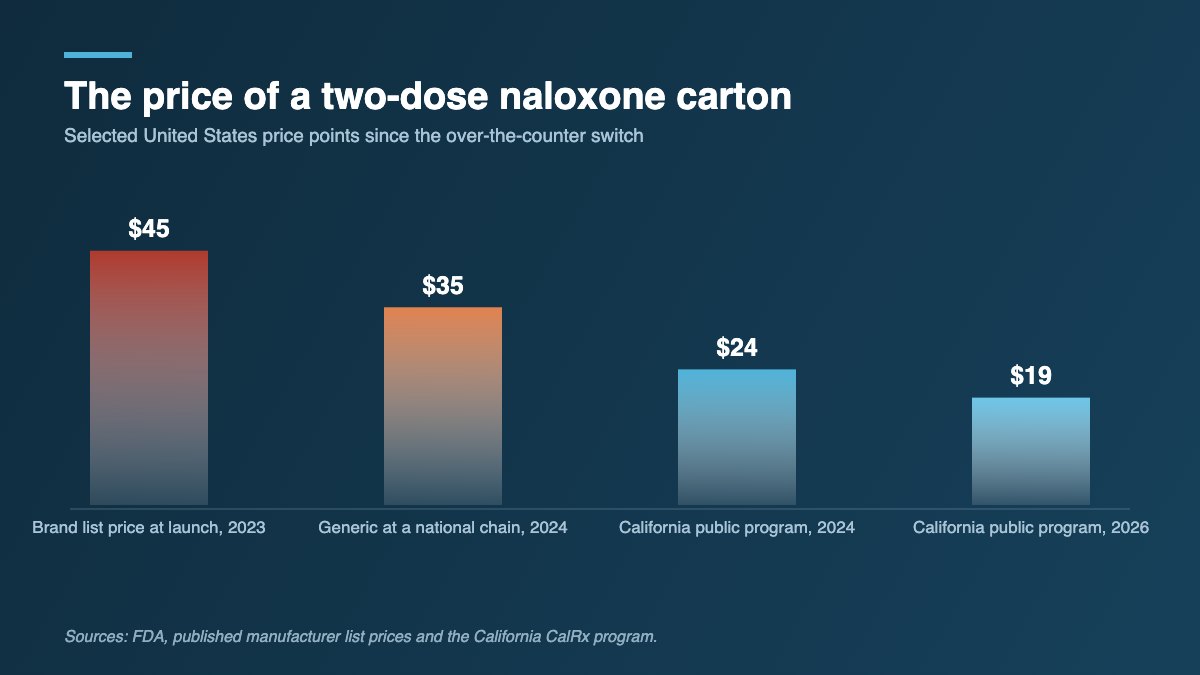
The list price at launch was about 45 dollars for a two-dose carton. Actual shelf prices ran higher in places, up to roughly 65 to 69 dollars at some retailers. For context, the branded two-dose product had sat near 60 dollars from 2015 through 2023, so the over-the-counter switch did coincide with a real price drop.
Where the price actually fell
The larger reductions since then have come from generic competition and public purchasing rather than from the regulatory change itself.
A generic over-the-counter version launched in 2022 at around 40 dollars. By 2024 a national pharmacy chain was selling its generic at 34.99 dollars. California’s state purchasing program contracted with a manufacturer to supply a two-dose carton at 24 dollars beginning in 2024, and cut that to 19 dollars from 1 January 2026.
That is the pattern worth noting. Deregulation made the product buyable without a prescription. Competition and a state acting as a bulk purchaser made it affordable.
The insurance gap nobody planned for
Over-the-counter status created a coverage problem that is close to a drafting accident.
Many insurance mandates and state laws were written around prescription naloxone. When a product moves to over-the-counter, those requirements do not automatically follow it, so a person can find that the version they can buy off the shelf is the version their plan will not reimburse. Only around a dozen states require private insurers to cover naloxone or remove cost barriers, and those requirements do not uniformly extend to over-the-counter purchases.
The practical workaround, which pharmacists will often tell you if asked, is that a prescription can still be written for naloxone specifically so that insurance applies. A person who needs a prescription in order to afford a product sold without one is a reasonable definition of a policy gap.
What the shelf audit found
The most useful evidence on access is not about price at all. Researchers ran a secret shopper study across 600 community pharmacies in North Carolina between November 2023 and January 2024, published in Drug and Alcohol Dependence in 2025.
Of the 500 pharmacies that sold naloxone in any form, only 57.4 percent sold the over-the-counter product. Of those that did, 62.5 percent kept it behind the counter rather than on an open shelf. Independent pharmacies were significantly less likely than chains to place it on an open shelf or to offer same-day pickup.
Placement varied by chain as a matter of corporate policy. One chain put it at the pharmacy counter and in the pain relief aisle; another put it at the front register.
None of this is unlawful, and stores have legitimate reasons for keeping small high-value items secured. But an over-the-counter product kept behind a counter reintroduces the exact interaction the policy change was meant to remove: having to ask a stranger for it.
The baseline this improved on
It is worth being fair about the direction of travel. A 2022 study across 11 states found that roughly 30 percent of pharmacies did not stock prescription naloxone at all. Against that baseline, a majority of pharmacies now selling the over-the-counter product is progress, even if placement remains inconsistent.
The honest reading is that the over-the-counter switch was necessary and insufficient. It removed a legal barrier and left the commercial and behavioral ones in place.
What to take from this
- Over-the-counter naloxone was approved in March 2023 and reached shelves that August.
- Two-dose cartons launched near 45 dollars; generics and state purchasing have since pushed prices as low as 19 dollars in one state program.
- Over-the-counter status does not automatically trigger insurance coverage. Asking for a prescription can still be the cheaper route.
- In a study of 600 North Carolina pharmacies, only 57.4 percent of those selling naloxone sold the over-the-counter version, and most of those kept it behind the counter.
- Independent pharmacies were less likely than chains to stock it on an open shelf.
- If a store does not have it out, ask. It is frequently in stock and simply not visible.
For background on the drugs naloxone reverses, see our drug information library and the pages on fentanyl and heroin.
Sources
This article relies on FDA approval announcements, published manufacturer and retailer pricing, California’s public naloxone purchasing program, a secret shopper study of North Carolina pharmacies published in Drug and Alcohol Dependence in 2025, and analysis from KFF on naloxone access and coverage.
Need help now? In an emergency call 911. If you are in crisis or thinking about suicide, call or text 988 (Suicide and Crisis Lifeline; veterans press 1). For free, confidential treatment referrals 24 hours a day, call the SAMHSA National Helpline at 1-800-662-4357. You can also search licensed programs at FindTreatment.gov, or use our rehab directory and state listings.
Addiction Now publishes health journalism and reference material. This page is not medical advice, a diagnosis, or a treatment plan. Do not stop a prescribed medication without talking to a clinician. Withdrawal from alcohol, benzodiazepines and barbiturates can cause seizures and can be fatal without medical supervision.