


A blackout is not forgetting. It is a failure to record. Alcohol temporarily blocks the transfer of memories from short term to long term storage in the hippocampus, which means the memory was never laid down in the first place. That distinction explains why trying hard to remember never works, and why blackouts are a marker worth taking seriously.
What alcohol does immediately
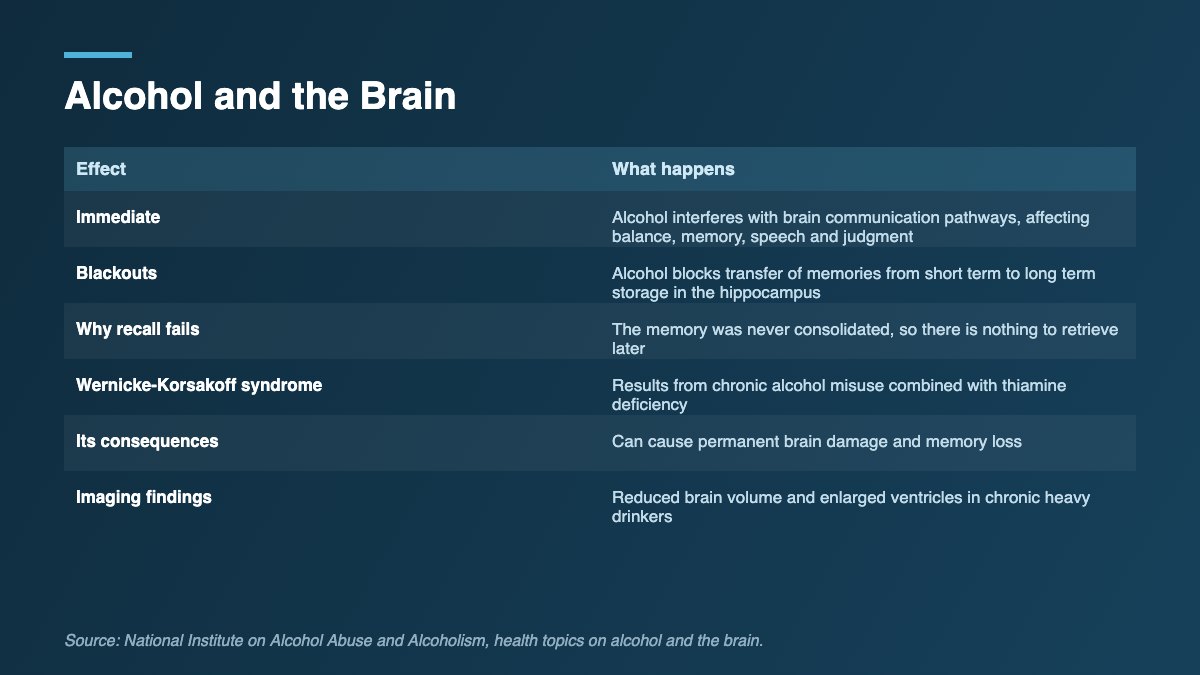
The National Institute on Alcohol Abuse and Alcoholism describes alcohol interfering with brain communication pathways, affecting balance, memory, speech and judgment. Those four are the visible signs of impairment and they appear in roughly that order as blood alcohol rises.
The judgment effect is the one that compounds everything else, because impaired judgment includes impaired judgment about how impaired you are. People do not feel their own decision making degrade.
How blackouts actually work
Memory formation requires consolidation, the process of moving an experience from short term into long term storage, which happens largely in the hippocampus. Alcohol at sufficient concentration blocks that transfer.

The consequence is specific. During a blackout a person can be walking, talking, driving and holding conversations, because those functions do not require new memory formation. What they cannot do is create a record of it. When they wake up there is no memory to find, and no amount of prompting, photographs or accounts from others will recover it. Prompts may allow someone to reconstruct what probably happened, which is a different mental operation from remembering.
This is why the common reassurance that it will come back to you is wrong as a matter of neuroscience. There is nothing to come back.
It is also why blackouts are a meaningful clinical signal rather than an embarrassing anecdote. A blackout indicates a blood alcohol concentration high enough to shut down hippocampal encoding, which is a substantial level of intoxication and a level associated with other risks including alcohol poisoning, injury and aspiration.
Wernicke-Korsakoff syndrome
At the severe end of chronic heavy drinking sits Wernicke-Korsakoff syndrome, which the NIAAA describes as resulting from chronic alcohol misuse combined with thiamine deficiency, and which can cause permanent brain damage and memory loss.
The mechanism matters because it is partly nutritional rather than purely toxic. Heavy drinking interferes with thiamine absorption and storage while often displacing food intake, and thiamine is essential to brain energy metabolism. That means part of the damage pathway is a vitamin deficiency running alongside the alcohol itself.
It also means thiamine replacement is a standard part of managing alcohol withdrawal in a clinical setting, and it is one reason unsupervised withdrawal is a worse option than supervised.
Imaging in chronic heavy drinkers shows reduced brain volume and enlarged ventricles, which is structural change visible on a scan rather than an inference from behavior.
What recovers
Some of this improves with sustained abstinence and adequate nutrition, and some does not. Brain volume loss shows partial recovery in the literature on abstinent drinkers. The memory deficits of established Korsakoff syndrome are generally persistent.
We should be careful not to overpromise here. There is no reliable way to tell an individual in advance which category they are in, and the honest framing is that stopping improves the odds without guaranteeing a particular outcome.
How common heavy drinking is
Federal survey data for 2024 found 134.3 million people aged 12 and over, 46.6 percent of the population, drank in the past month. Some 57.9 million, 20.1 percent, binge drank in the past month, and 14.5 million, 5.0 percent, reported heavy use.
Binge drinking is the pattern most associated with blackouts, because blackouts depend on how fast blood alcohol rises rather than on total weekly consumption. Four drinks in an hour and four drinks across an evening are very different events for the hippocampus.
See our alcohol reference page and drug information library.
Takeaways
- A blackout is a failure to encode memory in the hippocampus, not a failure to recall it.
- People can walk, talk and drive during a blackout because those do not require new memory formation.
- The memory will not come back, because it was never recorded. Reconstruction is not recall.
- Blackouts indicate a level of intoxication carrying other serious risks, and are worth treating as a warning sign.
- Wernicke-Korsakoff syndrome results from chronic drinking plus thiamine deficiency and can cause permanent damage.
- Blackout risk tracks how fast blood alcohol rises, which is why binge patterns matter more than weekly totals.
Sources
National Institute on Alcohol Abuse and Alcoholism, health topics on alcohol and the brain, and alcohol use in the United States, updated 2025. National Institute on Alcohol Abuse and Alcoholism alcohol facts and statistics.
Need help now? In an emergency call 911. If you are in crisis or thinking about suicide, call or text 988 (Suicide and Crisis Lifeline; veterans press 1). For free, confidential treatment referrals 24 hours a day, call the SAMHSA National Helpline at 1-800-662-4357. You can also search licensed programs at FindTreatment.gov, or use our rehab directory and state listings.
Addiction Now publishes health journalism and reference material. This page is not medical advice, a diagnosis, or a treatment plan. Do not stop a prescribed medication without talking to a clinician. Withdrawal from alcohol, benzodiazepines and barbiturates can cause seizures and can be fatal without medical supervision.