

Stimulant withdrawal does not look like opioid or alcohol withdrawal. There is no tremor, no seizure risk, no autonomic storm. What there is instead is exhaustion, flatness and craving, moving through phases clinicians actually name: the crash, the wall, and a protracted period in which anhedonia can last for months.
The crash
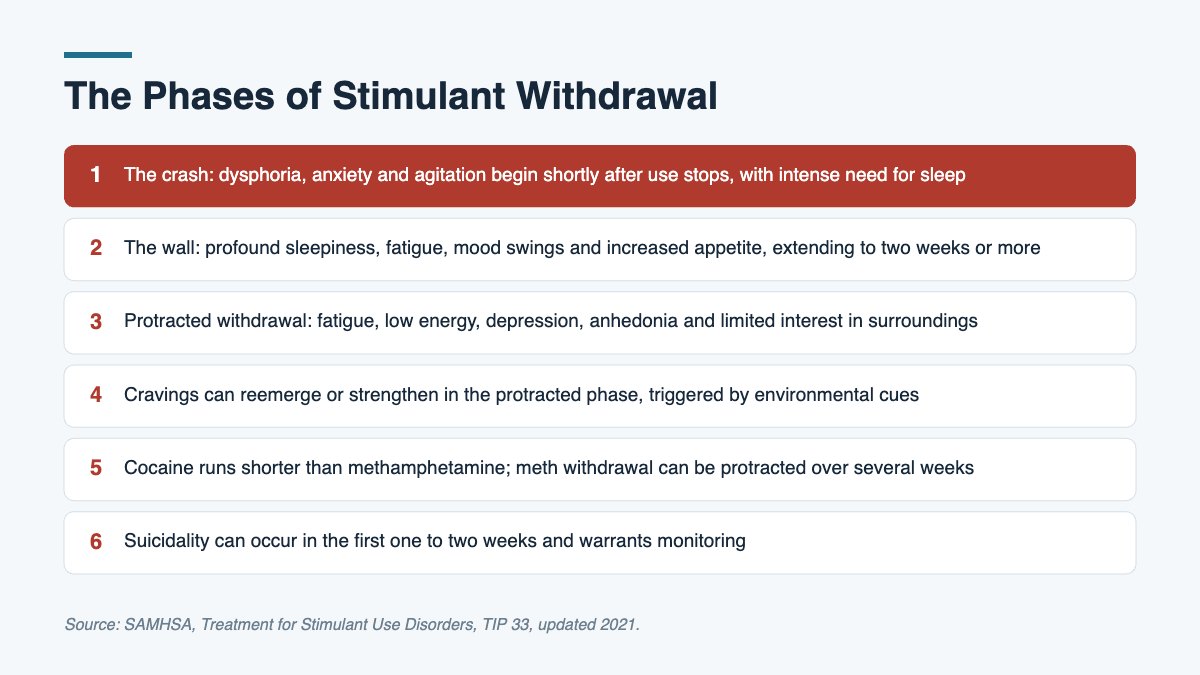
Federal treatment guidance describes a binge terminating in acute withdrawal, commonly called a crash, which can begin a short time after use stops. It is characterized by dysphoria, anxiety and agitation, alongside fatigue, deepening depression and falling mental and physical energy.
One detail is counterintuitive. An intense desire for sleep, often accompanied by insomnia, usually replaces drug craving during this phase. People do not primarily want more of the drug at this point; they want unconsciousness. That is also why some use what is described in the guidance as landing gear, meaning alcohol, benzodiazepines, cannabis or opioids taken to force sleep, which introduces its own risks.
Guidance notes that intense cravings during acute withdrawal frequently lead to recurrent use. It also flags something families should know: in the first one to two weeks of stimulant withdrawal some patients may experience suicidality and should be monitored appropriately. This is a sensitive point and it is in the clinical guidance for a reason.

The wall
The second phase, postacute withdrawal, is described as profound hypersomnolence, fatigue, mood lability and increased appetite. It may extend to two weeks or more after last use.
This is the phase that gets mistaken for laziness or lack of motivation by everyone around the person, including sometimes the person themselves. Sleeping fourteen hours and waking exhausted is a documented feature of the syndrome rather than a character problem.
Protracted withdrawal and anhedonia
The third phase brings fatigue, loss of physical and mental energy, depression, anhedonia and limited interest in one’s surroundings. Guidance notes that severity and duration correlate with how long and how heavily stimulants were used.
The most important single fact here: anhedonia and dysphoria can last for months in people who have used methamphetamine. Anhedonia means the inability to feel pleasure, and it is the reason early recovery from stimulants so often feels colorless rather than triumphant.
Cravings behave differently in this phase too. Guidance states that periods of drug craving may reemerge or become stronger, often triggered by conditioned environmental cues, and can only be extinguished by sustained abstinence. A craving arriving at week six is not a sign of failure; it is the described course.
Guidance also describes a post-crash euphoric phase, sometimes called the pink cloud, which often occurs around the one month mark. It is worth naming because the drop after it can be discouraging if nobody warned it was coming.
Cocaine versus methamphetamine
The two run on different clocks. For cocaine, some people report withdrawal beginning 1 to 2 days after the last dose, with the crash lasting several days and withdrawal persisting 1 to 2 weeks, cravings waxing and waning, and mood returning to normal after several days to a month. Protracted withdrawal may last longer.
For methamphetamine, symptoms begin 2 to 4 days after stopping and may persist 2 to 4 weeks. Physical features can include headache, pounding heartbeat, sweating and muscle or joint aches. The typical sequence is depression and anxiety with intense craving, then fatigue and sleepiness possibly mixed with insomnia, then intense hunger on waking, often with persistent anhedonia and dysphoria, and sometimes paranoia and agitation.
Guidance is explicit that cocaine withdrawal is shorter in duration than methamphetamine withdrawal, and that methamphetamine withdrawal can be protracted over several weeks.
After chronic regular use of either, severe symptoms last several days, with less severe symptoms such as fatigue, depressed mood, anxiety, craving and concentration difficulties lasting 1 to 3 weeks.
Psychosis and what resolves when
Heavy stimulant use, especially methamphetamine, can produce psychotic symptoms. International guidance reports these will usually resolve within a week of ceasing use. But federal guidance adds that patients may also experience breakthrough psychotic episodes during the protracted withdrawal phase.
One diagnostic complication is worth flagging. Methamphetamine withdrawal can mimic the symptoms of depression, which makes distinguishing withdrawal from an independent depressive disorder genuinely difficult in the early weeks. That is a reason for clinical follow up rather than a reason to wait it out alone.
There is no approved medication for stimulant use disorder, which makes the behavioral and supportive side of this period the whole of the treatment. See our methamphetamine page, cocaine page and drug information library.
Takeaways
- Stimulant withdrawal is characterized by exhaustion, flat mood and craving rather than the physical danger of alcohol or benzodiazepine withdrawal.
- Cocaine withdrawal starts 1 to 2 days after the last dose and generally persists 1 to 2 weeks.
- Methamphetamine withdrawal starts 2 to 4 days after stopping and may persist 2 to 4 weeks.
- Anhedonia and dysphoria can last for months after methamphetamine use.
- Cravings may strengthen weeks in, triggered by environmental cues, and that is the documented course rather than relapse.
- Suicidality can occur in the first one to two weeks. Clinical guidance calls for monitoring during that window.
Sources
Substance Abuse and Mental Health Services Administration, Treatment for Stimulant Use Disorders, TIP 33, updated 2021, publication PEP21-02-01-004. World Health Organization, Clinical Guidelines for Withdrawal Management and Treatment of Drug Dependence in Closed Settings, 2009. United Nations Office on Drugs and Crime, 2019, as cited in TIP 33. Rawson RA, 2013, and Hunt D and colleagues, 2006, as cited in TIP 33 on anhedonia duration.
Need help now? In an emergency call 911. If you are in crisis or thinking about suicide, call or text 988 (Suicide and Crisis Lifeline; veterans press 1). For free, confidential treatment referrals 24 hours a day, call the SAMHSA National Helpline at 1-800-662-4357. You can also search licensed programs at FindTreatment.gov, or use our rehab directory and state listings.
Addiction Now publishes health journalism and reference material. This page is not medical advice, a diagnosis, or a treatment plan. Do not stop a prescribed medication without talking to a clinician. Withdrawal from alcohol, benzodiazepines and barbiturates can cause seizures and can be fatal without medical supervision.