


In September 2020 the Food and Drug Administration required an updated boxed warning on every benzodiazepine, stating that physical dependence can occur when these drugs are taken steadily for several days to weeks, even as prescribed, and that stopping abruptly or reducing too quickly can produce withdrawal reactions including seizures, which can be life threatening.
What the 2020 warning changed
Benzodiazepines had carried warnings before, but the 2020 action applied to the whole class and addressed four things together: abuse, addiction, physical dependence and withdrawal reactions. The agency also required updates to the warnings and precautions section, the drug abuse and dependence section, patient counseling information and the medication guides.
The severe reactions clinicians were told to be prepared for are worth reading in full, because they go well beyond anxiety: catatonia, seizures, delirium tremens, depression, hallucinations, mania, psychosis, and suicidal ideation and behavior.
The scale behind the decision was substantial. In 2019, 92 million benzodiazepine prescriptions were dispensed in US outpatient pharmacies, with alprazolam accounting for 38 percent, clonazepam 24 percent and lorazepam 20 percent. Roughly half of patients dispensed oral benzodiazepines in 2018 received two months or more of supply.

The withdrawal timeline
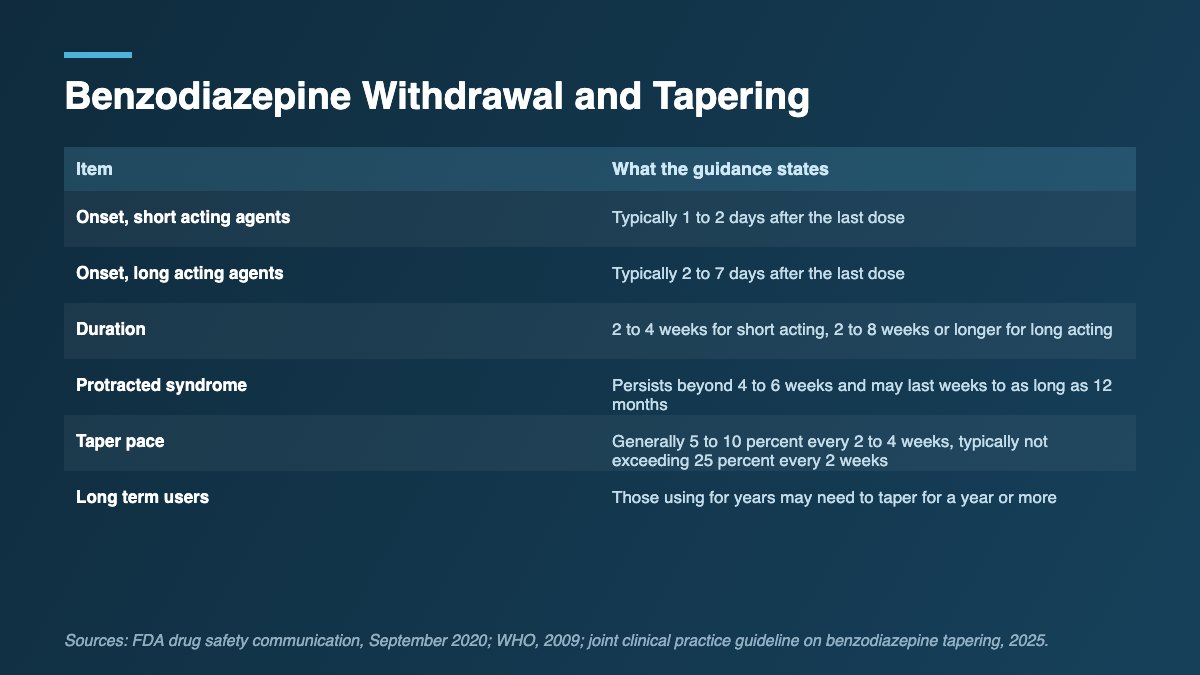
Onset depends on the half-life of the specific drug. International guidance reports that withdrawal from short acting agents such as oxazepam, alprazolam and temazepam typically begins 1 to 2 days after the last dose and continues for 2 to 4 weeks or longer. For long acting agents such as diazepam and nitrazepam it begins 2 to 7 days after the last dose and continues for 2 to 8 weeks or longer.
Another clinical reference gives a somewhat wider onset window of 2 to 10 days after discontinuation, with symptoms lasting weeks, and notes that onset and length depend on the agent’s pharmacokinetics, elimination half-life and duration of use.
One feature distinguishes this syndrome from most others. The intensity of symptoms does not decrease in a steady fashion. Symptoms fluctuate markedly, and for that reason international guidance does not recommend using withdrawal rating scales to monitor benzodiazepine withdrawal. A person feeling better on Tuesday and much worse on Thursday is experiencing something expected.
Protracted withdrawal
The FDA labeling describes a protracted withdrawal syndrome that persists beyond 4 to 6 weeks after initial withdrawal, with symptoms lasting weeks to as long as 12 months. Listed symptoms include anxiety, cognitive impairment, depression, insomnia, formication, motor symptoms such as weakness, tremor and muscle twitches, paresthesia and tinnitus.
The agency’s review of adverse event reports found onset of dependence described as early as days to weeks, and withdrawal duration ranging from weeks to years, with roughly 80 percent of the reviewed cases describing withdrawal.
Twelve months is a long time, and people going through it are frequently told they must be experiencing a return of their original anxiety rather than withdrawal. The labeling itself names this as a documented phenomenon.
What tapering guidance actually says
There is no single correct schedule. The FDA states plainly that there are no standard tapering schedules suitable for all patients and that a patient specific plan should be used to reduce the dose gradually. If withdrawal symptoms emerge, the agency advises that it may be necessary to pause the taper, or return to the previous dose and then proceed more gradually once stable.
A joint clinical practice guideline published in 2025, developed across ten professional societies, offers numbers. The initial pace should generally involve dose reductions of 5 to 10 percent every 2 to 4 weeks, and should typically not exceed 25 percent every 2 weeks. Patients on lower doses for less than three months may taper faster. Those who have used benzodiazepines for years may need to taper slowly for a year or more. Abrupt discontinuation should never happen in a patient likely to be physically dependent.
International guidance adds a rule that runs against instinct: when symptoms worsen during a taper, do not raise the dose. Hold at the current dose, then resume reducing. It also notes that the longer the interval between reductions, the more comfortable and safer the withdrawal.
One warning people miss
The FDA specifically flagged benzodiazepine products labeled for only one or two doses, including diazepam injection, nasal spray and rectal gel, midazolam nasal spray and injection, and lorazepam injection. Even these can cause life threatening acute withdrawal reactions if used long term and stopped abruptly.
And the drug the class is most often combined with is the most dangerous one. Between 2013 and 2017, 55 percent of benzodiazepine involved overdose deaths also documented involvement of prescription opioids. See our benzodiazepines page, sleep medications page and drug information library.
Takeaways
- Physical dependence can develop in several days to weeks of steady use, even exactly as prescribed.
- Withdrawal begins 1 to 2 days after a short acting benzodiazepine and 2 to 7 days after a long acting one.
- Symptoms fluctuate rather than declining steadily, which is why rating scales are not recommended for monitoring.
- Protracted withdrawal can persist for weeks to as long as 12 months according to FDA labeling.
- Guideline pace is 5 to 10 percent every 2 to 4 weeks, and long term users may need a year or more.
- Never stop abruptly. Seizures in benzodiazepine withdrawal can be fatal, and this taper belongs with a prescriber.
Sources
Food and Drug Administration drug safety communication requiring an updated boxed warning for the benzodiazepine drug class, September 2020. World Health Organization, Clinical Guidelines for Withdrawal Management and Treatment of Drug Dependence in Closed Settings, 2009. Brunner E, Chen C-YA and colleagues, joint clinical practice guideline on benzodiazepine tapering, Journal of General Internal Medicine, 2025. StatPearls, Withdrawal Syndromes, 2024.
Need help now? In an emergency call 911. If you are in crisis or thinking about suicide, call or text 988 (Suicide and Crisis Lifeline; veterans press 1). For free, confidential treatment referrals 24 hours a day, call the SAMHSA National Helpline at 1-800-662-4357. You can also search licensed programs at FindTreatment.gov, or use our rehab directory and state listings.
Addiction Now publishes health journalism and reference material. This page is not medical advice, a diagnosis, or a treatment plan. Do not stop a prescribed medication without talking to a clinician. Withdrawal from alcohol, benzodiazepines and barbiturates can cause seizures and can be fatal without medical supervision.