
Roughly half of people who suddenly stop or sharply reduce heavy drinking will experience withdrawal. Most of those cases are unpleasant rather than dangerous. But 3 to 5 percent progress to alcohol withdrawal delirium, and that condition can be fatal. Seizures can arrive as early as 8 hours after the last drink, before the syndrome has even peaked.
Why alcohol withdrawal is physically dangerous
The mechanism explains the danger. Chronic heavy drinking upregulates glutamate, the brain’s main excitatory signal, and downregulates the body’s own production of GABA, the main inhibitory signal. Alcohol has been supplying the inhibition. Remove it suddenly and the brain is left with a relative deficit of GABA and a simultaneous excess of glutamate.
What follows is autonomic hyperactivity: tremor, sweating, racing heart, rising blood pressure, agitation, nausea, insomnia. In its severe form that same excitatory imbalance produces seizures and delirium.
This is the crucial distinction between substances. Opioid withdrawal is agonizing and rarely kills on its own. Alcohol and benzodiazepine withdrawal can kill directly, through seizures and delirium. Anyone drinking heavily every day should not stop abruptly without medical supervision.

The timeline
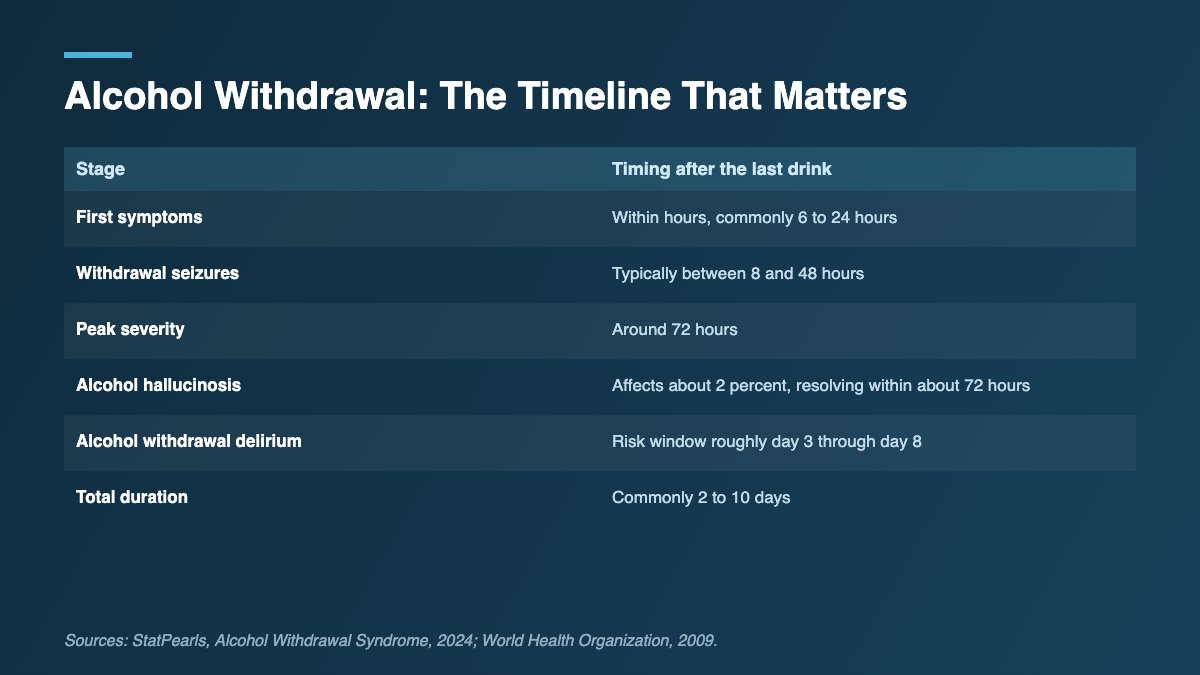
Symptoms can appear within hours of the last drink, and one widely used clinical reference gives 6 to 24 hours as the usual onset window. Severity peaks around 72 hours, and the whole course commonly runs 2 to 10 days.
Withdrawal seizures typically occur between 8 and 48 hours after cessation. That window opens before peak severity, which is why someone who looks manageable at hour 10 is not out of danger.
Alcohol hallucinosis affects roughly 2 percent of patients, producing auditory hallucinations and paranoia that generally resolve within about 72 hours. It is distinct from delirium and, importantly, occurs with a clear sensorium.
Alcohol withdrawal delirium, still widely called delirium tremens, arrives later. Clinical references place the risk window at roughly day 3 through day 8 after cessation, though the same reference elsewhere describes it as occurring up to 3 to 5 days out. We give the range rather than a single figure because the published sources are not internally consistent, and a family watching a clock deserves the wider window rather than the narrower one.
How often it turns serious
About half of people who stop or cut down abruptly experience withdrawal, with severity varying widely. Approximately 3 to 5 percent progress to alcohol withdrawal delirium.
On mortality, the figures have moved. Historically the death rate from alcohol withdrawal delirium ran as high as 20 percent. With modern critical care, prompt diagnosis and treatment, one clinical reference puts it at around 1 percent, while another gives a range of 1 to 5 percent. Either way the direction is clear: treated, this is usually survivable; untreated, it is not reliably so.
Scale is easy to underestimate. In a 2013 sample of more than 450,000 admissions to Veterans Affairs hospitals, 1 in 17 were treated for alcohol withdrawal syndrome.
Kindling: why each episode can be worse
This is the finding most people have never heard and it changes how repeated attempts should be understood. Successive withdrawal episodes tend to increase in severity, specifically regarding seizure risk. Repeated episodes lower the seizure threshold.
The clinical consequence is direct: someone who has previously had a withdrawal seizure has a high likelihood of having another. Clinical guidance holds that patients with prior complicated withdrawal, meaning seizures or delirium, should be treated in a monitored setting.
So the fifth attempt to stop drinking alone is more dangerous than the first, not less. That is the opposite of the intuition most people bring to it.
What treatment does
Benzodiazepines are the mainstay, because they act on the same GABA receptors alcohol was acting on and can substitute for the missing inhibition while being tapered in a controlled way. Clinical guidance notes that treatment with benzodiazepines reduces the risk of progression after a seizure has occurred.
Severe complications listed in international guidance include seizures, hallucinations, delirium, extreme fluctuations in body temperature and blood pressure, extreme agitation and extreme dehydration, and it states plainly that these can be life threatening.
One diagnostic caution worth knowing: clinicians are advised to consider an alternative explanation if a seizure occurs with no history of alcohol use, if there is evidence of trauma or fever, if the seizure is focal, or if the last drink was more than 48 hours earlier. Not every seizure in a person who drinks is a withdrawal seizure.
For related background see our alcohol reference page, benzodiazepines page and the wider drug information library.
Takeaways
- About half of people who abruptly stop heavy drinking experience withdrawal; 3 to 5 percent progress to delirium.
- Seizures typically occur 8 to 48 hours after the last drink, before peak severity at around 72 hours.
- Alcohol withdrawal delirium arrives later, with a risk window running roughly day 3 to day 8.
- Delirium mortality is now put at roughly 1 percent with treatment, against as high as 20 percent historically.
- Kindling means each successive withdrawal episode carries greater seizure risk than the last.
- Anyone drinking heavily daily, and especially anyone with a prior withdrawal seizure, should withdraw under medical supervision rather than alone.
Sources
StatPearls, Alcohol Withdrawal Syndrome, 2024, and Withdrawal Syndromes, 2024, National Center for Biotechnology Information Bookshelf. World Health Organization, Clinical Guidelines for Withdrawal Management and Treatment of Drug Dependence in Closed Settings, 2009. Wright T and colleagues, American Journal on Addictions, 2006, on delirium mortality. Steel TL and colleagues, Journal of Addiction Medicine, 2020, on hospital admissions treated for alcohol withdrawal.
Need help now? In an emergency call 911. If you are in crisis or thinking about suicide, call or text 988 (Suicide and Crisis Lifeline; veterans press 1). For free, confidential treatment referrals 24 hours a day, call the SAMHSA National Helpline at 1-800-662-4357. You can also search licensed programs at FindTreatment.gov, or use our rehab directory and state listings.
Addiction Now publishes health journalism and reference material. This page is not medical advice, a diagnosis, or a treatment plan. Do not stop a prescribed medication without talking to a clinician. Withdrawal from alcohol, benzodiazepines and barbiturates can cause seizures and can be fatal without medical supervision.